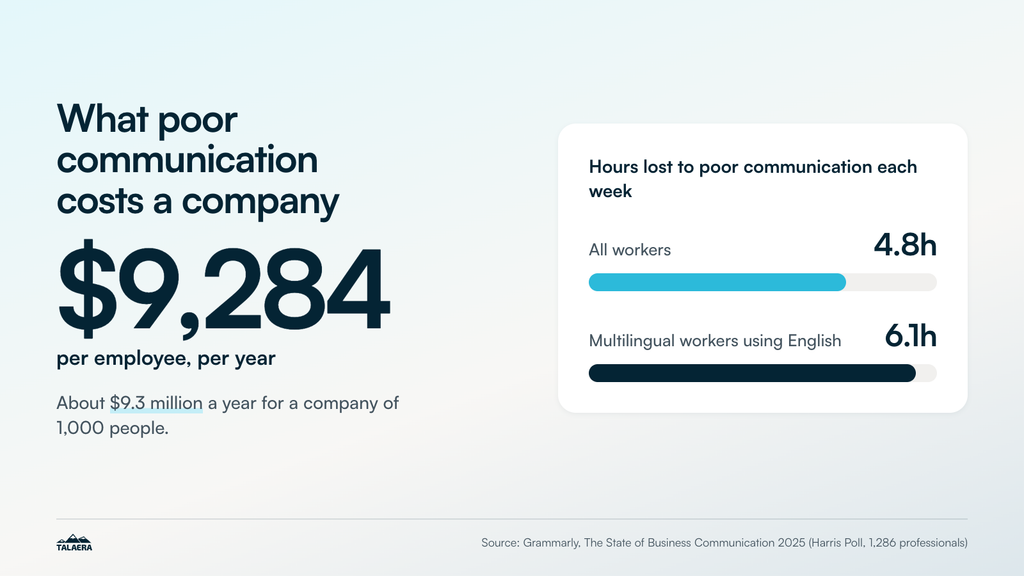
The cost of miscommunication in the workplace is about $9,284 per employee a year, according to Grammarly’s 2025 report, or roughly $9.3 million for a company of 1,000 people. Most of that money is lost time, since the average worker loses 4.8 hours a week to poor communication. For multilingual professionals who use English at work, the loss rises to 6.1 hours a week.
4 findings on the costs of miscommunication and what reduces it
Recent surveys agree on the size of the problem and on what reduces it:
- Cost per employee: Poor communication costs businesses about $9,284 per employee a year, based on a 2024 Harris Poll survey for Grammarly.
- Time lost: Workers lose 4.8 hours a week to poor communication, and multilingual workers lose 6.1 hours.
- Rework: In a December 2025 survey of 7,000 workers in seven countries, 80% had redone or wasted work in the past month after misunderstanding a written message.
- What works: Shared team norms and practice in real work situations cut the cost faster than one-off workshops or grammar tools.
The cost of miscommunication in the workplace, per employee and per company
Current research puts the cost at about $9,284 per employee per year, based on a Harris Poll survey of 1,286 professionals that Grammarly published in 2025. A December 2025 survey of 7,000 workers by Loom and Wakefield Research points the same way, with most workers reporting rework after unclear messages.
| Statistic | Figure | Source | Survey date and sample |
|---|---|---|---|
| Cost per employee, per year | About $9,284 | Grammarly 2025 report | Sep to Oct 2024, 1,286 professionals |
| Cost for a company of 1,000 employees, per year | About $9.3 million | Grammarly 2025 report | Same survey |
| Hours lost per worker, per week | 4.8 hours | Grammarly 2025 report | Same survey |
| Hours lost per multilingual worker, per week | 6.1 hours | Grammarly 2025 report | Same survey |
| Workers who missed a deadline because of poor communication | 69% | Grammarly 2025 report | Same survey |
| Workers who redid or wasted work after misunderstanding a written message (past month) | 80% | Loom and Wakefield Research | Dec 2025, 7,000 knowledge workers in seven countries |
| Workers who spend time each week interpreting unclear messages | Nearly 9 in 10 | Loom and Wakefield Research | Same survey |
| Workers who have seen a misunderstanding lead to real consequences | 82% | Loom and Wakefield Research | Same survey |
| Annual loss for U.S. businesses (older estimate) | Up to $1.2 trillion, about $12,506 per employee | Grammarly 2022 report | Oct 2021, 1,001 U.S. knowledge workers and 251 business leaders |
How to estimate the cost of miscommunication for your own team
Your own team’s number is more persuasive in a budget conversation than any survey average, and it takes four inputs to estimate.
To estimate the cost of miscommunication for a team, multiply the hours lost per person each week by the loaded hourly cost, the headcount and 48 working weeks.
For a 200-person team with a loaded cost of $40 an hour, Grammarly’s average of 4.8 hours a week works out to about $1.84 million a year, or roughly $9,200 per person. If most of that team works in English as a second language and loses closer to 6.1 hours a week, the estimate rises to about $2.34 million.
| Scenario (200 people, $40 an hour, 48 weeks) | Hours lost per person, per week | Estimated annual cost |
|---|---|---|
| Average worker | 4.8 | About $1.84 million |
| Multilingual worker | 6.1 | About $2.34 million |
To weigh that cost against a training budget, Talaera’s language training ROI calculator estimates the hours and salary value a program could recover. It includes an option to apply the 17% time saving from the WOW24-7 case study.
How poor communication shows up at work: 3 real-life examples
Most miscommunication starts as a small gap that someone fills with the wrong assumption. Its cost shows up later as rework or a frustrated customer. These examples come from situations Talaera clients and learners have described to us.
A polite yes turns into a missed deadline
One client described a team that “commits to deadlines even though they know they can’t deliver,” while their manager wanted them to feel comfortable saying what they could or couldn’t do. Saying no to a senior colleague felt riskier than missing the date, so the problem stayed hidden until the work arrived late. Managers who ask “What would make this timeline hard to hit?” tend to hear about risks earlier.
A company value of “be direct” stops working as the team grows
A fintech with 4,500 people in 27 countries made “be direct” its first company value. It worked at 2,000 employees and caused friction after headcount doubled, because what counts as direct changes from office to office. As its L&D lead put it, “in the context of the US, New York is direct, but they’re not in the context of the world.” Knowing how direct vs. indirect communication works helps teams talk about the clash instead of taking a short message personally.
A smart team member stays quiet in an important meeting
An HR director at a software consultancy described a team member who was clearly smart but hesitant to speak up in meetings. When a valuable coworker doesn’t flag a risk, the team finds out about it later in the project or from the client.
5 ways miscommunication costs companies money
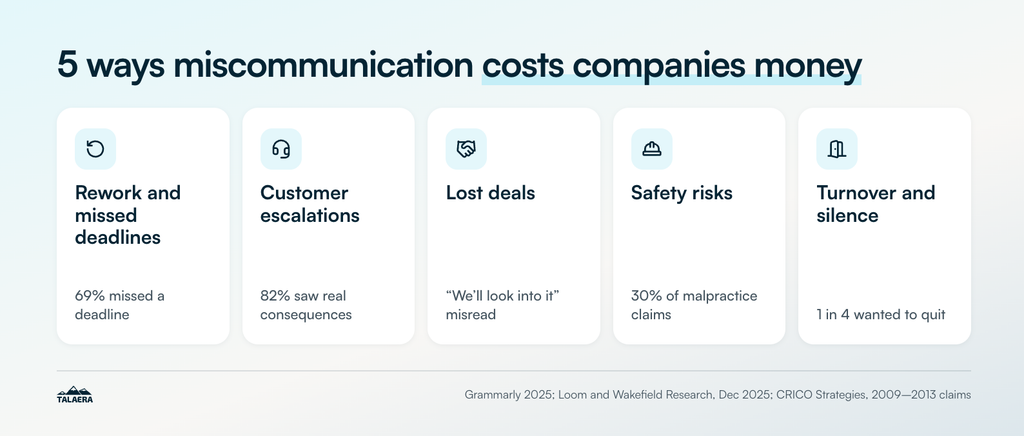
Companies pay for miscommunication in a few predictable places. Let’s break them down.
Rework and missed deadlines are the highest hidden cost
Grammarly’s report lists redoing misunderstood work as one source of those 4.8 lost hours. Two teams interpret a requirement differently, or an owner assumes someone else is handling the follow-up. In the same survey, 69% of workers said they’d missed a deadline because of poor communication, and each miss pushes cost onto the next team in line.
Customer escalations and churn often start with wording
Unclear updates and slow answers cost customer trust. In the Loom and Wakefield Research survey, 82% of workers had seen a misunderstanding lead to real consequences, including escalations and lost clients. Support teams that use clear de-escalation phrases give customers fewer reasons to switch providers.
Lost deals trace back to mismatched expectations across cultures
Sales conversations carry high cultural risk, because buyers and sellers can interpret the same words differently. A seller used to a high-context culture may say “we’ll look into it” as a polite no, while the buyer hears a promise and waits for a follow-up. When nobody checks, deals stall in a silence each side takes as the other’s decision.
Safety risks rise in hands-on and high-stakes work
In hands-on work, a misunderstood instruction can hurt someone. A CRICO Strategies study of U.S. malpractice claims from 2009 to 2013 found communication failures in 30% of cases, including 1,744 deaths. The study covers healthcare, and the same kind of risk exists on factory floors and construction sites.
Turnover and silence are the costs that show up last
Repeated misunderstandings wear people down. In the Loom and Wakefield Research survey, more than one in four workers said they’d wanted to quit after a miscommunication. Silence costs money too. Employees who don’t speak up can miss promotions, and their ideas never reach the decision-makers.
Why miscommunication costs more when teams work in English as a second language
Multilingual professionals who use English at work lose 6.1 hours a week to poor communication, compared with 4.8 hours for other workers, according to Grammarly’s 2025 report. Because they’re proficient enough to work in English, the gap is easy to miss. It shows up in moments that need speed, such as a fast meeting or an unexpected question.
Many professionals stay quiet in meetings held in English
Among professionals starting 1:1 coaching with Talaera, 36% say they rarely speak up in meetings in English (a self-rating of 1 or 2 out of 5 in a survey of 297 learners). A data scientist in Brazil said they can “understand most technical meetings, especially with English captions,” and that their main challenge is “speaking spontaneously.” Teams lose that person’s input in the moments where it could change a decision.
Remember that language proficiency and workplace communication are different skills. Someone can pass an English test and still freeze when a senior colleague asks an unexpected question.
Instructions and short messages cause more confusion in a second language
People working in a second language tend to follow instructions as written rather than as meant. Phrases like “ASAP” or “let’s punt on this” mean different things to different readers, and some people won’t ask because asking feels like admitting they didn’t understand. Written messages add tone problems too, since a short request can feel abrupt to someone who expects context first.
A company language policy doesn’t close the gap on its own
A corporate English policy sets the working language, which is a sensible first step. But it doesn’t build the skill to use that language under pressure. Everyday language barriers at work remain until people practice the situations where they come up.
The mistakes companies make when fixing miscommunication
Many companies reach for one of two fixes — grammar checkers and workshops. But both are ineffective at handling communication breakdowns. Grammar checkers polish text, but they won’t notice a missing owner or a deadline two teams understand differently, and most costly misunderstandings aren’t grammar mistakes.
Occasional workshops are the second fix. They often feel generic and happen outside the flow of work, so people go back to their desks with the same habits. Even good corporate language training platforms work only when practice is tied to the meetings and messages people face in day-to-day work.
In Talaera’s coaching work, correctness is something people can study and test, while speaking clearly under pressure is a performance skill that improves through live, repeated practice with feedback.
What managers can do to reduce the cost of miscommunication
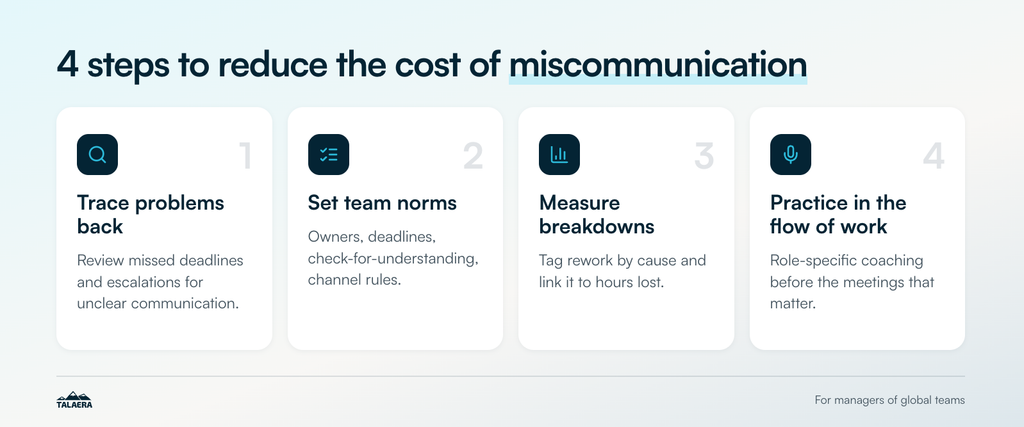
Managers control most of the conditions that make miscommunication cheap or expensive.
Step 1: Trace missed deadlines and escalations back to communication
Companies often misdiagnose communication problems because they treat symptoms like missed deadlines or turnover without asking if unclear communication caused them.
A good place to start is to look at escalations that clearer communication could have prevented and handoffs where ownership was lost. That review gives you a baseline and data you can bring to budget conversations.
Meetings deserve a close look as well. Every Talaera learner starts with a needs assessment and a written coaching plan built around 2 to 4 priority workplace tasks. In our analysis of 2,000 of those plans written between 2019 and 2026, meetings were one of the priority tasks in 68.4% of 2026 plans, up from 36.8% in 2019 (2026 is a partial year).
Step 2: Set “how we communicate” norms
Teams communicate better when the unwritten rules are written down. These four norms are a good place to start:
- Ownership and deadlines: Every request ends with who’s responsible and when it’s due.
- Confirming understanding: Important exchanges close with “What’s your takeaway?” or a short meeting summary.
- Clarifying questions: Managers ask, “Before we proceed, is there anything unclear?”
- Channel rules: Teams agree which decisions need a meeting and which can happen in chat.
These norms make asking for clarity a normal part of the team’s work, and they are most important in global teams where people can’t always clarify in real time. For meetings, teams can add Talaera’s effective-meetings checklist, the 3 Ps (purpose, process and preparation), to every invite.
Step 3: Measure where communication breaks down
Run a short survey or interview employees to find out where communication breaks down most. Then tag rework by cause, review escalation notes each month and link what you find to hours lost. A communication skills assessment shows which communication skills each role needs and where the gaps are.
Talaera measures its own programs in a similar way. Separate pre- and post-training surveys often fail because learners answer only one of them. So Talaera asks learners to rate their skills “before” and “now” side by side in a single end-of-program survey. For operational teams, Talaera adds business metrics such as ticket time and escalations.
Step 4: Put practice and support in the flow of work
Improving communication works best when it’s tailored to each employee’s role. A sales negotiation in Mexico is a different task from a client update in Germany, so practicing effective communication should match each role and region. Talaera pairs 1:1 coaching with Talk to Tally, an AI communication coach people can use for five minutes before a meeting. Our guide to miscommunication in global teams covers the daily habits that help.
Your own messages set the standard for the team
Teams pick up their manager’s habits. If a manager sends vague requests and never asks clarifying questions, the team won’t either. Managers who summarize decisions in writing and admit when they need something explained make it safe for everyone else to do the same.
Faster tickets and fewer escalations after communication training
Companies that invest in communication training have seen measurable benefits. A global customer support service provider, WOW24-7, reduced median time to close a support ticket from 15m 38s to 13m 02s (17% faster) after a five-session Talaera group course for agents.
Another example is Dialpad, which had 149 support agents in the Philippines, India and Argentina take part in scenario-based training with Talaera. Their confidence in handling frustrated customers rose 19.5%, and Dialpad recorded a 1.2% drop in manager escalations.
And at one global tech distributor, 44% of participants in Talaera workshops said they now avoid misunderstandings.
Clear communication is a cost you can measure and reduce
Miscommunication rarely appears as its own line in a budget, yet it costs thousands of dollars per employee every year. Estimating the cost for your own team makes it visible, and shared norms plus practice in real situations bring it down.
The right starting point depends on what your own rework and escalation data show. If you’d like to see how Talaera helps global teams cut rework and speak up with confidence, you can book a demo.
Frequently asked questions
What is the average cost of poor communication per company?
Grammarly’s 2025 report puts it at about $9.3 million a year for a company of 1,000 employees. Your own rework and escalation logs will give you a more precise number than a survey average.
How much does miscommunication cost per employee?
Poor communication costs businesses about $9,284 per employee a year, according to Grammarly’s 2025 report. That estimate is based on a Harris Poll survey of 1,286 professionals and the 4.8 hours a week each worker loses.
Where do miscommunication costs actually come from?
Most of the cost comes from rework and handoffs where nobody clearly owns the next step. Tone or cultural misunderstandings with customers and slow decisions add more, because each delay holds up the next stage of a project. Together they show up as lost hours and lower productivity.
What are some real-life examples of poor communication at work?
Common examples include a team agreeing to a deadline it knows it can’t meet and a short message that comes across as rude in another culture. Another is a capable employee who stays quiet in a meeting where a risk should be raised. Each looks small on its own and becomes expensive when it repeats.
How do language barriers add to the cost of miscommunication?
Multilingual professionals who use English at work lose 6.1 hours a week to poor communication, compared with 4.8 hours for other workers, according to Grammarly’s 2025 report. In our experience, much of that extra time goes into clarifying messages and fixing work that matched the words but missed the intent. Practice built around the meetings and messages people face each week helps reduce it.
How can I show ROI for communication training?
A baseline comes first, covering hours spent on rework, the number of escalations, cycle time between key stages and CSAT. After training, you track the change in each of those numbers. Time saved converts to money through fully loaded employee costs, and revenue effects show up in win rates or time to close.
What interventions work best for effective communication?
Team norms with simple check-for-understanding prompts are the cheapest place to start. In-the-moment coaching tailored to each role and region builds the skill, and regular measurement of rework and escalations shows whether it’s working. Approaches that change behavior in actual work tend to last longer than knowledge taught in a training room.
About the author

Paola Pascual is Marketing Director at Talaera, where she leads the company’s content and hosts the Talaera Talks podcast. She is also Content Director at LAIRE, a digital marketing agency. She holds a master’s degree in organizational psychology, has a background in translation and linguistics, and has lived and worked in six countries. Her writing on communication in global teams has also appeared in Training Industry.