The main alternatives to corporate English coaching are small-group courses and live speaking practice for teams, plus AI conversation practice and self-paced microlearning for individual practice. Most companies get better results by narrowing 1:1 coaching to the roles where communication carries the highest stakes and moving everyone else to formats built for frequent practice.
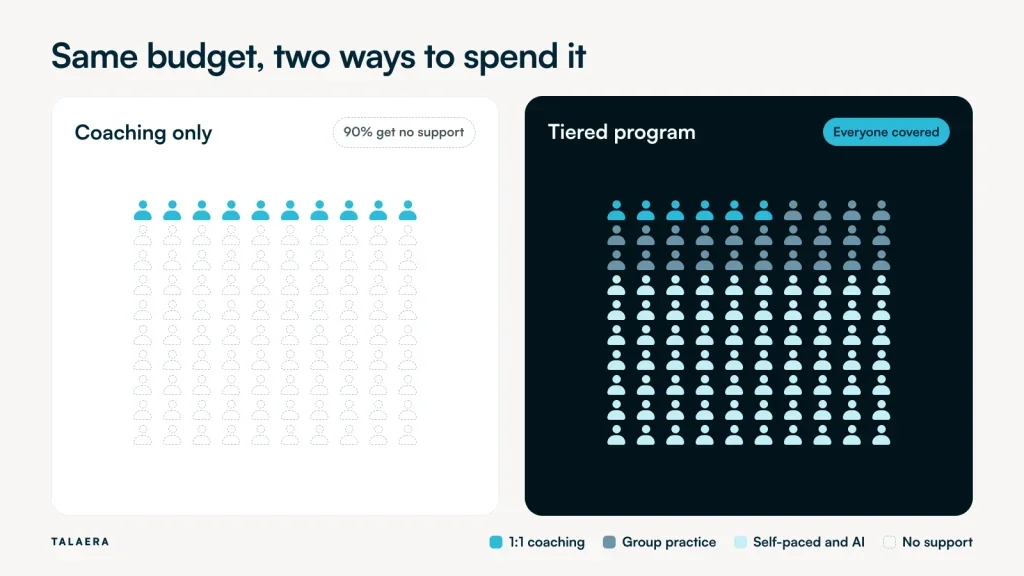
A coaching-only program asks one format to serve a whole workforce. Companies that keep 1:1 coaching for high-stakes roles and give everyone else regular practice reach far more people with the same budget.
Why companies look for alternatives to English coaching
Coaching programs usually work well for the people inside them and leave most of the workforce outside. A budget might fund coaching for 30 people while 300 run client calls and join global meetings in English. When L&D teams start asking for alternatives, these four signals tend to show up together:
- Usage is uneven: A few motivated learners book every session, and others never schedule their first one while their seats still cost money.
- Time zones break the schedule: A weekly slot that suits Berlin rarely suits Manila. Sessions slip, and momentum drops.
- Practice stops between sessions: A learner rehearses a client call with a coach on Tuesday and then has nothing until the following week.
- Reports stop at attendance: Finance and business leaders want to know whether meetings and customer calls actually got better.
Uneven usage is rarely a sign that coaching itself failed. Across 13,590 booked 1:1 sessions in Talaera’s 2024 data, 90% were completed, so the bigger gap is the employees who never book. An HR director at a software consultancy told us that with a previous provider, “People enjoyed their time on the platform,” yet the company wasn’t necessarily getting results.
Alternatives to corporate English coaching at a glance
Each format below can take over part of what a coaching program does today. The useful question is which part.
| Alternative | What it can take over from 1:1 coaching | What it can’t take over | Best for |
|---|---|---|---|
| Small-group courses | Training on a gap a whole team shares | Individual diagnosis and private rehearsal | Support or sales teams with one shared challenge |
| Live speaking practice | Regular speaking time and confidence | Work on one person’s specific goals | Learners who understand English well but freeze when speaking |
| AI conversation practice | Rehearsal and repetition between sessions | Expert judgment on influence and culture | Practicing specific moments in any time zone |
| Self-paced microlearning | Phrases and frameworks for specific tasks | Speaking practice and feedback | Reaching the whole workforce at low cost |
| Peer programs and webinars | Awareness and informal practice | Structured feedback | Supporting a structured program |
| Tiered program | Reach, by matching formats to the stakes of each role | Nothing, as long as 1:1 coaching stays in the top tier | Companies with 50+ learners across roles |
For a detailed comparison of coaching and apps by learner type, see our coaching vs. apps guide.
When each alternative works best
Every alternative fits a specific kind of learner and a specific kind of gap. These sections cover when each one earns its place in a program and where it falls short.
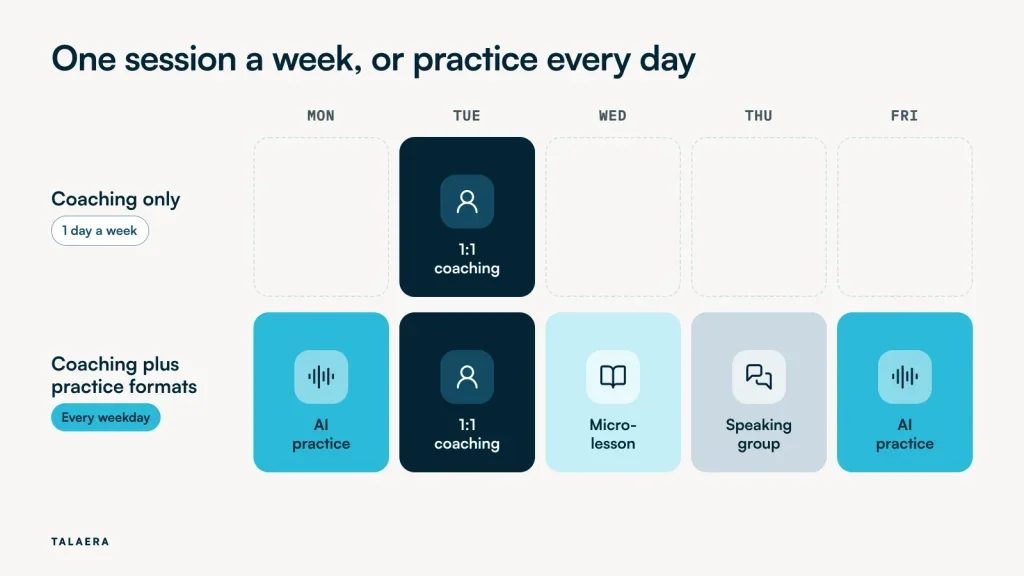
Two weekly calendars compared: with coaching only, the learner practices once a week on Tuesday, while with coaching plus practice formats, they practice every weekday through AI practice, a micro-lesson and a speaking group around the same coaching session.
Small-group courses for teams with a shared gap
A small-group course brings together up to ten people who face the same communication challenge, such as support agents handling escalations or engineers presenting to non-technical stakeholders. It works well as a replacement for 1:1 coaching among mid-level employees whose needs are similar, because the coach builds every session around situations the team actually faces.
Each learner speaks far less than in a 1:1 session, so group courses work best alongside independent practice. Talaera’s group courses run as live, coach-led programs built around each team’s real scenarios.
Speaking Club for confident listeners who freeze when they speak
Live speaking practice gives learners regular, low-pressure speaking time with a coach and a small group of peers. It suits employees who understand English well but go quiet in fast-moving meetings, because more lessons won’t fix a reflex that only practice builds.
That gap is growing. Talaera’s analysis of 2,000 coaching plans written between 2019 and 2026 shows hesitation in 55.2% of 2026 coaching plans so far, up from 28% in 2019, while grammar fell from 62% to 39.6% over the same period. At Talaera, the Speaking Club (Talaera Connect) runs weekly coach-led sessions built on role-plays and discussions, with selective feedback so people can speak freely.
AI conversation practice for volume and time zones
AI speaking coaches let employees rehearse a real conversation on demand, such as a tough client call or a project update, and get instant feedback. A 2026 study in Frontiers in Psychology found that students felt less anxious with an AI examiner than with human examiners and scored about the same under both. Most still preferred a human for evaluation, and almost all were open to using AI for practice, although the study was small and limited to one university.
Uptake can be fast where live scheduling is hardest. At a US field-technician team, 56% of learners used Talaera’s AI coach within three weeks of launch. One beginner using the AI coach described it as “similar to talking with a teacher, but without the embarrassment of being a beginner.” AI feedback is still narrower than an expert’s judgment on influence and culture. Talk to Tally is designed for short sessions of about five minutes, a few times a week, with feedback on clarity and tone.
Self-paced microlearning for reach at low cost
Microlearning breaks communication skills into short lessons that each solve one problem, which makes it the cheapest way to reach an entire workforce. According to Talaera platform data, many of the most-opened self-paced lessons in 2026 cover specific moments, such as presentation phrases or recovering when your mind goes blank in a meeting.
Self-paced content without nudges or a link to live practice tends to stall. It works best as one layer of a program, and SCORM versions can sit inside an existing LMS.
Peer programs and webinars as supporting layers
Peer programs pair colleagues for informal conversation practice, and webinars introduce a skill to hundreds of people at once. Both cost little and build awareness across regions. Volunteers’ day jobs come first. Colleagues also rarely know how to give precise feedback on tone, so these formats work best as add-ons to a structured program.
The strongest alternative restructures the coaching budget you already have
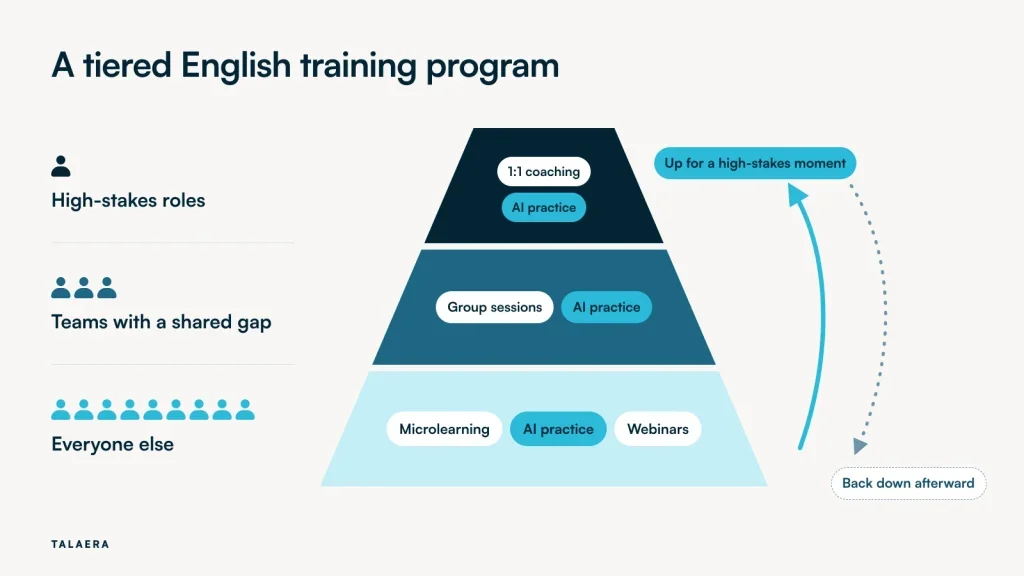
A tiered program matches the cost of each format to the stakes of each role. In most cases, the budget that funded coaching for a few dozen people can fund coaching for the highest-stakes roles plus practice formats for everyone else.
| Tier | Who it’s for | Formats | Why |
|---|---|---|---|
| Tier 1 | Client-facing roles and people facing a high-stakes moment | 1:1 coaching + AI practice | Their communication has a direct business impact, and their needs are individual |
| Tier 2 | Teams with a shared communication gap | Group courses or Speaking Club + AI practice | Shared scenarios make group formats efficient, and AI fills the practice gap |
| Tier 3 | Everyone else who works in English | Microlearning + AI practice | Broad reach at low cost, with a clear path to Tier 2 |
Two design choices make this model work. Segmenting by communication stakes matters as much as proficiency, because a CEFR level shows how well someone knows English but not whether they can handle a tense client escalation. Talaera’s Business English Assessment takes about ten minutes and gives you a baseline for every learner in scope. Movement between tiers should also feel normal, so a new manager might join Tier 1 for a block of sessions before a first global leadership meeting and then return to Tier 2.
The most efficient English training programs treat 1:1 coaching as a resource assigned to high-stakes moments, with practice formats carrying everyone else.
How to move from a coaching-only program without losing results
Changing a program that some employees value can create friction. A clear sequence keeps the transition smooth and gives you data to defend the decision:
- Audit current usage: Booking patterns show whether the problem is scheduling or relevance, especially among people who never started.
- Check the contract before renewal: The renewal date and the rules for unused sessions decide how much room you have, and many providers can convert part of a package into other formats.
- Assess everyone in scope: A short assessment across the full population, including people outside the current program, shows where the real gaps are.
- Explain each tier assignment: Current participants who move tiers should hear what they gain and how they can return to coaching for a specific moment.
- Pilot with one or two teams: Practice volume and one team metric over a few months show whether the new mix works before a full rollout.
Teams that skip the audit often cut coaching from the people who used it most. The sequence protects them while opening practice formats to everyone else.
What to measure when you restructure coaching
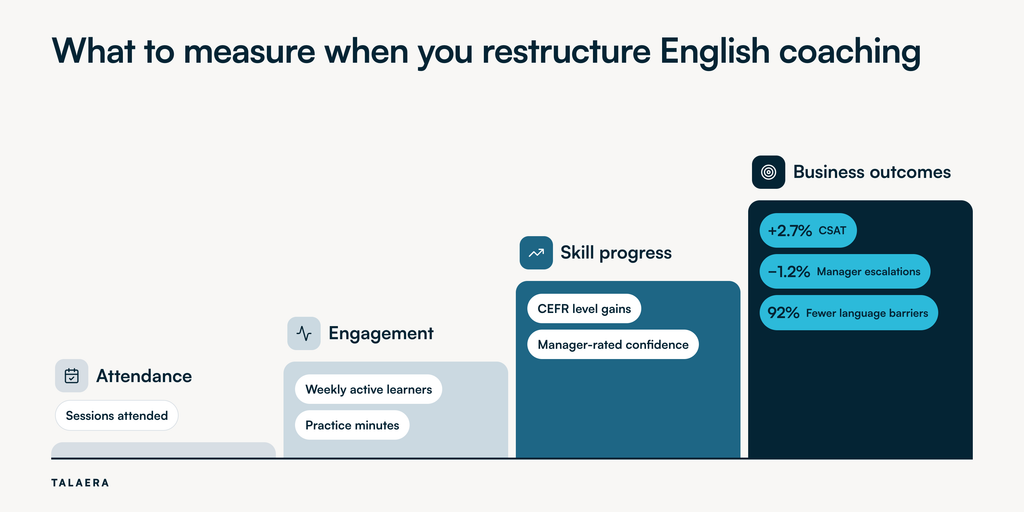
Attendance shows that people showed up, so measurement has to go further. Engagement and skill progress tell you whether the program is working, and one business metric per team tells you whether it matters. Separate pre- and post-training surveys often fail because learners answer only one of them. Talaera moved to a single end-of-program survey that asks learners to rate “before” and “now” side by side, which gives a cleaner read on change.
Talaera worked with Dialpad’s support team on a scenario-based program for 149 agents across three countries. Dialpad reported a 2.7% increase in CSAT and a 1.2% reduction in manager escalations, and 73% of agents said they felt confident de-escalating difficult situations. A coaching attendance report can’t produce numbers like these.
Attendance shows that people showed up. To show that communication improved, a program needs before-and-after skill data and one business metric the team already tracks.
When 1:1 coaching is still the right answer
One-to-one coaching stays the core format for senior people whose communication shapes strategy or client relationships, and for anyone preparing for a specific high-stakes event like a negotiation or a first board presentation. It also fits sensitive challenges, such as rebuilding confidence after negative feedback.
Programs with fewer than 20 learners and a comfortable budget may not need an alternative at all. In those cases, adding AI practice between sessions often helps more than changing formats, because learners arrive having already rehearsed.
Build a program that reaches more people for the same budget
Corporate English coaching works best for the people who need it most. Companies that get the most from their budgets keep coaching where the stakes are highest and surround it with formats that give everyone else frequent, relevant practice. The right mix depends on your roles and regions, so a short pilot is the safest way to find it.
Talaera brings 1:1 coaching and live group formats together with AI practice and self-paced courses in one platform, with team analytics for L&D. Book a demo to see how a tiered program could work for your organization.
Talaera’s content team drafted this guide with help from AI tools and checked every Talaera figure against our internal program data and published case studies.
Frequently asked questions
What can replace corporate English coaches?
Group courses and live speaking practice can take over team training from corporate English coaches, while AI practice and self-paced microlearning cover individual practice. Most companies get the best results from a tiered program that keeps 1:1 coaching for high-stakes roles and moves other employees to group and practice formats.
Should you cancel an English coaching contract or restructure it?
Restructuring is usually the better choice. Cancelling removes support from the leaders and client-facing employees who benefit most from 1:1 coaching. A smaller coaching tier plus practice formats for everyone else reaches more people, and reviewing usage before the renewal date leaves time to redesign.
How do you scale English training without scaling the coaching budget?
Companies scale by assigning formats according to communication stakes. A small group of leaders and client-facing roles keeps 1:1 coaching, teams with shared challenges join group formats, and everyone gets AI practice and microlearning. The same budget then covers far more employees.
What are the signs a coaching program needs to change?
Common signs are uneven session usage, a budget that covers only a small share of the people who work in English, and scheduling problems across time zones. Reports that show attendance but not improvement are another signal. If two or more apply, it’s worth reviewing the program before the next renewal.