Live coaching is better than self-paced language apps for business English when people need to speak at work: running meetings, presenting, negotiating, or handling clients. Self-paced apps are better for low-cost vocabulary, grammar, and listening practice across large groups. For most companies and most professionals, the strongest option is a blended program that uses AI and self-paced practice for daily repetition and live coaching for feedback and high-stakes moments. Talaera is built as that blended option, combining an AI communication coach, self-paced micro-lessons, live 1:1 and small-group coaching, and one dashboard for L&D.
So the real question behind “language app or coaching?” is which learners need which format, and how to combine them. This guide compares live coaching vs. self-paced apps (and group courses) on the criteria L&D teams actually evaluate, gives you a decision table, explains where AI coaches fit, and shows how to build the mix by learner need.
Key takeaways
- Live coaching moves speaking skills fastest because all the session time and all the feedback belong to one learner.
- Self-paced apps cost the least per learner, but completion is their weak point.
- AI conversation coaches add on-demand speaking practice. Research shows a moderate effect on speaking, strongest for beginners.
- Blended programs win when each format has a clear job: AI and apps for repetition, people for judgment, feedback, and accountability.
- Choose by learner segment and business goal, not by format. Start with an assessment and pilot before you scale.
What live coaching, group courses, speaking clubs, self-paced apps, and AI coaches deliver
Each format produces a different kind of learning experience, and understanding those differences matters before comparing outcomes.
Live coaching
1:1 business English coaching pairs a learner with an expert coach who builds sessions around that person’s actual work. Think preparing for a board presentation, rehearsing a difficult negotiation, or refining the tone of a client email. The coach provides personalized, real-time feedback on fluency, pronunciation, and strategic communication. Small-group formats (two to four learners) preserve most of this depth while lowering cost. Business English coaching carries the highest price per learner but delivers the deepest business-context relevance of any format.
Group courses
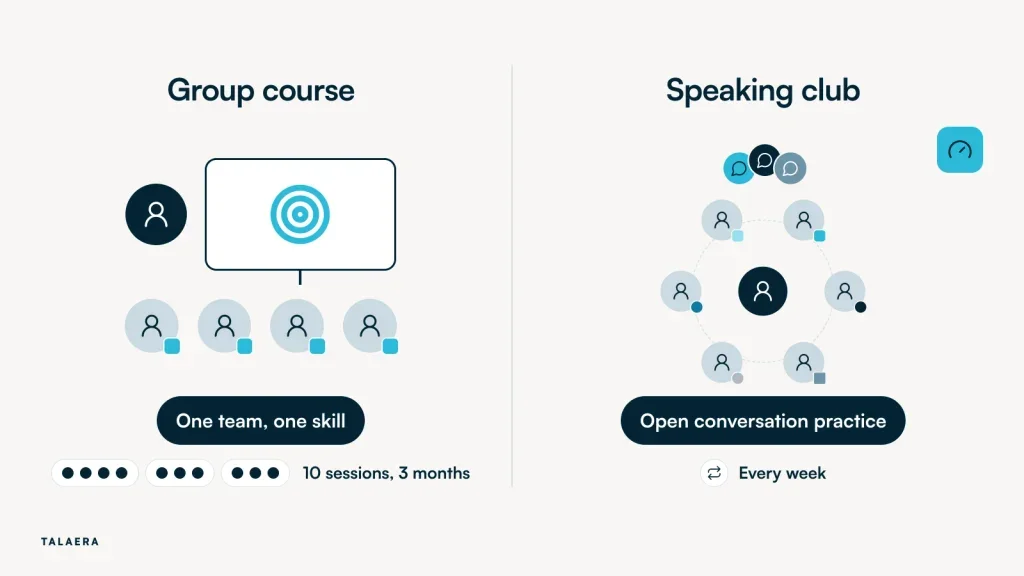
Corporate English group courses (often called group classes) bring a fixed cohort of four to twelve colleagues together with a live instructor following a structured curriculum. At Talaera, each course runs as a block of 10 sessions over three months and focuses on one skill the team needs, such as presentations, business writing, or client conversations. Peer interaction creates social accountability, and learners benefit from hearing colleagues work through similar challenges. The tradeoff is individual speaking time. While sessions last 90 minutes and instructors often use breakout rooms to maximize speaking time, each person still gets less speaking time than in an individual session. Group courses work well for building shared vocabulary across a team, but they can’t adapt deeply to any single learner’s role.
Speaking clubs
Speaking clubs are live conversation practice, not a course. In Talaera Connect speaking clubs, an expert business English coach leads weekly small-group sessions built around discussions, debates, and role-plays on topics like workplace rapport or self-advocacy. There are no in-depth grammar explanations, worksheets, or exams, and feedback is selective, so people can speak freely without fear of being corrected on every sentence. Learners need at least a lower intermediate level (A2+).
The difference matters when you plan a program. A group course teaches a specific skill to a team with a shared goal. A speaking club builds speaking confidence and fluency through regular practice, and it’s the cheapest way to add live speaking time between courses or coaching sessions.
Self-paced apps
Self-paced apps offer pre-built online lessons, gamified exercises, and drills for vocabulary, grammar, and pronunciation. Flexibility is the standout advantage. Learners can practice at midnight or between meetings, and cost per learner drops dramatically at scale. The gap is human feedback. Most apps can’t tell a learner that their phrasing, while grammatically correct, would land poorly in a stakeholder update.
AI conversation coaches
AI conversation coaches sit between apps and live coaching. Voice-based tools like Talk to Tally, Talaera’s AI communication coach, let learners speak out loud, get instant feedback, and rehearse job scenarios such as a project update or a reply to an unhappy client, at any hour. They add the speaking volume that static apps lack. They don’t yet replace a human who knows the learner’s role, culture, and stakes. The choice between language coaching, classes, apps, and AI is about fit for the learner and goal, not overall quality.

Decision table: when to choose self-paced, live coaching, or blended
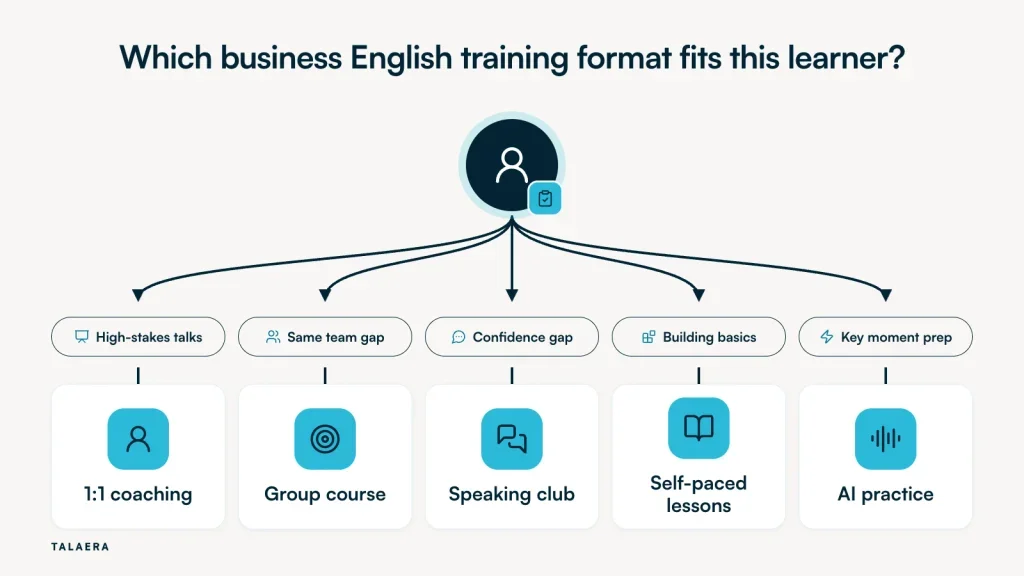
Use self-paced learning for foundations at scale, live coaching for high-stakes speaking, and a blended program when you need both progress and reach. The table maps common situations to the format that fits best.
| Your situation | Best format | Why it fits |
|---|---|---|
| Beginners (A1 to A2) building vocabulary and grammar | Self-paced app plus AI speaking practice | Repetition matters most at this stage, and AI speaking practice shows its largest effects with beginners. |
| Large frontline or shift-based teams on a tight budget | Self-paced learning plus periodic group sessions | Lowest cost per learner, with live sessions to keep people moving. |
| Intermediate learners (B1 to B2) who have plateaued | Live coaching plus AI practice between sessions | Plateaus break with targeted correction, which apps rarely give. |
| Managers running meetings and feedback conversations in English | Small-group classes plus targeted 1:1 coaching | Shared challenges suit a group. Sensitive conversations need private practice. |
| Executives presenting to boards, investors, or the media | 1:1 coaching | The stakes are high, and every session should target one person’s habits. |
| Sales, account management, and other client-facing roles | Live coaching plus AI role-play | Revenue depends on tone and persuasion, and AI lets people rehearse calls every day. |
| A whole team with the same problem, such as email tone in support | Group course | One curriculum, shared vocabulary, and a lower cost per head. |
| People who understand English well but freeze or hesitate when they speak | Speaking club plus AI practice | Regular, low-pressure speaking time builds confidence, which more lessons won’t fix. |
| Teams spread across many time zones | Blended: self-paced and AI by default, live sessions in regional time slots | Self-paced practice removes scheduling friction, and live sessions keep accountability. |
| Leadership wants proof of ROI | Blended program on one platform, with an assessment baseline | You can report proficiency movement, not only logins. |
A simple rule of thumb: if a learner needs to know more English, self-paced practice works. If they need to use English under pressure, add a human. Not sure where each person sits? Start with a short business English assessment to place every learner before you assign a format.
Live coaching vs. self-paced apps vs. classes: how they compare on what L&D evaluates
The table below scores each format against the six criteria that surface most often in corporate language training procurement. Each cell reflects typical performance, not best-case vendor claims.
| Criterion | 1:1 / Small-group coaching | Cohort classes | Self-paced apps |
|---|---|---|---|
| Proficiency velocity | Highest per hour of instruction. Sessions target individual weak points, so learners spend zero time on skills they’ve already mastered. | Moderate. Group pacing means some learners review known material while others need more time. Progress depends heavily on cohort homogeneity. | Lowest per hour of use. Algorithms adapt content, but without real-time human correction, errors can fossilize and plateau learners at intermediate levels. |
| Business-context relevance | High. Coaches tailor scenarios to the learner’s actual job tasks, from stakeholder emails to cross-functional standups. | Medium. Curriculum can be customized per cohort, but individual role-specific practice is limited by group size. | Low to medium. Most apps offer generic business English modules. A few allow company-specific content, but practice stays scripted. |
| Cost per learner at scale | Highest. Market rates for 1:1 instruction run $50 to $120 per hour, and structured programs typically cost $800 to $2,500 per employee per year, according to Edlingo’s budgeting guide. | Moderate. Small groups of three to six run about $15 to $55 per learner per session, according to the same guide, while preserving live interaction. | Lowest. Self-paced software often costs under $500 per learner per year, and volume discounts compress that further at enterprise scale. |
| Adoption and completion rates | High. Scheduled sessions with a live coach create accountability, and missed sessions are visible right away. | Moderate to high. Fixed schedules help, but dropout rises when session times conflict with shift work or time zones. | Low. Self-paced online courses have struggled with completion for years, and novelty-driven engagement often fades within weeks. |
| Reporting and measurement | Strong qualitative data. Coaches observe real communication behavior and can report on CEFR-aligned progress, but reporting quality varies by provider. | Moderate. Pre/post assessments are standard, though in-class observation data is harder to standardize across instructors. | Strong quantitative data. Apps track logins, time-on-task, and quiz scores automatically, but these metrics often don’t correlate with real-world proficiency gains. |
| Admin burden | Highest. Scheduling, learner matching, and coach quality management require ongoing L&D involvement. | Moderate. Cohort formation and scheduling need upfront work, then run semi-independently. | Lowest. Provision licenses, send invitations, monitor a dashboard. Rollout can happen in days. |
No single format wins across all six rows. Coaching delivers the fastest proficiency gains and the strongest business-context fit, but it costs the most and demands the most admin time. Apps scale effortlessly and report clean data, yet completion rates are low and the data they report often measures activity rather than ability. When choosing an English language training program, the question that matters isn’t which column looks best overall. It’s which column matches the learner segment you’re trying to move and the business outcome you’re trying to protect.
How fast does each approach move proficiency?
Business English coaching moves proficiency faster than any other format because every minute of session time targets the learner’s actual gaps. A coach identifies weak points in real time, adjusts the lesson on the spot, and delivers corrective feedback the learner can apply immediately. Cambridge English estimates that moving up one CEFR level takes approximately 200 guided learning hours. In a 1:1 coaching session, close to 100% of those hours count as active, personalized practice. That efficiency gap matters when you’re planning how long business English training takes for a specific workforce segment, or explaining to stakeholders what CEFR levels mean at work. In Thomson Reuters’ coaching program, learners in the Philippines and India took 10 individualized 1:1 sessions, and 92% said their language barriers were reduced.
Research on feedback supports this. A meta-analysis of 15 classroom studies with 827 learners found that oral corrective feedback had significant and durable effects on language development (Lyster and Saito, 2010). Prompts, where the teacher pushes learners to fix their own errors, worked better than recasts, where the teacher repeats the sentence correctly. Prompting is what a skilled coach does in every session, and it’s what most apps can’t do.
Group classes introduce a structural bottleneck. A learner in a cohort of eight to twelve participants shares speaking time with everyone else. Fluency Corp estimates that in a typical two-hour group class, an individual learner may get only about 20 minutes of actual talking time. Peer interaction adds value for listening exposure and collaborative practice, but measured per learner, the same 200 hours stretch much further on the calendar.
Apps offer unlimited volume. A learner can log hundreds of practice hours on their own schedule, which looks impressive in a dashboard. What apps struggle to provide is the corrective feedback loop that drives real movement in professional contexts. Pronunciation drills and grammar exercises build foundational skills, but they don’t teach a manager how to adjust tone when delivering difficult news to a cross-cultural team.
Pragmatic competence (register, diplomacy, persuasion) develops through interaction with a skilled coach who can model and correct in context. For frontline vocabulary building, apps deliver real value per hour invested. For the communication skills that define professional proficiency at B2 and above, the absence of human feedback becomes a ceiling.
Adoption and completion: the criterion L&D teams underweight
The best training format on paper is worthless if learners don’t use it. L&D teams spend most of their energy comparing content quality and price per seat while underweighting the factor that determines actual ROI: whether employees will complete enough hours to move their proficiency.
Self-paced formats face the steepest adoption challenge. Research on Harvard and MIT courses on edX found that low completion rates had not improved over six years, and most learners never returned after their first year (Reich and Ruipérez-Valiente, Science, 2019). Corporate app licenses often follow the same pattern without active program management: strong initial uptake that fades within weeks. Buying 500 licenses means little if only 30 people are still practicing by month three.
Live coaching drives higher completion because accountability is built into the format. A scheduled session with a real person creates social obligation. Learners show up because someone is waiting for them, because their manager can see attendance, and because the relationship with their coach generates its own momentum. Completion rates climb, but so does cost per learner, which limits how many employees you can enroll.
Group classes split the difference. Fixed schedules and peer dynamics create more accountability than an app sitting on someone’s phone, and attendance holds up better in the first months. But global teams introduce friction that weakens participation over time. Time zone mismatches force some learners into inconvenient hours, and scheduling conflicts accumulate as business demands shift.
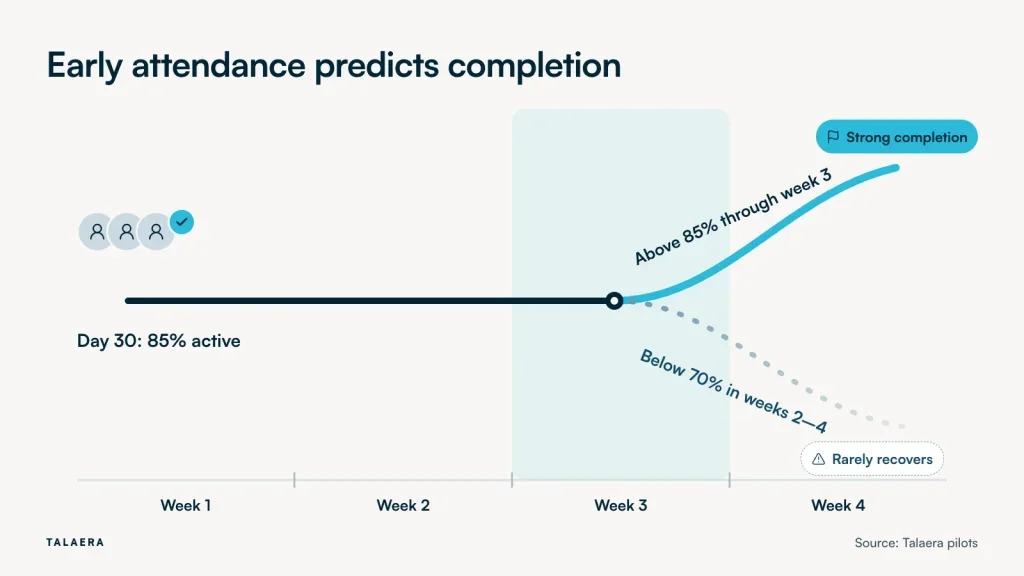
Early attendance tells you where a program is heading. Across Talaera pilots, 85% of learners are active on the platform within the first 30 days. Cohorts that keep attendance above 85% through week 3 consistently reach strong completion, while attendance that drops below 70% between weeks 2 and 4 rarely recovers on its own. We cover these benchmarks in what 100+ enterprise pilots taught us. Any L&D leader rolling out language training at scale needs to design for sustained engagement, not initial enrollment alone, because the gap between licenses purchased and hours completed is where training budgets disappear.
Where AI language coaches and blended learning fit
AI coaches make blended learning practical. They give every learner daily speaking practice at a low cost per person, so human coaches can focus on the moments that need judgment.
What the research says about AI speaking practice
The evidence on AI speaking practice is promising but uneven. A 2025 meta-analysis in ReCALL pooled 16 studies of dialogue-based systems and found a moderate overall effect on second-language speaking (g = 0.61). Effects were large for beginners and medium for intermediate learners. Evidence for advanced learners was too thin to show a significant gain. A larger 2026 meta-analysis of 51 studies found that generative AI tools had large, significant effects on language proficiency, with stronger results for productive skills like speaking and writing.
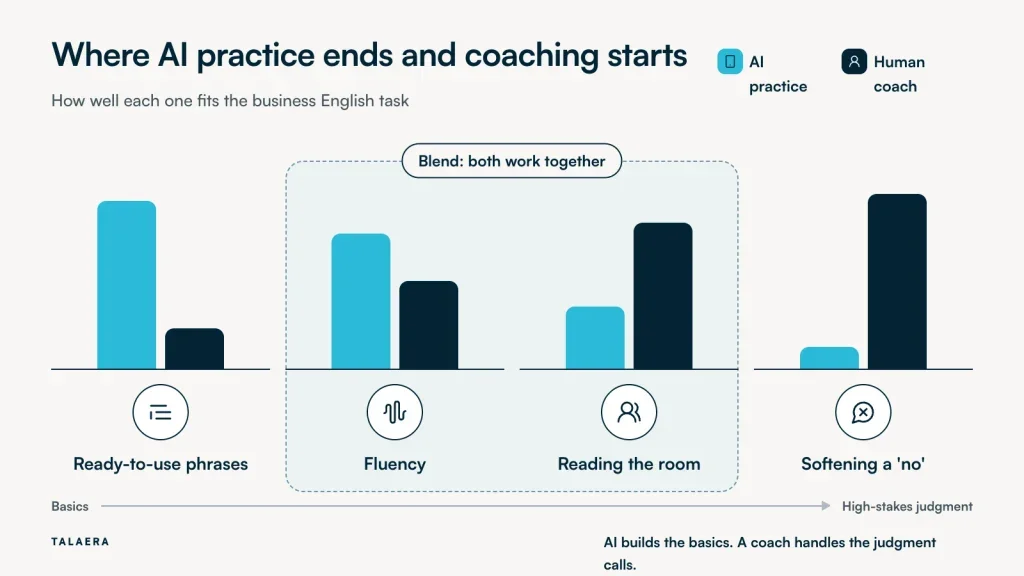
In practice, AI is strongest where most corporate learners start: building fluency, confidence, and ready-to-use phrases through repetition. It’s weakest where business English gets hard, such as reading a room, softening a “no” for a senior stakeholder, or adapting to a client’s culture. Those skills still develop fastest with a person who knows the learner’s role. Our look at whether AI will replace language teachers goes deeper.
Why blended programs outperform single formats
Blended learning works when each format has a clear job. A U.S. Department of Education meta-analysis found that blended conditions outperformed face-to-face instruction alone. Its authors noted that the blended conditions often included extra learning time and instructional elements, so the gains shouldn’t be credited to the technology itself. So design the blend first and pick the tools second. Each format covers another’s weakness:
- AI practice and self-paced lessons provide volume, flexibility, and low cost per learner.
- Live coaching provides targeted feedback, accountability, and role-specific practice.
- Group courses teach a shared skill to a team, with peer learning built in.
- Speaking clubs provide regular, low-pressure conversation practice with peers.
According to Talaera platform data, the English Speaking Club (Talaera Connect) is the third most-accessed content on the platform, and this live practice outranks every self-paced course. Even with a full library of self-paced content available, people go looking for real conversation.
How Talaera blends AI and live coaching
Talaera was built as a blended business English program, not as an app with tutors added on. Learners practice daily with Tally, work through self-paced micro-lessons on meetings, emails, and presentations, join Talaera Connect speaking clubs for weekly conversation practice, take group courses when a whole team shares a skill gap, and book 1:1 coaching for high-stakes moments. L&D teams see engagement and progress across all of it in one dashboard, instead of pulling reports from three vendors and reconciling different proficiency scales.
Netafim, the global irrigation company, used this kind of mix: personalized 1:1 business English coaching supported by self-paced online courses. In Netafim’s program, 76% of learners said they felt more prepared for English-based leadership roles.
A blended week for a B1 manager might look like this:
- Monday: 10 minutes with Tally rehearsing the opening of a weekly team update.
- Wednesday: a live coaching session on handling pushback in meetings.
- Friday: a short micro-lesson on phrases for polite disagreement.
- Thursday: a Talaera Connect speaking club session to practice speaking with peers.
For a wider view of vendors that combine formats, see our guide to blended learning solutions for employees.
What each model can report back to L&D
The data a training model produces matters less than whether that data answers the questions your stakeholders actually ask. Most L&D leaders need to show proficiency improvement tied to business outcomes, and the formats differ sharply in their ability to deliver that.
Apps generate the highest volume of data: logins, minutes spent, lessons completed, streaks maintained, and quiz scores. But quiz scores on decontextualized grammar exercises don’t tell you whether someone can now handle a client escalation call in English. Most app platforms lack meaningful proficiency-delta measurement, so you end up reporting activity metrics rather than capability gains. That becomes a problem the moment a CFO asks what the company got for its investment.
Coaching produces different evidence. A structured coaching program can report CEFR-level movement, qualitative proficiency assessments, and goal attainment tied to specific workplace tasks. That’s closer to what stakeholders want to hear. The catch is that this reporting depends on structured coach protocols and platform support, including dashboards and LMS integration. Without those, coaching insights stay locked in individual session notes that no one aggregates. When you’re measuring training effectiveness, the infrastructure behind the data matters as much as the data itself.
Group classes fall somewhere in between. Attendance records and curriculum completion rates come standard. Proficiency measurement, though, requires separate assessment tools, because most class platforms don’t track individual language gains with enough detail to satisfy an ROI conversation.
How to combine formats by learner need
Who’s learning, and what they need to achieve, determines the right mix. Before applying this framework, start by deciding which employees need English training in the first place. Once you’ve identified your learner populations, the segment-by-segment logic becomes clear.
Executives and senior leaders: coaching first
Board presentations, investor negotiations, and media interactions carry reputational and financial stakes that demand personalized, real-time feedback on tone, framing, and persuasion. A self-paced app can’t simulate a hostile Q&A from analysts, and a group class won’t address the specific habits holding back one VP’s credibility. Coaching gives executives a confidential space to rehearse high-pressure scenarios with an expert who adapts in the moment. AI practice can fill the days between sessions. For this tier, the cost per learner is high, but the cost of poor communication is higher.
Managers and team leads: group classes plus targeted coaching
Group classes work well when a cohort of managers faces similar challenges, because peer learning reinforces skills like running inclusive meetings or delivering feedback across cultures. Language coaching vs. classes becomes a real tradeoff here. Managers who lead cross-cultural teams or handle sensitive conversations (performance reviews in a second language, for example) often benefit from targeted coaching layered on top of class participation. If the challenge is shared across the cohort, classes deliver more value per dollar. If it’s individual, coaching fills the gap. Our guide to managing a multilingual team covers the manager side in more detail.
Individual contributors: self-paced and AI practice, with coaching for client-facing roles
Individual contributors are the largest population, so cost discipline matters most. Self-paced lessons and AI practice provide a strong foundation in vocabulary, grammar, and speaking fluency at scale, and periodic group classes add interactive practice. Coaching for ICs is harder to justify broadly, but it makes sense for client-facing roles in high-revenue functions like enterprise sales or key account management, where one awkward call can stall a deal. Communication benchmarks by role help you draw that line without overspending.
Frontline and large populations: self-paced at scale, with group support
When you need to reach hundreds or thousands of employees, the per-learner economics of coaching or even group classes become prohibitive. Self-paced learning provides consistent baseline instruction at a fraction of the cost. For cohorts that plateau or need structured support (warehouse teams preparing for safety certifications, for instance), add periodic group classes. This layered approach keeps costs manageable while giving struggling learners a path forward beyond self-study.
Match the mix to the business goal
The business outcome you’re solving for also shapes the blend:
- Safety and compliance needs consistent comprehension across large populations. Self-paced practice handles safety terminology and procedures, and group sessions add scenario practice, such as reporting a hazard. Coaching is rarely necessary.
- Customer experience and sales need employees who read tone, adapt in real time, and persuade. When the whole team shares the same problem, a live program built around real customer scenarios can move the numbers. After Dialpad’s support team completed a scenario-based communication program with Talaera, the company’s soft-skill CSAT rose 2.7%, and 73% of agents felt more confident de-escalating difficult situations. Individual high-stakes roles still call for coaching, and the ROI of English language training for client-facing staff usually makes the business case clear.
- Cross-cultural collaboration benefits most from group classes, because peer interaction across cultures is the training exercise itself. Add coaching for managers who lead multicultural teams.
- General workforce upskilling stretches budgets thinnest. Use self-paced and AI practice as the baseline, add group classes where English affects daily workflows, and reserve coaching for roles where communication quality directly affects business results.
Choosing for yourself: a language app or a coach?
If you’re a professional choosing for yourself, three questions will point you to the right format:
- What do you need English for in the next three months? If it’s a job interview, a promotion, or presenting to leadership, a coach will get you ready faster.
- Where are you now? If you’re still building basics, start with an app and AI practice. If you understand almost everything but freeze or ramble when you speak, you need feedback from a person.
- How do you stay consistent? If you tend to drop apps after two weeks, a scheduled session with someone waiting for you is the habit you need.
Most professionals end up using both: an app or AI coach for daily practice, and a coach for the moments that matter.
How to design your English training program in five steps
The strongest corporate language training programs follow a clear decision sequence:
- Segment learners by role and proficiency level. Use an assessment baseline so you know who sits where.
- Name the business goal for each segment, whether that’s safety compliance, customer experience, sales effectiveness, or cross-cultural collaboration.
- Match formats to each segment-goal pair using the decision table above.
- Confirm your assumptions, then pilot. Run a training needs analysis to see where proficiency gaps actually sit, then design a pilot that predicts scale. In Talaera’s experience, most pilots need 10 to 14 weeks to produce a meaningful signal on completion and proficiency movement.
- Only then evaluate vendors within each format. Our review of corporate language training platforms is a good starting shortlist.
Most organizations that get this right end up blending formats rather than choosing one, giving executives and managers live coaching while scaling AI-powered practice across larger populations. A uniform training architecture rarely fits a workforce with varied roles and needs.
Request a demo for your team →
Frequently asked questions
What is the best way to learn business English for a corporate team?
The best approach depends on your team’s roles and the business outcomes you’re targeting. Frontline employees focused on safety or customer interactions often benefit most from self-paced apps that deliver consistent, repeatable practice at scale. Managers and executives who need to lead meetings, negotiate, or present to stakeholders typically see faster proficiency gains from live business English coaching that mirrors real workplace scenarios. Most companies get the strongest results by blending modalities across learner segments rather than picking a single format for everyone.
Is business English coaching worth it compared to an app?
Coaching delivers faster proficiency movement per hour of training, especially for intermediate and advanced learners who’ve plateaued. Apps cost less per learner and scale more easily, but they produce lower completion rates and slower progress above the B1 level. Coaching is worth the higher per-learner cost when the business impact of faster improvement (closing deals, reducing miscommunication, retaining clients) outweighs the price difference. For large populations of beginner learners, an app may deliver better ROI.
When should a company choose coaching over a self-paced English app?
Choose coaching when learners need to apply English in high-stakes, context-specific situations like executive presentations, cross-cultural negotiations, or client-facing sales conversations. Coaching sessions allow real-time correction and scenario practice that apps can’t replicate. Apps work well for building foundational vocabulary and grammar, but they rarely simulate the unpredictable, relationship-driven communication that managers and executives face daily.
How do you measure the effectiveness of different English training approaches?
Track three metrics across all modalities. First, measure proficiency movement using a standardized framework like the CEFR, comparing pre- and post-program assessments. Second, monitor completion rates, since a program no one finishes produces no results regardless of its quality. Third, connect training data to business outcomes such as customer satisfaction scores, safety incident rates, or internal promotion rates for participants.