CEFR levels explained for workplace decisions come down to one point. The Common European Framework of Reference for Languages (CEFR) rates general language proficiency on a six-level scale from A1 to C2, and that rating says little about how well someone leads a meeting or presents results under pressure. For L&D and HR teams, the useful question is what a B2 or C1 score predicts about job performance. A C1 score confirms strong language ability, and a second assessment shows whether that ability holds up in real work moments.
The six CEFR levels describe language ability in three bands
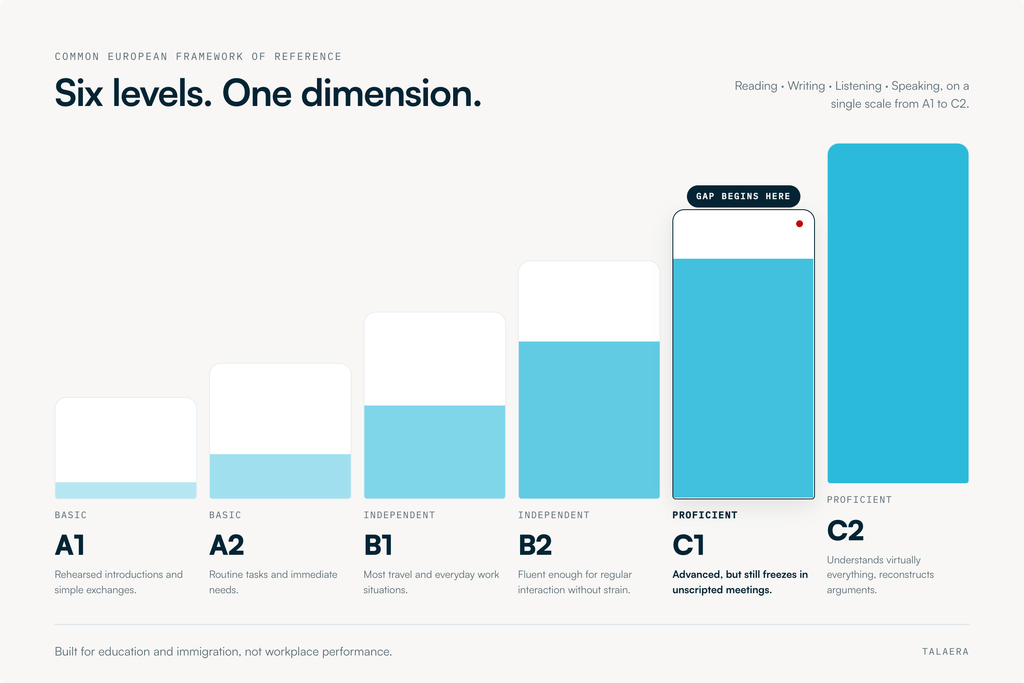
CEFR groups ability into three bands of two levels each. Basic users sit at A1 and A2, independent users at B1 and B2, and proficient users at C1 and C2. Each level comes with “Can Do” statements that describe what a person can accomplish with the language rather than which grammar rules they know.
CEFR rests on an “action-oriented approach” that treats learners as social agents who complete real-world tasks. The 2001 scale covered reception, production and interaction, and a 2020 Companion Volume added mediation and online interaction.
| Level | Band | What the learner can do |
|---|---|---|
| A1 | Basic User | Can introduce themselves and handle simple transactional exchanges using rehearsed phrases. |
| A2 | Basic User | Can communicate in routine tasks and describe their background, immediate environment, and basic needs. |
| B1 | Independent User | Can handle most travel and everyday work situations and produce simple connected text on familiar topics. |
| B2 | Independent User | Can interact with a degree of fluency that makes regular interaction with proficient speakers possible without strain for either party. |
| C1 | Proficient User | Can express ideas fluently and spontaneously, using language flexibly for social, academic, and professional purposes. |
| C2 | Proficient User | Can understand virtually everything heard or read and summarize information from different sources, reconstructing arguments coherently. |
A B2 result confirms that someone can follow complex arguments on familiar topics and sustain a conversation, which is useful information. Test providers also publish approximate alignments between their scores and CEFR levels. IELTS and Cambridge results can both be read against the same scale.
CEFR measures general language proficiency. It doesn’t measure whether someone can use that language to persuade a stakeholder or recover from a misunderstanding at work.
CEFR was built for language education, so it can’t predict workplace performance
The framework supports language teaching and assessment in education. That origin explains why a CEFR level, however accurate as a proficiency measure, can’t stand in for a workplace skills profile.
The framework was designed for classrooms and exams
Launched by the Council of Europe in 2001, the CEFR provides “a common basis for the elaboration of language syllabuses, curriculum guidelines, examinations, textbooks, etc. across Europe.” Governments and employers later borrowed the levels for entry and hiring requirements, and the Council of Europe itself notes that applying them to adult migrants needs “careful interpretation and adaptation.”
Four domains of language use (personal, public, educational, occupational) structure the framework. At B2, the CEFR descriptor for information exchange says a learner can understand and exchange complex information and advice on the full range of matters related to their occupational role. That sounds thorough until you ask what it leaves out. It says nothing about persuading a resistant audience or adjusting to a counterpart whose norms around directness differ from yours.
One level can hide opposite skill profiles
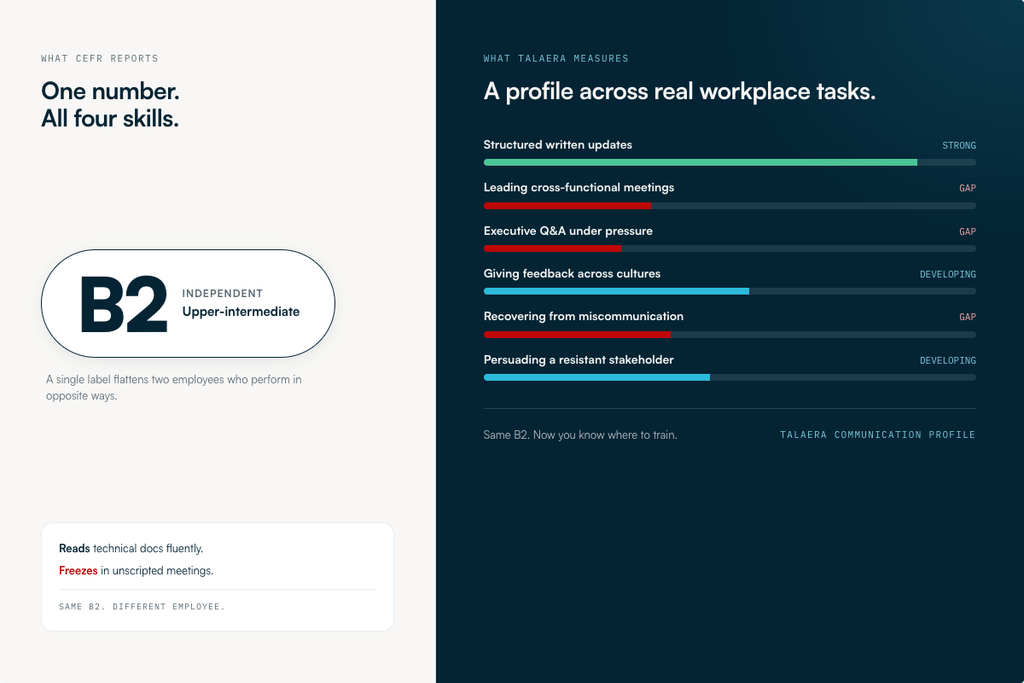
Two employees rated B2 can perform in opposite ways. One reads technical documentation fluently but freezes in unscripted meetings, while the other speaks with confidence and writes emails that create misunderstandings. A single level averages those profiles into one label. Any hiring or promotion decision then rests on a score that hides the difference that matters for the role.
Assessment methods add to the problem. Can-do descriptors are often self-assessed or measured through standardized tasks such as reading passages and controlled speaking prompts. Neither format reproduces the pressure of managing a relationship while thinking strategically in real time, and even AI-powered proficiency tests share that limit when they rely on the same task types. A CEFR score shows what someone knows about the language. It doesn’t show what they can do with it when the script runs out.
Why C1 employees still struggle in meetings and presentations
A strong CEFR score predicts language knowledge rather than communication performance. Three illustrative moments show how the gap appears at work, and Talaera’s coaching data shows how common it is.

A cross-functional meeting without a script
A C1-rated engineer asked to lead a cross-functional meeting can explain technical concepts with precision in a prepared setting. When stakeholders interrupt each other, the same engineer struggles to manage turn-taking or reclaim the floor, so the discussion drifts. Indirect disagreement, which is polite in many workplaces, can read as agreement to colleagues who expect directness. False alignment follows, and two weeks later the project is off track because “yes” meant something different to each person.
An executive question that goes off script
A B2-rated manager delivering a quarterly business review can present prepared slides in clear, structured language. Then an executive asks an unexpected question about falling margins in one region. That manager has the data but can’t reframe it with the strategic conciseness an executive expects. They over-explain and lose the thread. A CEFR-based test is unlikely to flag this risk, because most of them measure controlled tasks rather than spontaneous, high-stakes interaction.
Difficult feedback to a direct report
A C1-rated team lead giving difficult feedback to a direct report has the vocabulary and the grammar. What the team lead lacks is the pragmatic skill to set the right level of directness. Either the message softens until its seriousness doesn’t register or it lands with a bluntness that damages trust. When the conversation turns emotional, recovery is hard because CEFR doesn’t assess reading emotional cues or repairing a conversation that is going sideways.
What Talaera’s coaching data shows
Talaera’s analysis of 2,000 coaching plans written between 2019 and 2026 shows hesitation in 55.2% of 2026 plans, up from 28% in 2019, while grammar fell from 62% to 39.6% of plans (2026 is a partial year). Hesitation overtook grammar in 2024. Accuracy can be studied and tested, while fluency under pressure is a performance skill that improves through live, repeated practice.
The gap widens among the most fluent learners. Among coaching plans for learners assessed as Advanced or Nearly Native, 43.1% diagnose a confidence barrier, up from 34.2% before the pandemic. One coach’s first-session note on a learner at roughly C1 to C2 level says the plan will focus on confidence, with “language as a secondary aim.” An L&D lead at a global IT services company says of their teams, “They know how to speak the language, but where we need help is aspects like speaking up in meetings and communicating effectively.”
How misdiagnosis hurts both sides
Language Testing International notes that limited language skills can reduce confidence and make employees reluctant to take on tasks. It adds that “decision-making processes can also be affected, especially among monolingual English-speaking leaders within the company who might misinterpret communication gaps as lack of professional competency.” Employees underperform while managers misread the cause.
What CEFR leaves out maps directly to what effective workplace communication requires. Running a meeting takes turn-taking strategy, and answering an executive takes register-switching and strategic framing. When an employee struggles, that distinction changes how you diagnose the issue and which training investment will move the needle.
What a workplace communication readiness assessment measures
Workplace communication readiness is the ability to complete specific professional communication tasks under real conditions. An employee at C1 has the linguistic resources, but whether they can lead a tense cross-functional meeting or recover when a stakeholder misreads a recommendation is a separate question.
What the assessment covers
The skills include structuring an argument for a specific audience and managing turn-taking so quieter colleagues contribute. They also include shifting tone when a project update becomes a difficult performance conversation and recovering from miscommunication without losing credibility. None appear on a proficiency scale, and measuring them means assessing strategic competencies alongside language ability.
A workplace communication assessment scores performance on realistic professional tasks rather than knowledge of grammar and vocabulary.
How the result differs from a level
Task-based evaluation places people in realistic scenarios such as presenting quarterly results or negotiating a timeline with a resistant partner. It then scores how clear the structure is and how confidently the person handles pressure.
The output is a multi-dimensional profile of where an employee is strong and where gaps sit across professional tasks. One person might write precise updates but lose clarity when fielding unscripted questions, while another handles one-on-one feedback well but struggles to manage participation in groups. A single B2 or C1 label flattens those differences, which sends training investment to the wrong skill.
When CEFR is enough and when to add a second assessment
CEFR remains the right tool for several decisions, and replacing it would create new problems. It fits best when the goal is setting minimum hiring thresholds for roles that need general English or benchmarking language ability across offices in Munich and Seoul. Tracking individual progress through a language program over time also works well, and compliance rules that cite specific CEFR levels need those scores on file.
A communication readiness assessment becomes necessary when the question shifts from “can this person use English?” to “can this person perform in English?” That shift shows up in four situations. Deciding whether someone is ready to present to clients or executives takes more than a B2 score, and designing targeted training means knowing which professional skills have gaps rather than where someone falls on a six-level scale.
Promotion decisions that hinge on communication need evidence of what someone can do under pressure. Evaluating training ROI also works better with outcome-based metrics tied to workplace performance than with progress from B1 to B2.
Moving from English proficiency levels to communication readiness
CEFR tells you what someone knows about the language, and communication readiness tells you what they can do with it when it matters. Both are useful, and treating them as the same measure leads to misplaced confidence in decisions about who to hire or promote and how to train them.
CEFR works as a screening and tracking tool, and a communication assessment belongs on top of it for any decision that depends on performance.
A practical next step is an audit of where your organization uses proficiency levels as a proxy for communication readiness. Promotion panels and client-facing role assignments are good places to start. A training needs analysis focused on communication gaps will show where CEFR scores mask performance risk, and Talaera’s free assessment takes 10 minutes and shows real-world business English readiness. Every organization’s mix of roles and regions differs, so the right depth of assessment depends on the stakes of each decision.
Frequently asked questions
What does CEFR measure?
CEFR measures general language proficiency, covering receptive skills (reading and listening) and productive skills (writing and speaking). The Council of Europe designed it to support language teaching and assessment in education. It shows whether someone can understand and produce language at a given level of complexity but not whether they can use it effectively in high-pressure professional situations such as negotiations or executive presentations.
Is B2 fluent enough for workplace communication?
A CEFR B2 level means someone can interact with a degree of fluency on familiar topics and handle most routine work conversations. For day-to-day email and standard meetings, B2 often works well enough. Where it falls short is in unscripted, high-stakes moments such as a difficult client call or pushback from senior stakeholders, which depend on pragmatic and strategic skills that a B2 score doesn’t capture.
Why do employees with C1 English still struggle in meetings?
C1 indicates advanced language range and the ability to produce well-structured, detailed text. Meetings demand different skills, including reading the room and interrupting diplomatically while adjusting tone in real time. That is why C1-rated employees often write polished reports and go quiet when a cross-functional discussion turns contentious.
How can L&D leaders assess English readiness for meetings and presentations?
A workplace communication readiness assessment complements CEFR by evaluating what someone can do with English in realistic professional scenarios. It measures skills such as structuring a persuasive argument and managing Q&A rather than testing grammar and vocabulary in isolation. Talaera’s Communication Profile applies a 900-point framework that interprets clarity, confidence, and comprehension from real interactions, so L&D teams can target training where CEFR scores leave blind spots.