The best alternatives to in-house English teachers, tutors and language academies depend on what your people need. Teams that already work in English usually get the most from a blended business English platform such as Talaera, while companies training people in many languages are better served by an online language academy. Tutor marketplaces suit a handful of learners who mainly want conversation practice.
What to replace each in-house format with
Every in-house format has an online equivalent, and each one comes with a different question to settle before you switch.
| In-house format | Online replacement | What to check first | Keep in mind |
|---|---|---|---|
| English teacher on staff | 1:1 coaching plus group classes | Whether a learner keeps the same coach | Your teacher knows the business, so capture that context before you switch |
| In-house or contracted tutors | Tutor marketplace or coaching platform | How tutors are vetted and matched | Marketplaces give more choice and less consistency |
| Language academy (onsite or contracted) | Online language academy or blended platform | Whether session times work across regions | Academies cover more languages, blended platforms more workplace situations |
| In-house communication training | Workshop series for non-native speakers | Whether the training teaches the English along with the skill | Generic courses often assume full fluency |
Talaera covers all four rows for English, through 1:1 coaching and group courses, plus workshops and Talaera Connect, its free group sessions for fluency practice. If you also need other languages, you’ll need an academy alongside it. We’re Talaera, so we wrote this guide, and our comparison of 11 providers covers named vendors side by side.
Why in-house English programs stop working at scale
In-house programs work well for one office, where a teacher who knows the team can tailor every lesson. Once a company spans several countries, each new location needs its own teacher or academy contract, and quality starts to depend on who teaches each group.
The admin load grows with every vendor. An L&D lead at a fintech, where language vendors had been bought country by country, described what that looks like. “Imagine this whole thing needs to be managed by one person. Yep, that’s me. 1,800 users.”
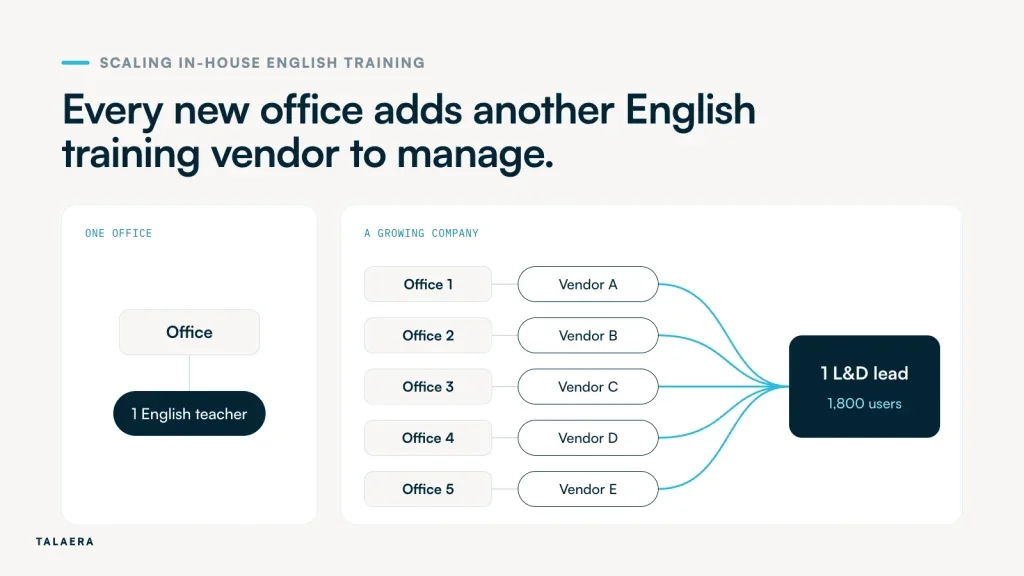
An in-house English program stops scaling when one person has to coordinate several vendors and still can’t show what changed at work. Fewer providers with one method and one report make both problems smaller.
What are the best alternatives to in-house English language academies?
Online language academies are the best alternative to an in-house academy when you need many languages, and blended business English platforms such as Talaera fit better when your teams already work in English. Both keep the structure of a timetable while removing the tie to one site.
An in-house academy’s weak point is location. Classes happen at one office and at times that rarely suit colleagues in other regions, so people in smaller offices can miss out. Before replacing it, check how a provider handles three things. Session times should work for every region you train, and mixed levels need separate groups. Content should follow the situations your people face at work, such as meetings and client calls, rather than a general textbook.
What are the best alternatives to in-house language tutors?
Tutor marketplaces and coaching platforms are the two main alternatives to in-house language tutors. Marketplaces give each learner the widest choice, while coaching platforms give a whole team one method and one view of progress.
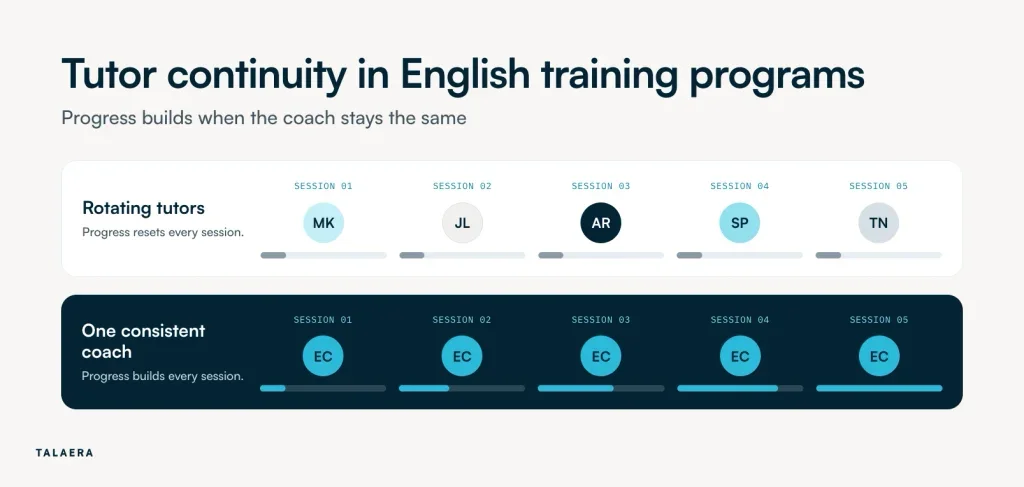
Consistency becomes the main issue as a tutor program grows. An HR director at a software consultancy told us that people enjoyed their previous provider’s platform, yet the company wasn’t seeing results. That provider rotated tutors, and with a new tutor each time, “learners felt like they were starting over every session.” Four questions separate the options quickly:
- Vetting: Who checks a tutor’s business experience, beyond a teaching certificate? Coaching a sales director through a negotiation takes different skills from conversation practice.
- Continuity: Does each learner keep the same tutor? Switching tutors resets context and slows progress.
- Matching: Does a person review the match, or does the learner pick alone? At Talaera, an algorithm suggests five coaches by role and native language, and a person makes the final choice.
- Reporting: What does L&D see without asking? Session counts show activity, while skill progress shows whether the program is working.
If 1:1 coaching is already in place and cost is the issue, our guide to alternatives to corporate coaching covers what to add around it.
What are the best alternatives to in-house communication training?
For non-native English speakers, the best alternative to in-house communication training is a program that teaches the skill and the English together. Generic soft-skills courses often miss this audience because they assume everyone already speaks with full confidence.
A technique like “push back with a clear recommendation” only helps when someone has the English to use it under pressure. Format matters as much as content. A single session can introduce a skill, but people need repeated practice to use it in a real meeting, so a series spread over several weeks or months is more likely to change behavior than a one-day event. Regular speaking practice between sessions helps people keep what they learned.
Talaera’s workshops follow that model, with 10 sessions of 90 minutes over three months built around one team’s situations. Our guide to communication training that works covers how to design a program for global teams.

How to switch from an in-house program without losing momentum
The safest way to replace an in-house program is a short pilot with one team, run alongside the existing setup until the results are clear. Moving everyone at once risks losing what your in-house teacher knows and unsettling learners who are mid-course.
- Capture what your teacher knows: A written brief covering the roles your teacher supports and the situations learners struggle with gives any new provider a head start.
- Involve the teacher early: Your teacher can help write that brief, and keeping them on during the pilot protects learners who are halfway through a course.
- Pick one team and one metric: A support team and its ticket close time, or an engineering team and its meeting participation, gives you a number to compare before and after.
- Set the decision upfront: We suggest a pilot of 4 to 12 weeks with 20 to 50 people, with the result that would justify a wider rollout agreed before day one.
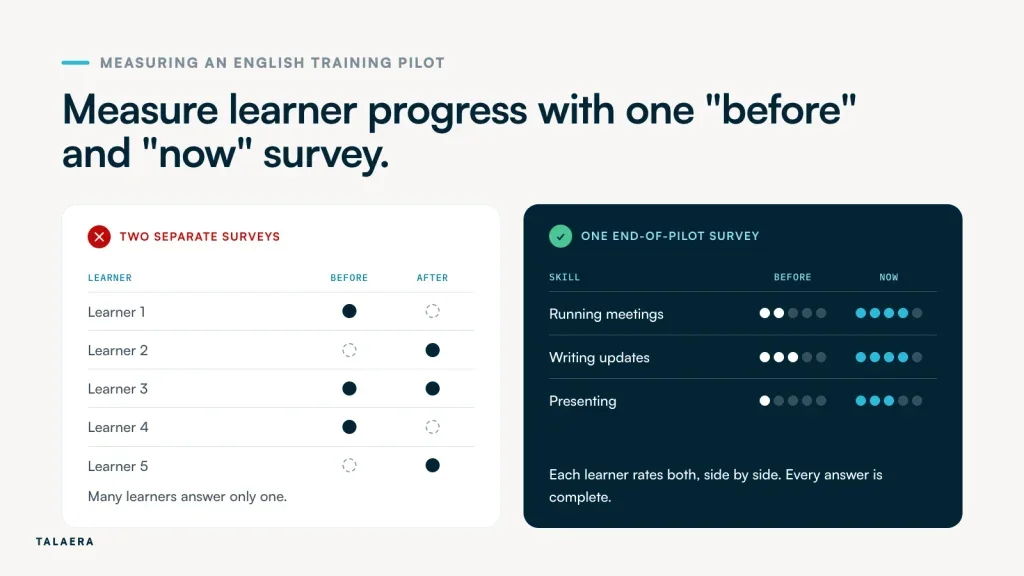
One practical lesson from our programs is about surveys. Separate before and after surveys often fail because many learners answer only one of them. A single end-of-pilot survey that asks people to rate their skills “before” and “now” side by side gives cleaner data. Good pilots can also spread on their own, and at one asset manager, a 10-person pilot led several countries to ask leadership for access. Our buyer’s guide covers the procurement side, including SSO and reporting.
What the switch costs
Each alternative uses a different pricing model, so per-seat prices only compare well within one type. Tutor marketplaces usually price per lesson, apps price per seat, and coaching platforms tend to quote per program.
In-house programs hide part of their cost in admin, such as scheduling across time zones and compiling reports by hand. A fair comparison counts those hours next to the vendor price, along with sessions that get paid for and never used. It’s worth asking every provider whether unused sessions can move to other learners. Talaera lets L&D teams do this on their own.
Results belong in the cost comparison too. In the WOW24-7 case study, median time to close a support ticket fell 17% after a five-session group course, a result the support team could measure in its own tools.
Which language training alternative fits your team
Teams that already work in English and need to communicate better at work get the most from a blended platform. Companies that need many languages should start with an online academy, while a few learners on a tight budget can begin with a marketplace. Whichever way you lean, a pilot with one team and one metric will tell you more than any comparison table.
If your teams work in English and you’d like to see how a Talaera program would run alongside your current setup, book a demo.
Frequently asked questions
How much do alternatives to in-house English teachers cost?
Costs vary widely by category. Tutoring marketplaces like Preply or Cambly range from $10 to $30 per hour per learner, while self-paced e-learning apps cost $10 to $30 per user per month. Blended enterprise platforms like Talaera typically fall between $100 and $300 per employee per month but bundle live coaching, AI practice, and analytics into a single contract. When you factor in the admin overhead of managing multiple vendors, blended platforms often deliver a lower total cost of ownership at scale.
Can online platforms match the quality of in-house English teachers?
The best ones exceed it. In-house teachers offer personalized attention, but quality depends entirely on individual hires and lacks standardization across locations. An online business English course on a blended platform pairs certified coaches with structured curricula and AI-driven practice, so every employee gets consistent quality regardless of time zone. Talaera‘s 500-point communication framework ensures that coaching targets the specific business skills each learner needs, not generic fluency.
How do companies scale English training across global teams?
Scaling requires a platform that works asynchronously and across time zones without multiplying admin effort. Self-paced apps scale easily but produce low engagement and no measurable behavior change. English language training for business that combines on-demand AI practice with scheduled live sessions gives distributed teams flexibility while maintaining accountability. Unified dashboards let L&D leaders track progress across every region from one place, which eliminates the fragmented reporting that plagues marketplace and in-house models.
Is AI replacing corporate English teachers?
AI handles repetitive practice well, including pronunciation drills, vocabulary reinforcement, and writing feedback. It can’t replicate the coaching humans provide for high-stakes scenarios like negotiations, executive presentations, or cross-cultural conflict. The most effective programs use AI to increase practice volume between live sessions, freeing human coaches to focus on complex communication skills where their expertise matters most.
How do you measure the ROI of business English training?
Move beyond fluency scores to business metrics. The Kirkpatrick model outlines four levels of training evaluation, and most language programs only measure Levels 1 and 2 (satisfaction and test scores). Connecting training to Level 3 and 4 outcomes like faster customer resolution times, higher CSAT scores, or improved cross-team collaboration is what proves ROI to leadership. Platforms with built-in analytics that map skill gains to performance data give you the evidence a spreadsheet of course completions never will.
How we evaluated these alternatives
We compared types of provider rather than individual vendors, against four questions. Our first two asked which in-house format each type replaces and how it delivers training, and the last two covered language range and the main trade-off. Talaera’s details come from our product documentation and internal learner data, and our comparison of 11 providers explains how we checked facts about other vendors. AI tools helped us organize research and draft this update. Our content team then checked every fact against its source before publishing.