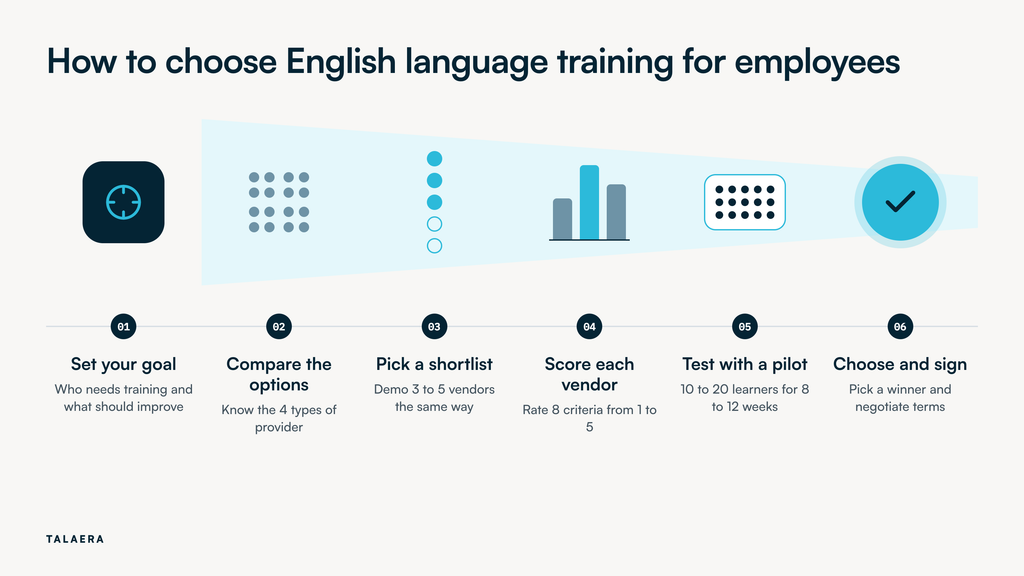
To choose English language training for employees, define the communication gaps you need to close, decide which type of provider fits your workforce, score three to five vendors on the same weighted rubric, screen out vendors with red flags, and run a pilot before you sign a full contract. The providers worth shortlisting tailor training to real work situations, offer more than one delivery format, and measure progress in ways your leadership will trust.
This guide is for HR, L&D, and People leaders at global organizations. It covers the full buying process in six steps, with a scoring template, the questions to ask in every demo, and the contract terms to negotiate. If you already know which vendors you want to compare, our side-by-side review of corporate language training platforms is a good starting shortlist.
Download the free vendor scorecard to score providers as you read.
Key takeaways
- Start with the business need. Most failed training investments trace back to buying before defining who needs what, and why.
- Business English training and general ESL solve different problems. Professionals who already speak English need to perform in meetings, presentations, and client conversations.
- Score every vendor on the same weighted rubric. It turns sales demos into a comparison you can defend to finance and leadership.
- Two red flags remove a vendor from your shortlist.
- Pilot before you commit. A short pilot with 10 to 20 learners shows whether a program works for your people, in your time zones, with your managers.
Step 1: Define the need before you talk to vendors
The most common buying mistake happens before the first demo. Without a clear internal brief, you end up comparing vendors against each other instead of against your own requirements, and the best sales deck wins.
Answer four questions first:
- Who needs training, and at what level? List the teams and roles in scope and assess current proficiency. A short, CEFR-aligned assessment gives you a baseline and shows whether you need one program or several tiers. Our guide on how to decide which employees need business English training walks through this.
- Which business outcome should improve? Tie each group to one measurable result, such as fewer escalations in customer support, more participation in global meetings, or clearer project updates from engineering.
- What are your constraints? Document time zones, work schedules, budget range, and whether the program must connect to your LMS or HRIS.
- What does success look like? Agree on it with the requesting manager before talking to vendors. Examples include assessment gains, manager-reported improvement, or a change in one team metric.
A simple way to sharpen the brief is to ask each requesting manager to rank the situations that matter most for their team: meetings, presentations, professional email and messaging, negotiations, or client calls. The top two or three become the core of your evaluation.
Why general ESL programs fall short for professional teams
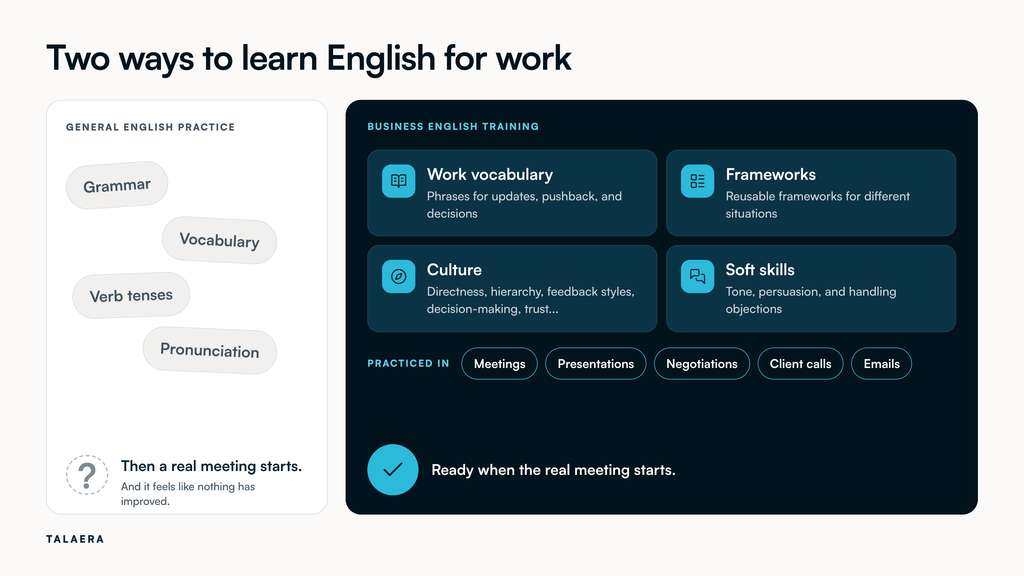
Many buyers discover that the bigger risk is choosing the wrong category of training. General ESL programs build foundational language: grammar, vocabulary, and everyday conversation. Business English communication training helps professionals perform in English in the situations their jobs depend on, such as leading a quarterly review, handling pushback from a senior stakeholder, or writing a project update that doesn’t need three rounds of edits.
General ESL programs teach people how to speak English. Business English communication training teaches professionals how to perform in English, in the meetings and negotiations their roles depend on.
The difference shows up quickly in practice. A software engineer in Berlin who presents technical proposals to U.S. stakeholders has moved well past conversational English. What they need is the ability to structure an argument, respond to objections, and adjust their style for a different business culture. Cambridge English surveyed 5,373 employers in 38 countries and found that the English skills employers need exceed the skills available in every industry they studied.
Culture is part of the same problem. Norms around directness, hierarchy, and feedback shape how a message lands as much as vocabulary does. Programs that treat language and cross-cultural communication as separate tracks miss how closely they’re connected at work.
Step 2: Understand the four types of English training providers
| Provider type | How it works | Best for | Main limitations | Typical pricing model |
|---|---|---|---|---|
| Tutor marketplaces | Learners book freelance tutors from a large online pool | Flexible scheduling and many languages on a budget | Uneven tutor quality, lighter reporting and LMS integration | Per lesson or credits |
| Enterprise language platforms | Full-service programs with curricula, account management, and integrations | Large organizations that need compliance tracking and many languages | Higher cost, longer implementation, less tailoring by role | Annual enterprise license |
| App-based and self-paced platforms | Employees learn independently through web or mobile apps | Broad rollouts where reach and cost matter most | Little live speaking practice, low completion without reinforcement | Per seat, per month |
| Specialized business communication providers | Training built around specific roles and workplace situations, often blending coaching and digital practice | Professionals who need to perform in English at work | Narrower language range than multilingual platforms | Per seat, per session, or hybrid |
Many organizations combine types, for example an app for foundational learners and a specialized provider for client-facing teams and leaders. Talaera sits in the last category, combining 1:1 coaching, live group courses, AI practice, and self-paced lessons for business English communication.
Three questions narrow the field quickly: How many learners are in scope? What is your budget per learner? Do employees need general proficiency or specific business communication skills? A company giving 2,000 employees in 15 countries basic access to English learning has different needs than one preparing 50 managers to run meetings in English.
Format matters as much as provider type. Live coaching, group classes, self-paced apps, and AI practice each do a different job, and most programs work best with a mix. Our comparison of live coaching vs. self-paced apps covers which format fits which learners.
Format matters as much as provider type. Live coaching, group classes, self-paced apps, and AI practice each do a different job, and most programs work best with a mix. Our comparison of live coaching vs. self-paced apps covers which format fits which learners.
Which type of English training is best for HR teams?
The best option depends on what matters most to your organization. Use this table as a quick guide, then score specific vendors in Step 4.
| If your priority is | Look for | Why |
|---|---|---|
| Fast, visible results for specific teams | Live coaching (1:1 or small group) combined with AI practice between sessions | Targeted feedback on real work situations moves skills fastest, and practice between sessions keeps momentum |
| The lowest cost per employee | App-based or self-paced platforms, with group sessions for key teams | The lowest per-seat price, though completion depends on structure and manager support |
| Flexibility across time zones | AI practice and self-paced lessons, plus live sessions offered in several time slots | Employees practice when it suits them, and live sessions add accountability |
| Engagement and motivation | Live sessions with a coach or peers, plus regular nudges and visible progress | Scheduled sessions with real people keep learners coming back |
| Personalized one-on-one support | 1:1 business English coaching matched by role and goals | Every session targets one person’s needs and upcoming situations |
| All of the above | A blended provider that offers these formats on one platform with one dashboard | One vendor, one contract, and one view of progress |
For named vendors and how they compare, see our review of corporate language training platforms.
Step 3: Build a shortlist and run consistent demos
Aim for three to five vendors. Fewer gives you little to compare, and more leads to demo fatigue. Source candidates from HR and People communities, peer recommendations, and review sites such as G2 and Capterra, filtered by company size and industry.
Ask every vendor the same questions in the same order. Consistency is what makes the scores comparable later. The rubric in Step 4 lists the questions for each criterion. Before the demo, also prepare:
- A real scenario from your business, such as a support escalation call or a monthly update to leadership. Ask the vendor to show how they would train for it.
- A request for a sample lesson plan or session tied to that scenario.
- A request for anonymized reporting from a client similar to you in size and industry.
If a vendor highlights AI features, ask what the AI actually does, what feedback it gives, and what L&D can see from it. Our guide to AI in corporate language training covers what to look for.
Step 4: Score vendors on a weighted rubric
A weighted rubric turns subjective impressions into a comparison you can present to stakeholders. Score each vendor from 1 to 5 on each criterion, multiply by the criterion’s weight, and add up the totals.
The eight evaluation criteria
| Criterion | What good looks like | Ask the vendor | Red flag if missing |
|---|---|---|---|
| 1. Needs assessment and placement | Proficiency testing plus analysis of each learner’s role and communication situations | “How do you assess learners at the start, and what do you measure beyond proficiency level?” | A package proposed before any discovery |
| 2. Business-context customization | Content built around real scenarios for your industry and roles | “Show us how you’d adapt training for our sales team versus our engineers.” | Generic catalog content only |
| 3. Coach quality and matching | Coaches with business experience, matched by role, industry, level, and goals | “How do you recruit, vet, and match coaches, and what happens if a match isn’t working?” | No clear vetting or matching process |
| 4. Measurable outcomes and reporting | Baseline and follow-up assessments, plus reporting tied to workplace behavior | “What would our executive dashboard show after 90 days?” | Attendance and satisfaction scores only |
| 5. Engagement and completion | Proactive nudges, flexible scheduling, and clear data on who is active | “What is your average completion rate, how do you define it, and how do you re-engage inactive learners?” | No engagement data or a vague definition of completion |
| 6. Delivery format and flexibility | A mix of 1:1, group, self-paced, and AI practice that works across time zones | “Can we use different formats for different teams, and what is your make-up policy for missed sessions?” | One format only, rigid scheduling |
| 7. Enterprise readiness and support | SSO, SCORM, LMS or HRIS integration, a dedicated contact, and capacity to scale | “Which systems do you integrate with, who supports our account, and what limits apply as we grow?” | Separate logins, ticket-only support, caps on growth |
| 8. Cross-cultural communication | Cultural norms built into training on meetings, feedback, and client work | “How does your training cover differences in directness, hierarchy, and feedback styles?” | Culture offered as a separate add-on or not at all |
On criterion 1: Proficiency frameworks like the CEFR measure language level. They don’t tell you whether someone can run a tense client call or present a budget request to a VP, which is why strong providers assess workplace communication too. Our article on CEFR levels and workplace readiness explains the difference. Talaera’s communication framework, for example, assesses observable behaviors such as clarity, structure, interaction, tone, and influence alongside language level.
On criterion 4: The Kirkpatrick model is a useful lens here. Ask whether the vendor measures only reaction and learning, or also behavior change at work and business results. Behavior and results usually need input from managers and your own team metrics, so agree on how that data will be collected before you start.
On criterion 5: Completion is where many programs quietly fail. Ask for engagement data from a client similar to you in size and industry. For reference, Talaera reports that 85% of learners are active within their first 30 days.
How to weight the criteria
Set weights before you see any demos so the scores reflect your priorities instead of whoever gave the most polished presentation. Two common patterns:
- If the goal is measurable skill improvement for specific teams, weight criteria 1 to 5 most heavily.
- If the goal is a global rollout across many regions, give more weight to criteria 6 to 8.
Scoring template
| Criterion | Weight | Vendor A (1 to 5) | Vendor B (1 to 5) | Vendor C (1 to 5) |
|---|---|---|---|---|
| 1. Needs assessment and placement | ||||
| 2. Business-context customization | ||||
| 3. Coach quality and matching | ||||
| 4. Measurable outcomes and reporting | ||||
| 5. Engagement and completion | ||||
| 6. Delivery format and flexibility | ||||
| 7. Enterprise readiness and support | ||||
| 8. Cross-cultural communication | ||||
| Weighted total | 100% |
Worked example: Your team weights content relevance at 2x and reporting at 3x. Vendor A scores 5 on content (5 × 2 = 10) and 3 on reporting (3 × 3 = 9), for a total of 19. Vendor B scores 4 on content (8) and 5 on reporting (15), for a total of 23. Vendor B ranks higher because it’s stronger on the criterion your stakeholders care about most.
Red flags that should remove a vendor from your shortlist
Watch for these during demos and proposals:
- No needs assessment. The vendor proposes a package before understanding your learners and goals.
- Vague or hidden pricing. You can’t get a ballpark figure until late in the process.
- No outcome measurement. Reporting stops at attendance and satisfaction surveys.
- One-size-fits-all curriculum. The same catalog for every client, with no tailoring by industry or role.
- No references or case studies. Only anonymous testimonials, or none at all.
- Pressure to sign an annual contract without a pilot.
- Opaque coach quality. No clear answer on how coaches are recruited, vetted, matched, or replaced.
- Rigid scheduling. No options for different time zones and no make-up policy for missed sessions.
One red flag deserves a follow-up question. Two or more from the same vendor should remove them from your shortlist.
Step 5: Run a pilot before you commit
A pilot turns vendor selection into a decision based on your own data. It also gives you the strongest evidence for the budget conversation that follows.
- Cohort: 10 to 20 learners across a mix of proficiency levels, roles, and regions. Avoid filling the pilot with only your most motivated learners or a single department. An engineer in São Paulo at an intermediate level faces different challenges than a project manager in Seoul with advanced English, and you want to see how the program handles both.
- Timeline: 8 to 12 weeks, with a firm decision date at the end. Agree on the review date before the pilot starts.
- Success metrics: Learner satisfaction with relevance to their work, before-and-after assessment results, engagement, manager-observed changes, and one business metric the team already tracks.
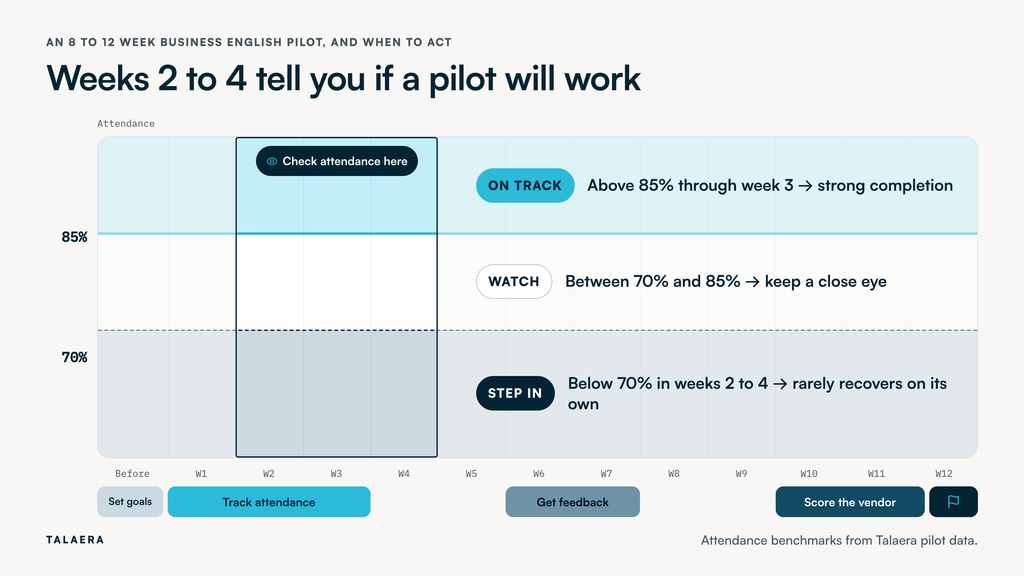
- Health checks along the way: Early attendance tells you where a pilot is heading. In Talaera pilots, cohorts that keep attendance above 85% through week 3 consistently reach strong completion, while attendance that drops below 70% between weeks 2 and 4 rarely recovers on its own. Ask any vendor which early signals they watch and what they do when a pilot falls behind.
- Feedback: Collect it at the midpoint and at the end from learners, their managers, and the vendor.
Brief participants’ managers before the pilot starts so they know what to look for, and give an executive sponsor visibility from the first week. When a senior leader has seen the results develop, the approval conversation moves much faster. If you want to compare two vendors directly, run them in parallel with the same cohort profile, metrics, and timeline.
Our pilot program design guide covers setup in more detail, and how to roll out language training employees actually complete covers the step after a successful pilot.
Step 6: Build the business case and recommend a vendor
Speak to each stakeholder’s priorities
| Stakeholder | What they care about | What to show them |
|---|---|---|
| CFO | Cost and return | Cost per learner, total annual cost, and the business metric the pilot moved |
| CHRO or Head of People | Talent development and retention | Learner feedback, engagement, and career-relevant skill gains |
| Business unit leaders | Team performance with clients and partners | Manager-observed changes and team-level results |
| IT and security | Integration and data protection | SSO, LMS or HRIS integration, and the vendor’s security documentation |
Tie the program to goals leadership already owns, such as expansion into new markets, customer satisfaction in specific regions, or faster onboarding of international hires.
Structure a one-page recommendation
- Business need: The problem, the teams affected, and what it costs today, such as delays, escalations, or rework.
- Evaluation summary: The vendors you reviewed and how they scored. Attach the completed scorecard as an appendix.
- Recommended vendor: Your top choice with two or three reasons tied to the rubric.
- Runner-up: A clear fallback option.
- Investment: Cost per learner per month and total annual cost.
- Expected outcomes: Each linked to a business metric, using pilot results where you have them.
- Next step and timeline: Usually a phased rollout with checkpoints.
Pilot results carry more weight than vendor benchmarks. Dialpad’s support team, for example, worked with Talaera on a scenario-based program and reported a 2.7% increase in CSAT and a 1.2% reduction in manager escalations. Results like these, from your own teams, make the strongest case. For a ready-made structure, see our employee training proposal guide.
How English training is priced, and what to negotiate
The four common pricing models
- Per seat: A monthly or annual fee per enrolled learner, usually covering platform access and digital content. Costs scale with headcount.
- Per session or per hour: You pay for each live 1:1 or group session. This is common for coaching-led programs.
- Enterprise license: A flat annual fee for broad access across the organization. This works for large rollouts but rarely makes sense for small cohorts.
- Hybrid: Platform access plus a set number of live sessions. This often gives the most flexibility for a mixed workforce.
Ask every vendor for a cost per learner per month and a total annual cost so you can compare different models side by side. For context, the Training Industry Report found that U.S. companies spent an average of $874 per learner on training in 2025, with large companies averaging $468 and midsize companies $782. Programs with live coaching often cost more per learner than that average, so frame the investment against the business outcome it supports.
What drives the price up or down
- Customization: Training built around your industry, roles, and scenarios costs more than off-the-shelf content.
- Format mix: 1:1 coaching costs the most per learner, group formats less, and self-paced and AI practice the least.
- Volume and term length: Larger cohorts and longer commitments usually lower the per-learner price.
Contract terms to negotiate
- A shorter first term, such as six months instead of twelve, for a new provider.
- Transferable licenses or sessions, so unused capacity can move to new learners as roles change.
- Pilot-to-rollout pricing, locking in per-learner rates if you expand after the pilot.
- Clear cancellation terms, including notice periods and early termination fees.
- Engagement support over the full term. Before signing a long-term contract, ask how the vendor keeps learners engaged after the first few months and what they do when activity drops.
Hidden costs to ask about
- Onboarding or setup fees on top of the quoted price.
- Separate charges for industry or company-specific content.
- Reporting and analytics locked behind a premium tier.
- Minimum seat commitments that leave you paying for unused licenses.
Your decision checklist
- Map learner needs to business goals, by team and role.
- Confirm you need business English communication training, general ESL, or both.
- Decide which provider types and formats fit your workforce.
- Shortlist three to five vendors and run the same demo for each.
- Score them on a weighted rubric and screen out red flags.
- Pilot with 10 to 20 learners and measure against agreed success criteria.
- Present a one-page recommendation and negotiate terms before full rollout.
Find the right fit for your team
The right English training program closes the specific communication gaps that slow your teams down, fits how they work, and gives you evidence your leadership will trust. Use the rubric and checklist above to compare providers on the same terms.
If your teams need to communicate with more clarity and confidence in English at work, book a demo with Talaera to see how our coaching, group courses, AI practice, and team analytics work together, or start with a free team assessment to see where your people stand. You can also download the vendor scorecard to run your own evaluation.
Frequently asked questions
How do you choose an English language training provider for employees?
Start by defining which employees need training, which business outcome should improve, and how you’ll measure success. Then shortlist three to five providers, run the same demo with each, and score them on a weighted rubric covering needs assessment, customization, coach quality, reporting, engagement, delivery formats, enterprise readiness, and cross-cultural communication. Pilot your top choice with 10 to 20 learners before committing.
How much does corporate English training cost?
Cost depends on format, customization, and scale. Self-paced and app-based programs cost the least per learner, 1:1 coaching costs the most, and blended programs fall in between. Most providers price per seat, per session, through an enterprise license, or as a hybrid. Ask every vendor for a cost per learner per month and a total annual figure so you can compare offers directly.
How is business English training different from general ESL?
General ESL builds foundational language skills like grammar, vocabulary, and everyday conversation. Business English training focuses on the situations professionals face at work, such as meetings, presentations, email, negotiations, and collaboration across cultures. Most employees in corporate programs already speak English at an intermediate level or above and need to communicate with more clarity and confidence.
How do you measure the ROI of English language training?
Measure at several levels: learner satisfaction, before-and-after assessment results, behavior change observed by managers, and at least one business metric such as customer satisfaction, escalations, or project delays. Set the baseline before training starts. Vendors should cover satisfaction and skill progress in their reporting, and behavior and business results usually need your managers’ input and your own team data.
How long does it take to see results from English training?
Learners often report more confidence within the first few weeks, and engagement data shows early on whether a program is working. Measurable gains in workplace communication usually take a few months of regular practice. A pilot is designed to show leading indicators like engagement, confidence, and manager-observed change before you commit to a full rollout.