
If you’ve ever stopped mid-sentence wondering whether to write “I’m doing this to help you” or “I’m doing this for you” — you’re not alone. TO and FOR are two of the most commonly confused prepositions in business English, and the mistake shows up everywhere: emails, presentations, Slack messages, client calls.
The good news? There are clear rules. Once you know them, you’ll write and speak with more confidence in every professional situation.
The difference between TO and FOR: Start with these 3 rules
Your grammar doesn’t need to be perfect to communicate effectively. But getting TO and FOR right removes a common source of confusion. Here’s where to start:
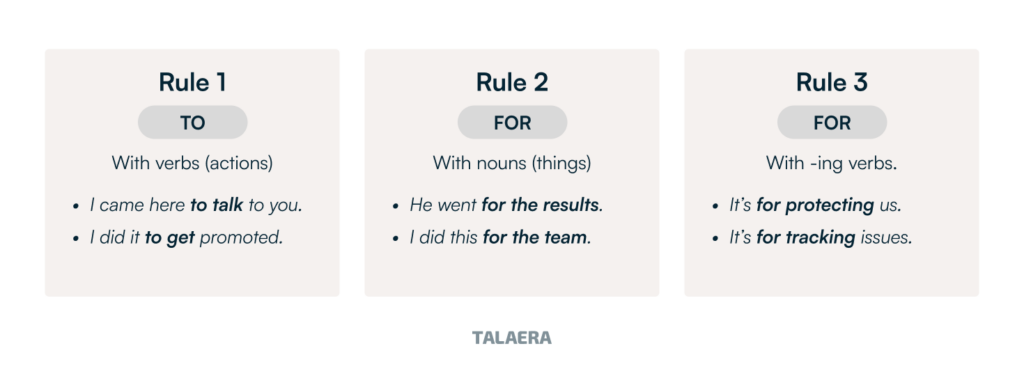
Rule 1: If there’s a verb (an action) → use TO + infinitive
- I emailed her to confirm the details. (confirm = verb/action)
- We restructured the team to improve collaboration. (improve = verb/action)
Rule 2: If there’s a noun (a person, thing, or idea) → use FOR
- He came for the onboarding session. (session = noun/thing)
- I did this for the client. (client = noun/person)
Rule 3: For definitions using “to be” → use FOR + verb-ing
- The checklist is for tracking deliverables.
- This clause is for protecting both parties.
Bonus rule: With verbs, you can use FOR + verb-ing, but if you can replace it with TO + infinitive, do it. It usually sounds more natural.
- Use this template for writing professional emails. ✓ → Use this template to write professional emails. ✓✓
- This tool is used for debugging the system. ✓ → This tool is used to debug the system. ✓✓
When to use TO
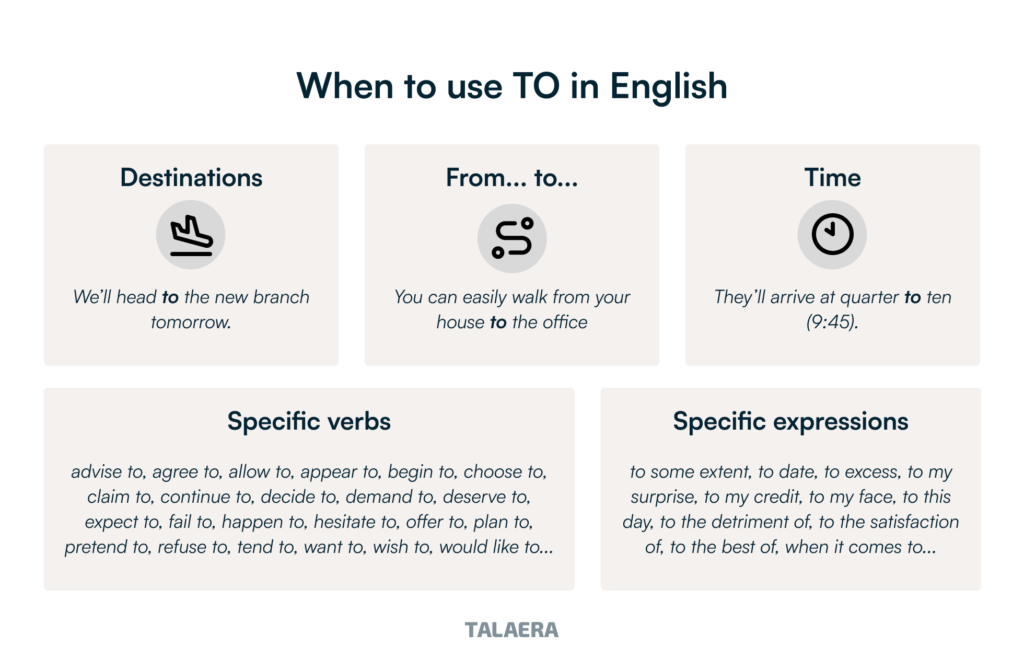
a. To indicate the destination or direction
We use TO when we indicate the destination, and usually there is movement involved. We often use verbs such as: go to, travel to, come to, head to, mail to, send to.
- Our CEO is going to Rome tomorrow.
- We’ll head to the headquarters in a second.
- I am traveling to our branch in Bristol next month.
b. In the structure “from … to …”
- It’s about 5km from my house to the university.
- I work from 5 to 9.
c. To tell the time (usually in the UK)
In the USA, it is quite common to tell the time by saying the hour + the minutes.
Examples:
- 5:30 – It’s five thirty.
- 8:50 – It’s eight fifty.
However, especially in the UK, it is very common to express how many minutes there are left until you reach the next hour, once it is 30 minutes after o’clock.
Examples:
d. Use TO with the following verbs
These verbs always take TO + infinitive — useful to know when writing professional emails or preparing for meetings:
| Verb | Example |
|---|---|
| agree | She agreed to present the findings. |
| advise | I’d advise you to review the contract first. |
| allow | We’re not allowed to share that data. |
| choose | The team chose to move forward. |
| decide | We decided to delay the launch. |
| expect | We expect you to lead the session. |
| hesitate | Please don’t hesitate to reach out. |
| hope | I hope to hear from you soon. |
| intend | We intend to finalize this by Friday. |
| invite | They invited us to join the pilot program. |
| manage | We managed to close the deal. |
| need | We need to align on priorities. |
| offer | She offered to take on the project. |
| plan | We plan to roll this out in Q3. |
| promise | They promised to deliver by Monday. |
| refuse | He refused to sign the NDA. |
| tend | She tends to over-explain in emails. |
| want | We want to finish this today. |
| would like | I would like to schedule a follow-up. |
e. Common TO expressions in business contexts
| Expression | Meaning | Example |
|---|---|---|
| to some extent | partly | I agree, to some extent. |
| to date | until now | No issues have come up to date. |
| to my surprise | unexpectedly | To my surprise, they accepted immediately. |
| to the satisfaction of | meeting expectations of | We resolved it to the satisfaction of the client. |
| to the detriment of | at the cost of | He focused on speed to the detriment of quality. |
When to use FOR
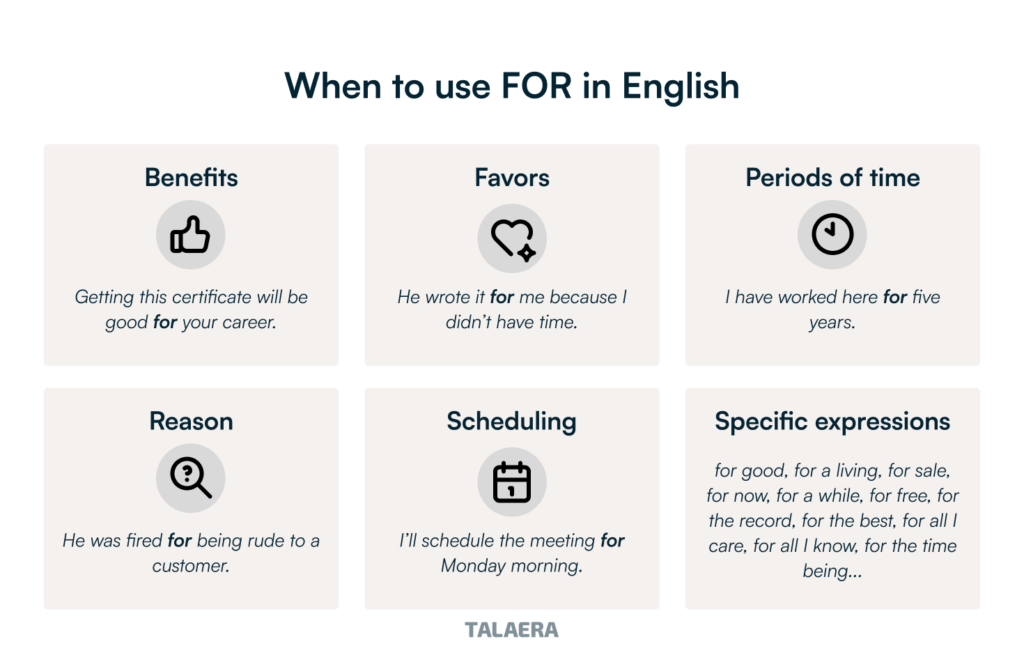
a. Expressing the benefits of something
- Getting this certificate will be good for your career.
- Fruits and vegetables are good for your health.
b. Doing a favor
- He picked up the mail for me.
- I didn’t know how to write the letter and she did it for me.
c. Giving a reason (replaceable with “for the reason of”)
- He was put on a performance plan for missing deadlines.
- She was recognized for improving team response times.
d. Periods of time (“for how long?”)
- I’ve worked in this role for three years.
- We were in the negotiation for two hours.
e. Scheduling something in the future
- I’ve set the kickoff for Thursday at 10am.
- Let’s schedule the review for next week.
f. Useful FOR expressions
| Expression | Meaning |
|---|---|
| for good | permanently |
| for now / for the time being | temporarily |
| for sure | definitely |
| for the record | to state officially |
| for free | at no cost |
| for a living | as a profession |
Confusing cases: TO or FOR?
When expressing goals
If you’re using a verb to express a goal, use TO + infinitive — not FOR + infinitive.
✗ I attended the workshop for improve my presentation skills. ✓ I attended the workshop to improve my presentation skills.
You can use FOR + verb-ing in some cases, but when in doubt, TO + infinitive is always safe.
“For you” vs. “To you” — what’s the difference?
This comes up constantly in professional writing, especially with verbs like send, give, write, and forward.
Use TO → when transferring something to a recipient
- I sent the report to you. (= You will receive it.)
- Can you forward this to the client?
Use FOR → when doing someone a favor
- I sent the report for you. (= You couldn’t send it yourself, so I did it.)
- I prepared the slides for her while she was traveling.
A quick test: ask yourself, “Is this person receiving something, or benefiting from something I did?”
- Receiving → TO
- Benefiting → FOR
Practice exercises with solutions
Fill the blanks with TO or FOR and then check your answers here.
- I am writing an email __ find out the details.
- We’re traveling __ Singapore in two months.
- I’ll set up our next meeting __ Monday.
- They came __ the results.
- He’ll head __ the new branch in the morning.
- You’re seeing Sue at the weekend, right? Can you give this present __ her?
- There are some good points, but also many negatives, so I only agree __ some extent.
- I have to prepare a report __ the meeting.
- I think they went a bit too far, but she was fired __ being late.
- This contract is only __ ensuring that your needs are covered.
- You can use this tool __ debug the system.
- He came quite early, at quarter __ five.
- She continued __ talk.
- Sarah sent the parcel __ me because I had the flu and couldn’t go out.
- They need __ provide all their details before we sign the agreement.
- I would love __ visit you in Rome.
- He’s super sweet, he picked up the parcel __ me.
- We always have happy hour on Fridays. The tradition started 10 years ago and it continues __ this day.
- The whole team was sad about the news – apparently he left the company __ good.
- Roy hasn’t got any money so I’ll have to pay the bill ___ him.
Answers: 1. to | 2. to | 3. for | 4. for | 5. to | 6. for | 7. to | 8. to | 9. for | 10. for | 11. to | 12. to | 13. to | 14. for | 15. to | 16. to | 17. for | 18. to | 19. to, for | 20. for
Hopefully, now you know the difference between these two prepositions, although having a teacher you can practice your grammar and speaking with is one of the most effective ways of learning a language. If you are interested in trying our online Business English training, you can do it for free. Get in touch!
Keep improving your Business English
Grammar is one piece of the puzzle, but communicating with clarity, confidence, and the right tone at work takes more than knowing the rules. At Talaera, we help non-native English speakers develop the business communication skills that actually matter on the job: writing emails that land, leading meetings with confidence, and navigating cross-cultural situations with ease.
Whether you’re looking to sharpen your skills independently or your organization wants to develop a global team, Talaera has a path for you:
- Talk to Tally: Practice business English anytime with Talaera’s AI coach, trained on tens of thousands of hours of real coaching sessions.
- Self-paced courses — Hundreds of practical lessons on emails, meetings, presentations, and more.
- 1:1 Business English coaching — Work with an expert instructor on exactly what you need, from high-stakes presentations to day-to-day communication.