Cultural intelligence predicts how well you’ll work across cultures far better than general knowledge of customs or languages. Professionals who develop it build trust faster, avoid costly miscommunications, and adapt without losing credibility. This article covers what CQ is, why it matters at work, and how to build it.
What is cultural intelligence (CQ)?
The traditional “treat others as you’d like to be treated” rule breaks down across cultures. Different cultural backgrounds carry different expectations about directness, hierarchy, timing, and relationship-building, and what feels respectful to you may register as rude or cold to someone else.
Cultural intelligence is the ability to interact effectively with people from different cultures. It involves understanding that cultural differences are real and consequential, and adapting your behavior without abandoning your own identity in the process.
Professionals with high cultural intelligence don’t know everything about every culture. What they do well is recognize when cultural friction is happening, stay curious about the cause, and adjust their approach quickly enough to keep the relationship intact.
Keep reading: 17 Essential Tips on American Business Etiquette

The four components of cultural intelligence
Researchers Ang, Van Dyne, and Livermore describe four distinct cultural intelligence capabilities, each measuring something different. Understanding where you’re strong and where you’re weak helps you target your development.
CQ-Drive
CQ-Drive is your motivation and confidence to function in culturally diverse settings. People with high CQ-Drive want to engage across cultures even when it’s uncomfortable, and they don’t avoid situations where they might get things wrong.
CQ-Knowledge
CQ-Knowledge covers what you actually know about cultural similarities and differences, including values, communication styles, and social norms. It goes beyond surface-level awareness of holidays and food to include the invisible frameworks that shape how people make decisions and interpret behavior.
CQ-Strategy
CQ-Strategy is how you make sense of unfamiliar cultural situations in real time. People with strong CQ-Strategy notice when their assumptions might not apply, pause before reacting, and adjust their mental model as they gather more information.
CQ-Action
CQ-Action is the ability to adapt your verbal and nonverbal behavior across cultural contexts. Knowing that a direct no is impolite in some cultures doesn’t help unless you can actually change how you respond when someone gives you an indirect answer.
Why cultural intelligence matters for global teams
Misalignments in global teams usually don’t come from bad intentions. They come from two people operating under different invisible assumptions about how professional interactions should work.
A manager who interprets silence as agreement, a colleague who reads a short email as hostility, a team member who treats a deadline as approximate because in their context it is: all of these are cultural intelligence gaps playing out in real time. When they go unexamined, they produce friction, eroded trust, and work that gets done twice.
Cultural intelligence matters in business because it shifts your default from “they’re being difficult” to “I’m probably missing something.” That shift changes how you respond, and it changes outcomes.
How culturally intelligent are you right now?
Assessing your own cultural intelligence honestly requires looking at several dimensions at once. On the knowledge side, the question is whether you actively seek out information about cultural norms beyond what you’ve accidentally absorbed. On the behavioral side, the question is whether you can actually adjust how you communicate when you’re in a high-stakes moment, not just when the stakes are low.
Most professionals overestimate their cultural intelligence in one of two ways. Some assume that because they’ve worked internationally or managed diverse teams, they’ve developed strong cultural awareness by default. Others know they lack knowledge but underestimate how much their behaviors are also shaped by unexamined cultural assumptions. Regular reflection on specific cross-cultural interactions, including the ones that felt awkward or went sideways, gives you better data than general self-assessment.
Ask yourself these questions:
- Awareness: Can you recognize differences and similarities across cultures? Are you aware of your own cultural biases and how they might impact your interactions with people from other cultures?
- Knowledge: Do you actively seek to understand the cultural norms, practices, and values of others? This includes both the observable aspects, like traditions and behaviors, and the unobservable ones, like beliefs and values.
- Empathy: Can you empathize with people from different cultural backgrounds, seeing things from their perspective without judgment?
- Adaptability: Are you able to adapt your communication style, behaviors, and expectations to fit various cultural contexts?
- Curiosity: Do you have a genuine interest in learning about other cultures, asking questions, and engaging in cross-cultural experiences?
- Respect: Do you show respect for different cultural perspectives and practices, even if they are vastly different from your own?
- Reflection: Do you regularly reflect on your cross-cultural experiences to gain deeper insights and improve your interactions?
- Flexibility. Are OK with being uncomfortable and not knowing everything? Can you make sense of unfamiliar situations and blend in?
Cultural intelligence is not about knowing everything about every culture. What matters more is to be aware of your own cultural lens, showing respect and empathy towards other cultures, and being willing to learn and adapt. It’s a continuous journey, one that enriches both our personal and professional lives.
So, take a moment to reflect: How culturally intelligent are you? And more importantly, how willing are you to grow in this area?
Examples of cultural intelligence
Let’s look at some examples that showcase how individuals or organizations can successfully navigate the complexities of cross-cultural interactions.
Cultural intelligence in team management:
A project manager leading a diverse team understands that cultural differences can impact team dynamics. They employ cultural intelligence by acknowledging these differences and adapting management styles accordingly. For instance, some team members may value individual recognition, while others prefer collective achievements. The manager tailors their approach to motivating each team member effectively, fostering a cohesive and productive environment.
Cultural intelligence in negotiations:
In a global company, executives from different countries come together for a negotiation. A culturally intelligent approach involves each party researching the others’ cultural backgrounds, communication styles, and business etiquette. For example, in some cultures, direct conflict or disagreement is avoided during discussions, while in others, it’s common. Understanding and respecting these nuances can lead to more effective negotiations and stronger business relationships.
Cultural intelligence in customer service:
In a customer service setting, a representative demonstrates high cultural intelligence by recognizing and adapting to the diverse cultural backgrounds of customers. They may encounter customers who have different expectations about communication, timeliness, or problem resolution. Understanding these cultural differences and responding in a culturally sensitive manner enhances customer satisfaction and loyalty.
Cultural intelligence in global virtual teams:
In a virtual setting, team leaders and members practice cultural intelligence by being mindful of time zones, language barriers, and communication preferences. They use inclusive meeting practices and technology tools that accommodate everyone, ensuring effective collaboration and team cohesion.
These examples highlight the importance of cultural intelligence in various aspects of work and life. By understanding and adapting to cultural differences, individuals and organizations can build more effective, respectful, and collaborative relationships across cultures.
How can you increase your cultural intelligence?
Working across cultures can be challenging, but there are ways to increase your cultural intelligence. By understanding and respecting cultural differences, you can build trust and communication with people from other cultures.
Three sources of cultural intelligence: Head, Body, Heart
An influential HBR article identified three components of developing cultural intelligence: Head, Body, and Heart.
- The head refers to the cognitive means that will help you develop your cultural intelligence: learning about your own and other cultures and understanding cultural diversity.
- The body, or physical means, is about taking that knowledge and transforming it into actions. You understand that when your actions coincide with those of the other culture, it is easier to build trust and create openness. You demonstrate cultural understanding through body language, gestures, greetings, etc.
- The heart is the motivational means that helps you develop your cultural intelligence. It is about gaining the confidence and motivation to interact with other cultures. You are not afraid to make mistakes because you know that you have good intentions and you are willing to learn from your mistakes.
10 ways to develop cultural intelligence
Developing cultural intelligence doesn’t require a formal program. Most of the work happens through deliberate attention during interactions you’re already having.
1. Understand your own cultural background
Before you can read cultural differences accurately, you need to understand what you treat as “normal” by default. Read about how your own culture is typically perceived from the outside. Most people are surprised by how much of what feels like personal preference is actually cultural conditioning. Read more about your own culture and how it is usually perceived by others.
2. Make an effort to learn about other cultures.
Be curious about the customs, values, and beliefs of other cultures. Learn about them and how they differ from your own. This will help you understand and respect differences. Read books, watch films, and talk to people from different cultures to gain a better understanding of their customs and beliefs. When you travel, talk to the locals, and pay attention to their habits, behaviors, and foods.
3. Seek out opportunities to interact with people from other cultures.
Whether in person or online. Travel, work, or volunteer in another country. Join a club or group that celebrates diversity.
4. Try to become more aware of your own cultural biases and assumptions.
Take a cultural intelligence assessment and reflect on your own thoughts and behaviors.
5. Keep an open mind.
Thinking that our way of doing things is “normal” and “the correct way” is an all-too-common mistake. To be successful in cross-cultural interactions, you need to be open-minded and willing to accept that there are different ways of doing things. Don’t try to force your own culture on others – instead, learn about their culture and try to see things from their perspective.
6. Be flexible.
One of the most important aspects of cultural intelligence is flexibility. Things will often not go as planned in cross-cultural interactions, so you need to be able to adapt and adjust your behavior accordingly.
7. Be patient.
Don’t expect others to immediately understand your culture or point of view. Allow time for learning and adjustment.
8. Communicate effectively.
Good communication is essential for successful cross-cultural interactions. Learn how to effectively communicate across cultures. Make sure you are clear and concise in your communication and be aware of potential language barriers.
9. Focus on building relationships.
Building relationships is key to success in cross-cultural interactions. Get to know people from other cultures, and show them that you are interested in their culture and way of life. Always adopt a curious approach, never a judgemental one. When you build genuine relationships with people from other cultures, they will likely be more forgiving of any faux pas.
10. Learn a new language.
When you learn a new language, you discover multiple correct ways of expressing the same idea. Speaking other languages rewires your brain and helps you understand other cultures and other ways of thinking.
By increasing your cultural intelligence, you’ll be better equipped to work across cultures and build strong relationships with people from all backgrounds.
Cultural intelligence in action! Working across cultures framework
Now that you know what CQ is all about and how to increase it, let’s see what being culturally intelligent looks like in action. Feel free to use this framework when you approach an unfamiliar situation.
The first step is to look inward. Run a mindset checklist and make sure you are approaching the situation with the right mentality. Then, look outward. To make sense of unfamiliar situations, you may have to ask questions. We’ll look at some quick tips to do so in cross-cultural interactions.
Run a mindset checklist
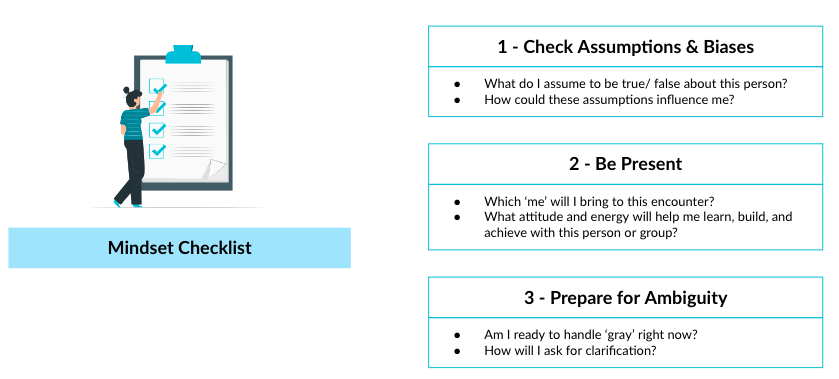
The first step is to look inward. Ask yourself the following questions.
- Check assumptions and biases: What do I assume to be true/false about this person? How could these assumptions influence me?
- Be present: Which ‘me’ will I bring to this encounter? What attitude and energy will help me learn, build, and achieve things with this person, group, or culture?
- Prepare for ambiguity: Am I ready to handle ‘gray’ right now? How will I ask for clarification?
What’s most important – remember that human beings are complex. Our minds tend to put people in boxes as it helps us make sense of reality. But keep in mind that we all belong to multiple categories (or boxes) and have a wide range of characteristics. Individuals do not (and should not) represent their entire culture or country.
Instead, approach unfamiliar situations with an open mind and curiosity. Read and learn about other cultures but forget about stereotypes. Even if there might be some truth behind some stereotypes, remember that they are oversimplified and fixed ideas about a particular group of people and it can be dangerous to rely on them.
Asking the right questions
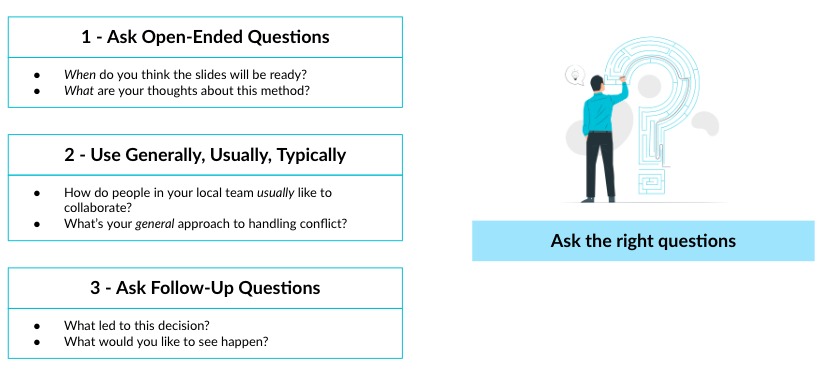
Once you’ve completed your mindset checklist, you are ready to look outward and ask questions. We talked about asking better questions in a previous episode, but here’s a quick summary:
- Ask open-ended questions: instead of “Will the slides be ready tomorrow?” try “When do you think the slides will be ready?”
- Use generally, usually, typically: generalize and de-personalize questions to avoid putting people on the spot. For example, “How do people in your local team usually like to collaborate?”
- Ask follow-up questions: keep digging with follow-up questions like, “What led to this decision?” or “What would you like to see happen?”
Strengthen your cultural intelligence
Cultural intelligence develops through attention and practice, not through accumulated knowledge alone. When you understand that silence, directness, timing, and relationship-building carry different meanings across cultures, you gain the ability to diagnose friction before it becomes conflict. The professionals who work most effectively across cultures aren’t the ones who never make mistakes. They’re the ones who recover faster because they’re paying closer attention.
Frequently asked questions about cultural intelligence
What is the difference between cultural awareness and cultural intelligence?
Cultural awareness means knowing that cultural differences exist. Cultural intelligence goes further: it’s the ability to adapt your behavior, thinking, and communication in response to those differences. Awareness is passive; CQ is active and situation-specific.
Can cultural intelligence be measured?
Yes. Formal CQ assessments measure all four capability areas: drive, knowledge, strategy, and action. These tools give professionals specific feedback on where their cross-cultural competence is strong and where it breaks down under pressure.
How long does it take to develop cultural intelligence?
CQ develops over time through deliberate practice and reflection, not through a single training or trip abroad. Professionals who actively reflect on cross-cultural interactions and seek out diverse experiences typically show measurable improvement within months, though the development continues throughout a career.
Can cultural intelligence be trained in a professional setting?
Yes. CQ develops through structured learning, reflection, and practice, and it responds well to coaching and group training when the content is grounded in real workplace scenarios rather than abstract theory. The most effective programs combine cultural frameworks with language skill-building, since how you communicate is inseparable from how you come across across cultures. Talaera’s business English and cross-cultural communication training is designed specifically for international teams who need both.
How can organizations build cultural intelligence across their teams?
Team-level CQ develops when individuals get consistent exposure to cross-cultural frameworks alongside opportunities to practice in realistic professional contexts. One-off workshops help, but lasting change comes from ongoing development embedded in how teams actually work. Organizations that train communication skills and cultural awareness together tend to see faster results than those that treat them as separate programs.