Intercultural conflict at work usually starts when people bring different expectations about how to disagree and decide, and nobody says those expectations out loud. Good intercultural conflict resolution means matching your response to the type of conflict, such as listening for meaning when signals get misread or finding a compromise when a decision gets stuck.
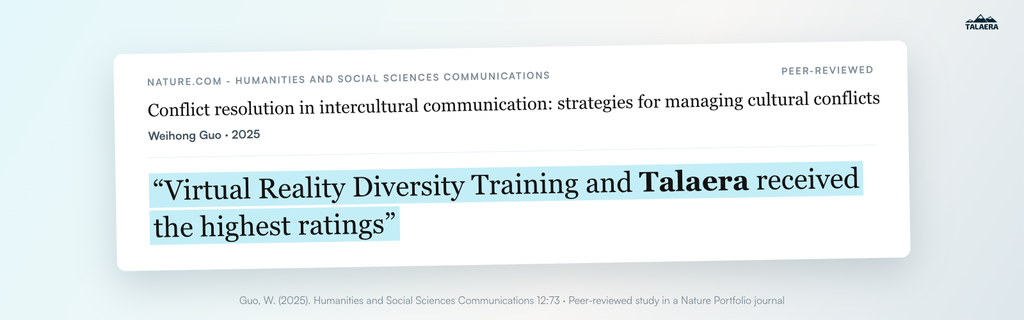
A 2025 peer-reviewed study published in Humanities and Social Sciences Communications, a Nature Portfolio journal, found that professionals using specific conflict strategies and online training tools performed better in simulated workplace conflicts. Talaera was one of the two highest-rated online training tools evaluated, with 58% of participants rating it as highly useful.
What causes intercultural conflict at work?
Intercultural conflict happens when people read the same behavior through different cultural expectations.
A direct “no” can sound efficient to one colleague and rude to another, and a pause before an answer can mean careful thought or quiet disagreement. Working in a second language adds another layer, because a short message can come across as cold and silence in a meeting can be mistaken for agreement. In the 2025 study, participants pointed to personality traits (48%) and attitudes and beliefs (33%) as the main sources of conflict, followed by adaptability (15%) and emotions and perceptions (14%).
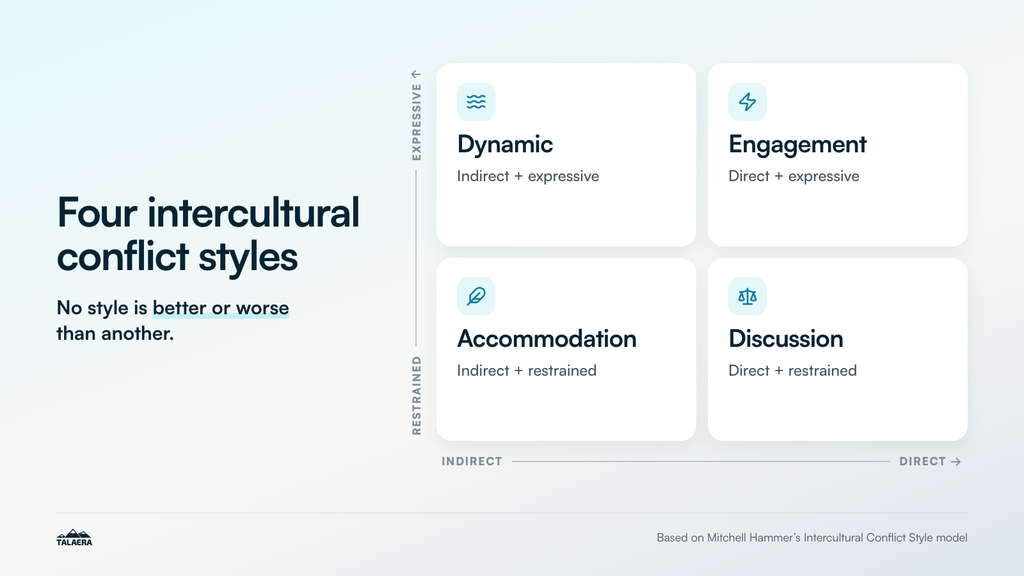
Erin Meyer’s research on disagreement places cultures on a scale from confrontational to confrontation-avoiding. Open debate shows engagement at one end of that scale and can threaten group harmony at the other. Mitchell Hammer’s Intercultural Conflict Style model looks at how directly people say what they mean and how openly they show emotion, and it sorts people into four styles called discussion, engagement, accommodation and dynamic. Both frameworks describe tendencies across groups, so use them to make sense of a colleague’s behavior and avoid using them to predict it.
What a 2025 study found about intercultural conflict resolution
Does intercultural conflict training work? A 2025 study in Humanities and Social Sciences Communications, a Nature Portfolio journal, suggests it helps. Weihong Guo of Shandong Management University tested conflict strategies with 146 professionals at the China World Trade Center in Beijing. Half of them handled simulated intercultural conflicts on instinct, with minimal instructions, while the other half used specific strategies and online training tools.
The group using specific conflict strategies scored an average of 75 on conflict resolution, compared with 70 for the group acting on instinct, a statistically significant difference.
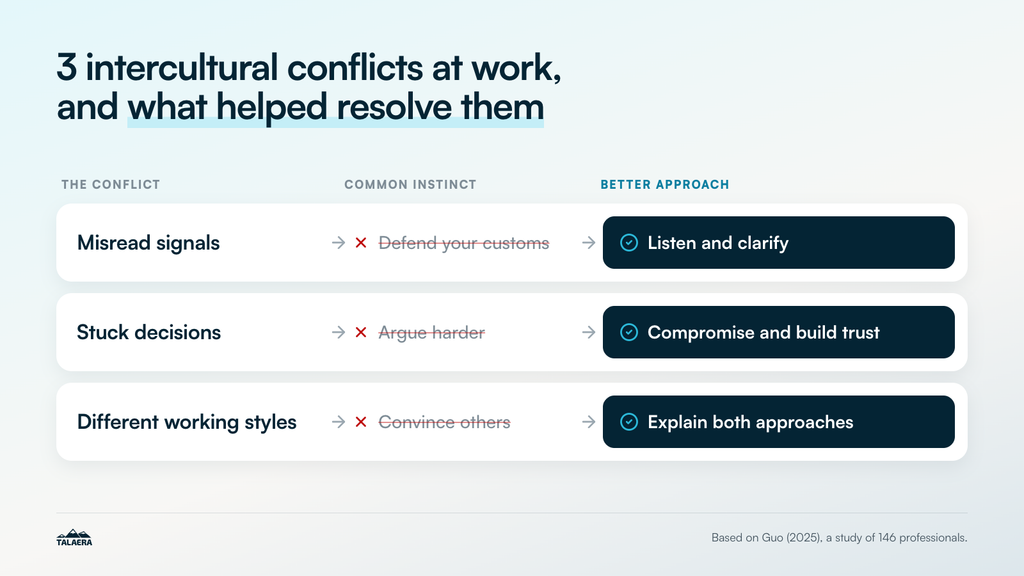
| Type of conflict | What people did on instinct | What the higher-scoring group did |
|---|---|---|
| Misread gestures, symbols or signals | Justified or explained their own traditions | Listened actively and cooperated |
| No agreement on a decision | Relied on arguments or authority | Looked for a compromise or built the relationship |
| Individual vs. collective ways of working | Tried to persuade others to adopt their view | Explained the advantages of both approaches |
Like any study, this one has limits. It took place in one business center with volunteer participants, and the conflicts were simulated. Because the strategy group also received extra explanations and tools, the better results can’t be credited to the strategies alone.
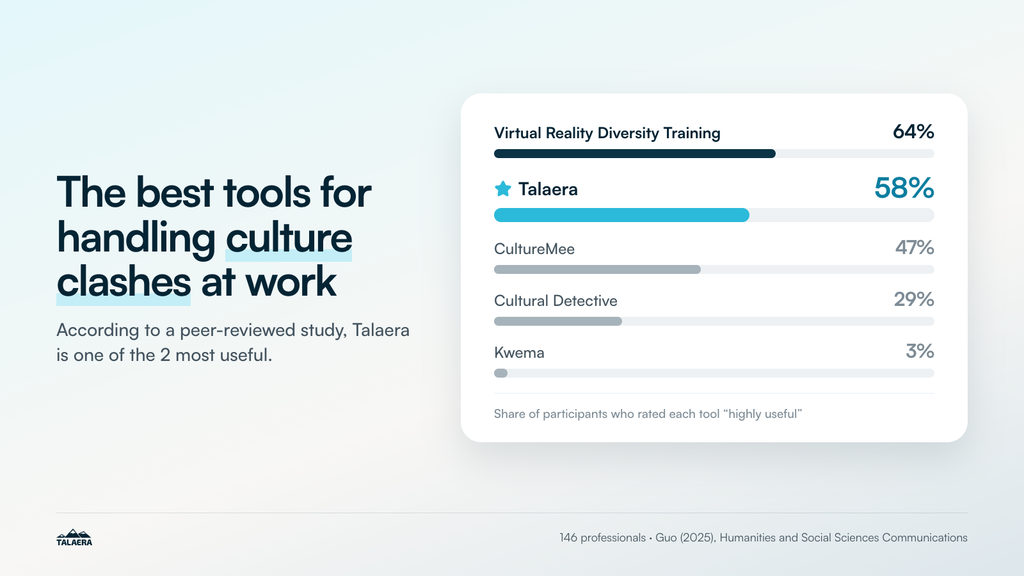
Talaera was among the highest-rated intercultural training tools
The study also evaluated five online intercultural training tools. Talaera ranked second, with 58% of participants rating it as highly useful, behind Virtual Reality Diversity Training at 64%. The other tools received lower ratings: CultureMee (47%), Cultural Detective (29%), and Kwema (3%).
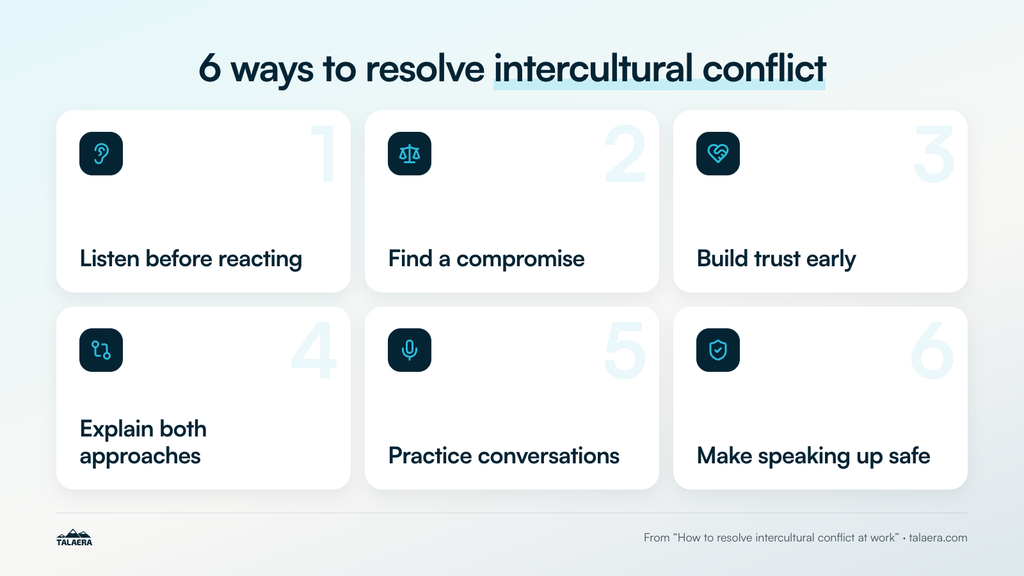
Each of the six strategies below builds on the study’s three approaches and on what participants said they found hardest.
1. Listen for meaning before you respond
When a message or a gesture feels wrong, find out what the other person meant before you react. In the study, the higher-scoring group used active listening and cooperation for this type of conflict. People acting on instinct explained their own customs instead.
Take a product manager who posts a one-line reply in the team chat that says “This won’t work. Let’s go back to the old version.” A colleague who expects more context reads it as dismissive and stops contributing for the rest of the week. The product manager meant it as a quick, practical update.
Either person could fix this by describing what they noticed and how they understood it, then asking what the other person meant. After that, they can agree on what would work better next time, such as adding one line of reasoning to short replies. Our guide to avoiding cultural misunderstandings shows how the same words can carry different meanings. These four phrases help you check meaning without sounding defensive.
- To check your reading: “When you said X, I understood Y. Is that what you meant?”
- To own a possible misread: “I may have read your message the wrong way. What did you have in mind?”
- To learn how the team works: “Can you help me understand how this usually works on your team?”
- To agree on next time: “What would make these updates easier to follow on your side?”
2. Look for a compromise when a decision gets stuck
When a team can’t agree, look for a trade that both sides can accept. Without a strategy, people tried to settle decisions with stronger arguments or their authority. The higher-scoring group used compromise.
A common example is a project team where half the people want to decide in the meeting and move on, and the other half want time to check with their stakeholders first. One workable compromise is to agree on the direction in the meeting and confirm the details by Thursday, once everyone has consulted their teams.
Erin Meyer also recommends short pre-meetings, which give people who prefer to consult before committing a chance to prepare. Asking “What would you need to feel comfortable with this decision?” opens the door to a trade, and “If we go with your approach on the timeline, could we try mine on the budget?” puts one on the table. Our guide on how to respectfully disagree at work has more phrases.
3. Build the relationship before the hard conversation
People find disagreement easier to accept from someone they trust. Guo’s higher-scoring group paired relationship-building with compromise for decision conflicts. Meyer notes that the same disagreement feels less confrontational when people have a strong relationship.
A new cross-border team might spend its first month escalating small disagreements to their managers. Often, nobody on the team has talked about anything except deadlines. Without that foundation, a comment about someone’s work can sound like criticism.
Short one-on-ones early in a project, before anything goes wrong, give you a chance to ask how people prefer to work and receive feedback. When a hard conversation does come, reconnect with the person before you raise the issue. The lesson Building Trust Across Cultures covers this in more depth, and these phrases help you start on good terms.
- To reconnect first: “Before we get into the issue, how’s the week going on your side?”
- To learn their style: “I’d like to understand how you prefer to work, so we can avoid friction later.”
- To show good intent: “I value working with you, and I want us to get this right.”
4. Explain the logic behind each working style
When people disagree about how to work, explain why each approach makes sense before you choose one. Guo called this an education strategy and used it when people clashed over individual and collective ways of working. Those acting on instinct tried to win others over to their own style.
Consider a sales team where some reps want individual targets and individual credit, while others prefer shared targets and group decisions. The first group sees the second as slow, and the second sees the first as self-interested. A manager can reset the discussion with “Both approaches have advantages. Which one fits this project better?”
Start by describing both approaches in neutral terms, or say “Here’s why I usually work this way. I’d like to hear why you prefer the other approach.” Individual ownership makes accountability clear and speeds up decisions, while collective work spreads knowledge and builds support for the outcome. Once you’ve decided together which approach fits this project, write the decision down as a team norm so nobody has to argue it again. Meyer also suggests explaining your own behavior, for example by saying “Let me play devil’s advocate for a minute to test this idea” before you challenge someone directly. Our guide to individualism and collectivism in global teams goes deeper.
5. Practice difficult conversations before they happen
Using a strategy in a tense conversation is harder than knowing it. In the study, 29% of participants said applying new strategies was their biggest difficulty, and people in the group acting on instinct asked for more practical exercises and training.
Say a team lead needs to tell a peer that their part of a project is behind schedule. This peer prefers indirect feedback, and the team lead tends to be blunt. If the team lead goes in unprepared, the conversation could damage a working relationship that took months to build.
Before the conversation, the team lead can script the first two sentences, since that’s where tone matters most. Role-playing it with a coach or an AI practice tool helps, ideally with someone who will push back. Our course Agree and Disagree With Confidence at Work includes practice for these moments, and these opening lines are a good place to start.
- To ask for the conversation: “I’d like to share some thoughts on the timeline. Is now a good time?”
- To raise the issue gently: “One area where I think we could improve is the handoff to the client team.”
- To move to next steps: “What would help you get this back on track?”
6. Lower the stress around speaking up
Uncertainty about one’s own abilities was the most common difficulty in the study, reported by 37% of participants, and another 15% reported emotional stress. When people feel unsure, they often keep disagreement to themselves, and it can return later as a bigger problem. Think of a senior engineer who works in English as a second language and rarely disagrees in meetings. After the team has committed to a plan, she sends a private message with serious concerns about it.
Someone who hesitates over their English may still be the person who knows the system best. Treat language confidence and expertise as separate things.
Managers can create moments where speaking up feels safe and expected. Sharing the agenda before the meeting gives people time to prepare, and a written option such as “Take a day to think about it and send me your thoughts in writing” helps people who think better in writing. Asking specific people for input also helps, for example “You know this system better than anyone here. What risks do you see?” A team norm such as “Before we decide, I’d like to hear from everyone who hasn’t spoken yet” makes this routine, and Meyer suggests collecting ideas anonymously so the team debates the idea instead of the person who proposed it. For the other side of this conversation, see assertiveness across cultures.
Match your response to the conflict and keep practicing
Research suggests that choosing the right strategy for the conflict can improve how people handle difficult conversations. For global teams, that means practicing these situations regularly, especially when people work in English as a second language. L&D teams can measure progress by scoring how people handle the same conflict scenarios before and after training.
Talaera was among the highest-rated training tools in the study. Separately, our own analysis of about 100,000 coaching sessions shows how frequently these situations arise.
Feedback conversations are the third most common coaching scenario. Difficult conversations and conflict come up in 1,025 of those sessions. One learner described speaking up in a weekly sales meeting and getting the team’s sales target changed to a more reasonable figure, “which never happened before as [I lacked the] confidence to express disagreement.”
Talaera helps global teams build these skills through 1:1 coaching with expert coaches, group courses, self-paced courses and AI speaking practice. According to Talaera platform data, more than 8,600 learners have opened our culture and etiquette lessons. If your teams work across cultures, book a demo to see how training could work for them, or read about our cross-cultural communication training.
Frequently asked questions
What is intercultural conflict resolution?
Intercultural conflict resolution means working through disagreements that come from different cultural expectations about how to disagree and decide. In practice, you match your response to the type of conflict. For example, you listen for meaning when signals get misread or look for a compromise when a decision gets stuck.
Does intercultural conflict training work?
A 2025 peer-reviewed study suggests it helps. Professionals who used specific conflict strategies scored an average of 75 on conflict resolution, compared with 70 for those who acted on instinct. The conflicts were simulated and the study took place in one business center, so the result has limits.
How can managers help non-native speakers disagree in meetings?
Share the agenda before the meeting so people can prepare, and offer a written option for people who think better in writing. Ask specific people for their input and agree on a team norm such as “we hear from everyone before we decide.” Treat language confidence and expertise as separate things.
Was Talaera evaluated in the 2025 intercultural conflict study?
Yes. Talaera was one of five online training tools evaluated in Guo’s 2025 peer-reviewed study of 146 professionals. It received the second-highest usefulness rating, with 58% of participants rating it as highly useful.
About the author

Paola Pascual is Marketing & Content Director at Talaera, where she leads the company’s content and hosts the Talaera Talks podcast. She holds a master’s degree in organizational psychology, has a background in translation and linguistics, and has lived and worked in six countries. Her writing on communication in global teams has also appeared in Training Industry. Connect with Paola on LinkedIn.