Deciding who should receive business English training is harder than sorting employees by seniority or sending everyone below a certain CEFR level to class. A better question is: where is a communication gap creating the most friction or risk, and what kind of support would actually help?
One recent Talaera prospect with an international engineering team captured the distinction well. He wasn’t looking for “English lessons.” He needed his engineers to “communicate better in English at work.” Those two things are not the same. The employee who struggles to clarify requirements in a global project meeting may need more support than someone with a lower English level who rarely uses the language at work. Two employees with similar roles and proficiency can still need completely different training if one struggles with spontaneous speaking while the other needs help writing clearly.
The framework below helps you prioritize employees across four areas: English exposure and role context, communication risk, current capability, and business importance. From there, you can choose the right mix of 1:1 coaching, group training, AI practice, and self-paced learning.
Why job titles and CEFR scores alone won’t tell you who needs business English training
Most companies default to one of two shortcuts when allocating corporate language training. They assign coaching by job title (“all directors get 1:1 sessions”) or group employees by CEFR level (“all B1s go into the same class”). Both approaches waste budget. A product manager who communicates only with internal teams has fundamentally different training needs than a sales director pitching to global clients, even if they share the same seniority band. CEFR-level-only grouping tells you how well someone speaks English but nothing about how much that proficiency gap costs the business.
The missing variable is communication risk, the potential business cost when an employee’s English falls short in a specific interaction. Consider two employees, both assessed at B1. One is an analyst writing internal summaries read by bilingual colleagues. The other is an account executive negotiating a six-figure contract with a monolingual English-speaking client. The proficiency score is identical, yet the stakes differ enormously. When you decide how to allocate training, that risk gap should drive the investment difference. According to Training Magazine, average per-learner training spend dropped to $774 in 2024, down from $954 the year before. With budgets tightening, directing those dollars toward low-risk roles while under-serving high-risk ones is a mistake you can’t afford.
According to Talaera’s 2026 internal platform analytics, Human Resources, Finance, and Engineering are some of the largest job categories among its learners, and they span more than 15 job functions. Most workplace communication needs are much more ordinary than an executive presentation: explaining an idea, clarifying a request, handling a difficult conversation, contributing to a meeting, or responding clearly when someone asks an unexpected question.
CEFR assessment still matters. You need a baseline capability score as one input into your segmentation. A solid training needs analysis captures proficiency alongside role context and business exposure. But proficiency alone isn’t the decision. One-size-fits-all programs spread budget evenly across the workforce, which means low-impact learners consume resources that high-impact employees need more. That is why proficiency should be one input into the decision, rather than the decision itself. The framework that follows scores each employee on four axes so you can defend every allocation decision with data, not defaults.

Four factors to consider when prioritizing business English training
A corporate language training strategy should segment employees along four axes before assigning any training format.
1. English exposure and role context
Start with what the employee actually does in English. How often do they use it? With whom? Through which channels? In what situations?
Someone who joins global meetings every day has a very different communication environment from someone who occasionally reads English documentation. An HR business partner handling employee conversations across regions has different needs from an engineer explaining technical decisions to colleagues, even if both are internal-facing.
Look beyond labels such as “client-facing” and “internal.” Ask about the moments that repeatedly create difficulty.
Across Talaera Connect, our weekly speaking club, sessions in June and July 2026, practice themes included pushing back and adjusting deadlines, giving concise status updates, handling unexpected questions, prioritizing competing demands, and persuading someone to try an idea. These are useful examples of the everyday communication situations that can reveal a training need more accurately than a job title.
2. Communication risk
Next, ask what happens when communication breaks down. Communication risk is the financial or reputational cost your company absorbs when an employee’s English fails at a critical moment. Examples include a lost deal, a misunderstood compliance clause, or a botched client presentation. This axis measures business exposure, not employee confidence.
Consider two employees, both assessed at B2 on the CEFR scale. One is a sales director negotiating a $500K contract who stumbles through pricing objections because they can’t articulate value propositions with precision. That miscommunication costs real revenue. The other is a data analyst who misspells a word in an internal Slack thread. Same proficiency band, but the business consequences aren’t comparable. Research from the Economist Intelligence Unit and others estimates that communication failures cost large companies millions annually in lost productivity, missed deals, and rework. When you score employees on communication risk, you’re quantifying which failures your organization can absorb and which it can’t afford.
3. Current capability for the communication the role requires
CEFR gives you a proficiency band, but it doesn’t capture everything that matters in workplace communication. Two B2 speakers can have dramatically different training needs. One might write polished proposals but freeze during live Q&A sessions. Another might lead meetings with ease but produce emails full of ambiguity. Confidence, cultural fluency, and context-specific skills like presenting to executives or handling objections all sit outside a standard proficiency score.
Talaera’s Communication Framework breaks communication into more than 500 observable micro-skills across five areas:
- Foundations: vocabulary and grammar
- Expressing Ideas: clarity and structure
- Understanding Others: listening and interpreting intent
- Conversation Skills: skills such as turn-taking, clarifying, and interrupting
- Culture & Context: directness, hierarchy, feedback styles, and other workplace norms
4. Business importance and urgency
The framework is designed to move assessment beyond a general proficiency level and toward the communication behaviors a particular role requires. This distinction matters because two employees at B2 can look completely different at work. One may write excellent emails but struggle when speaking without preparation. Another may speak fluently but ramble, miss indirect cues, or find it difficult to structure complex ideas. So when you assess capability, measure the gap between what an employee can currently do and what their role requires them to do, rather than treating the CEFR level itself as the gap.
Some employees sit on the leadership pipeline, manage key accounts, or are entering new markets where English is the working language. Their improvement carries outsized ROI because it directly accelerates revenue, retention, or expansion goals. Others occupy stable roles with no imminent English-dependent milestone on the horizon.
Urgency changes the training decision too. Someone who needs to handle a difficult customer meeting next month may benefit from intensive practice around that particular situation. Someone gradually taking on more global responsibilities can build the same capability over a longer period.
This prevents seniority from becoming a proxy for importance. The question is not “How senior is this employee?” It is “How important is effective English communication to what this employee needs to accomplish?”
How to score and decide which employees need business English training first
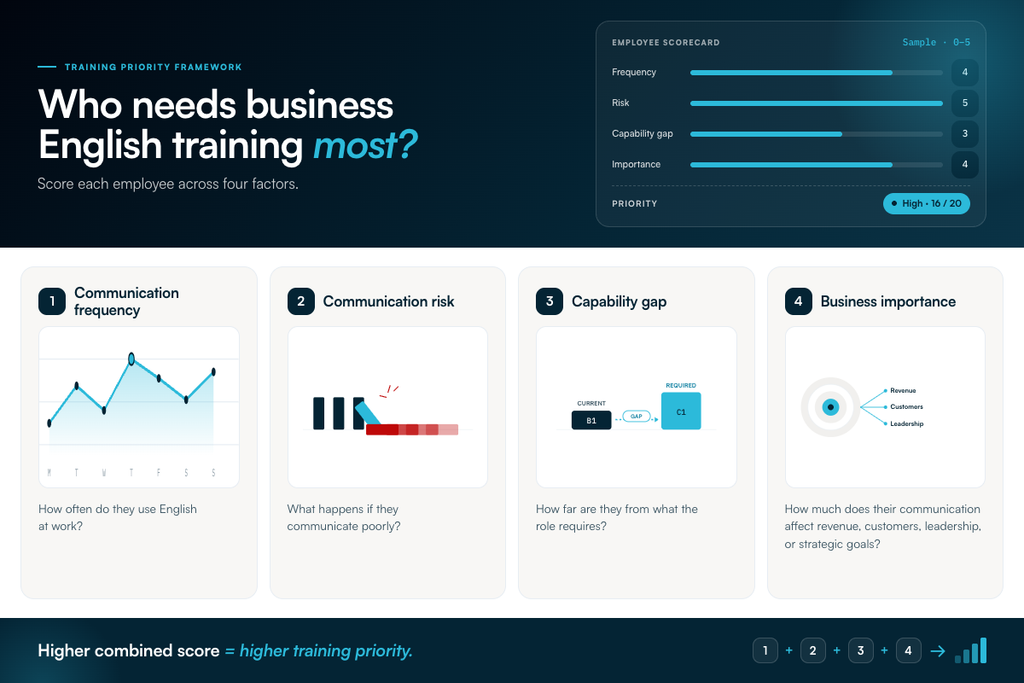
A scoring table turns the four axes into a repeatable training needs analysis you can hand to any manager or present to finance. Score each employee (or role group) from 1 to 5 on communication frequency, communication risk, current capability gap, and business importance. Sum the four scores for a priority rank between 4 and 20.
These anchors keep scoring consistent across raters. A 1 on communication frequency means the person rarely communicates in English. A 5 means they’re in English-language meetings, emails, or calls daily. For communication risk, a 1 means errors carry no material consequence, while a 5 means a miscommunication could lose a client or create legal exposure. Capability gap scores how far the employee sits from the proficiency their role demands, not their absolute CEFR level. And business importance reflects revenue impact, strategic visibility, or leadership influence on a 1-to-5 scale.
A completed table for four common profiles looks like this:
| Employee / Role | Comm. Frequency | Comm. Risk | Capability Gap | Business Importance | Total |
|---|---|---|---|---|---|
| Regional Sales Director | 5 | 5 | 3 | 5 | 18 |
| Product Manager (global squad) | 4 | 4 | 3 | 4 | 15 |
| IT Support Engineer (domestic) | 3 | 2 | 4 | 2 | 11 |
| Junior Data Analyst | 2 | 1 | 4 | 2 | 9 |
The Sales Director scores 18 because she’s client-facing every day with high-stakes deals on the line, even though her capability gap is moderate. The Junior Data Analyst scores 9 because, despite a larger gap in proficiency, the role carries minimal communication risk and limited business impact right now.
Deciding which employees need business English training first becomes straightforward once you set tier breakpoints. Scores of 16 to 20 place an employee in Tier 1, where 1:1 coaching delivers the fastest return. Scores of 11 to 15 fall into Tier 2, best served by group classes combined with AI practice tools that reinforce skills between sessions. Scores of 6 to 10 land in Tier 3, where self-paced courses paired with occasional AI conversation practice build foundational skills without consuming premium budget. Anyone scoring below 6 doesn’t need active training today. Flag them for monitoring and reassess when their role scope changes.
That requires another question: Is the communication need highly individual, or is it shared by a larger group?
Map employee segments to the right business English training modality
The decision matrix below converts priority scores into specific communication training formats, giving you a defensible artifact you can drop into any planning deck or budget proposal.
| Priority tier | Score range | Recommended modality | Rationale | Expected outcome | Example roles |
|---|---|---|---|---|---|
| Tier 1 | 16–20 | 1:1 coaching | High communication risk meets high business importance. Errors carry revenue or reputational consequences. | Improvement in high-stakes interactions within 8–12 weeks | Sales directors pre-pitch, C-suite presenting to investors, key account managers negotiating contracts |
| Tier 2 | 11–15 | Group training + AI practice | Shared role needs make cohort learning efficient. AI fills gaps between live sessions. | Consistent team-level vocabulary and communication norms within one quarter | Engineers in global sprints, customer support teams, project managers running cross-border standups |
| Tier 3 | 6–10 | Self-paced learning + optional AI practice | Low communication risk means slower progress won’t hurt the business. Foundational skills build over time. | Steady proficiency gains over 3–6 months without disrupting daily work | Back-office analysts reading English reports, junior developers reviewing documentation, regional HR coordinators |
| Monitor | Below 6 | No dedicated budget. Offer access to self-paced resources only. | No current English-dependent responsibilities. | Baseline awareness maintained for future role changes | Domestic warehouse staff, local-market administrative assistants |
Tier 1 employees typically represent 10–20% of your learner population, yet they drive outsized ROI because their communication directly affects deals, partnerships, and executive decisions. A sales director preparing for a pitch to a global prospect can’t afford to workshop phrasing in a group setting where feedback is diluted across eight participants. One-on-one business English training gives these employees targeted practice on the exact scenarios they’ll face next week, not generic curriculum.
Tier 2 is where group training paired with AI practice creates the strongest cost-to-impact ratio. Engineering teams running daily standups across time zones share the same vocabulary gaps and the same communication patterns. A group session builds shared norms, and AI conversation tools between sessions let each person practice at their own pace without waiting for the next class. Customer support cohorts benefit from the same structure because they handle similar interaction types and can role-play real scenarios together.
Tier 3 employees need corporate language training that doesn’t pull them away from their primary responsibilities. Self-paced courses with optional AI practice let an analyst who reads English reports twice a week build reading fluency gradually. The cost of slower progress here is low because their communication risk score already told you that mistakes in these roles don’t cascade into lost revenue or damaged client relationships.
Scheduling flexibility matters for Tier 2 and Tier 3 alike. Self-paced and AI formats minimize business disruption because employees fit practice around their workload rather than blocking calendar time for live sessions.
For the Monitor tier, don’t allocate dedicated budget. Give these employees access to your self-paced platform so they can explore on their own, and reassess their scores quarterly or whenever their role scope expands into English-dependent territory.
Six examples of employees with different business English training needs
Scoring axes and tier labels become useful when you can point to a real person and say, “This is why they get coaching and that person gets self-paced.” The six profiles below show how the framework plays out across different roles, proficiency levels, and business contexts.
1. Carla, Regional Sales Director (LATAM). Carla is B1 and regularly handles sales conversations with international prospects. She has an important pitch coming up and struggles to respond concisely to objections without losing her train of thought. Her communication risk, capability gap, and immediate business need are all high. Because the upcoming challenge is highly specific to her conversations and sales context, targeted 1:1 coaching could be the best fit, supported by additional practice between sessions.
2. Tomás, Software Engineer on a global product team. Tomás is B2 and communicates in English every day during standups, sprint reviews, and cross-functional discussions. He understands his colleagues well but struggles to explain technical decisions spontaneously and tends to over-explain status updates. The need matters, but it is also likely to be shared by other engineers working in the same environment. A group program focused on meetings and complex collaboration can address the common skills, while individual AI practice gives Tomás more opportunities to rehearse concise updates and explanations.
3. Aisha, HR Business Partner expanding scope to EMEA. Aisha is B1 and will soon handle more employee conversations across countries. Her English is functional, but sensitive discussions require more than grammatical accuracy. She needs to ask precise questions, communicate decisions carefully, understand indirect responses, and adjust her communication to different cultural expectations. The need is high priority and context-specific. Depending on how many colleagues face similar challenges, either specialized group training or 1:1 coaching could work. The scoring identifies the need; the degree of individualization should determine the format.
4. Jun, Finance Analyst at headquarters. Jun is B2 and mostly uses English to read reports, write updates, and occasionally explain figures to colleagues in other regions. His current communication works reasonably well, but he wants to make written explanations clearer and contribute more comfortably when discussions move from numbers to recommendations. Because the risk is moderate and improvement can happen gradually, self-paced learning or a broader group program may be a better investment than dedicated coaching.
5. Priya, Customer Support Lead. Priya is A2 and works with English-speaking customers through chat and occasional calls. Her team repeatedly handles similar situations: clarifying the problem, setting expectations, explaining next steps, and responding when customers are frustrated. Her capability gap is substantial, but the need is highly repeatable across the support team. Structured group training can build the shared language and communication patterns the team needs, with additional individual practice for repetition.
6. Lars, Product Designer. Lars is C1 and already communicates comfortably with his immediate team. English is part of his job, but there is no meaningful communication gap affecting his current work. He does not need intensive training simply because he works in an international environment. Give him access to learning resources if he wants them and reassess if his responsibilities change.
These examples are illustrative. Their purpose is to show why proficiency, seniority, and job title should never determine the training decision in isolation.
These profiles are illustrative starting points. Your org will have roles and risk profiles that don’t map neatly onto any of them, so adapt the scoring axes to reflect your own business priorities and team structures.
How to allocate a language training budget across segments
A corporate language training strategy becomes defensible when every dollar maps to a tier with a clear rationale. Start with this template and adjust based on your org’s cost benchmarks and headcount distribution.
Allocate 40–50% of your total budget to Tier 1 learners, even though they represent only 10–20% of your training population. These are the employees routed to 1:1 coaching because their communication risk and business importance scores are highest. Dedicate 30–35% to Tier 2, covering the 30–40% of learners in group classes and AI practice tools. Reserve the remaining 15–20% for Tier 3, your largest learner segment (40–50% of participants), who receive self-paced courses with optional AI conversation practice.
This split looks lopsided until you factor in per-learner costs. One-on-one coaching can cost 5–10x more per learner than self-paced platform access. According to Training Magazine, U.S. companies spent an average of $874 per learner across all training types in 2025, but that average obscures massive variation by modality. A single 1:1 coaching engagement for a senior sales director might run $3,000–$5,000 over six months, while self-paced digital access for a back-office analyst might cost $150–$300 annually. Without segmentation, organizations either spread budget evenly and underspend on the people who drive revenue, or concentrate spending on executives by default and leave entire teams without support. Neither approach survives scrutiny when you need to justify the investment to finance.
Engagement should also affect allocation after the program starts. Talaera’s program model allows unused sessions to be reassigned when a learner is not engaging, rather than leaving training budget tied indefinitely to the original allocation. That makes segmentation an ongoing resource decision rather than an enrollment exercise you complete once a year.
Tracking outcomes across these tiers requires centralized analytics. An LMS that captures completion rates, proficiency gains, and engagement data for each segment lets you prove that your Tier 1 coaching spend produced clear improvement in deal velocity or client retention, while your Tier 3 self-paced investment maintained baseline proficiency at scale. That visibility turns a one-time budget request into a repeatable annual allocation you can defend with data, not assumptions.
When to blend modalities for one employee segment
Tiers assign a starting modality, not a ceiling. Some segments perform better when you layer a second format on top to fill a gap the primary modality can’t address alone.
Consider Tier 2 engineers participating in global sprints. Biweekly group sessions build shared technical vocabulary and meeting phrases the whole cohort needs. But group practice alone doesn’t give each engineer enough individual reps to build fluency under pressure. Adding daily AI practice between sessions lets each person rehearse sprint updates, async comments, and standup summaries at their own pace. Group sessions establish shared language, and the AI tool gives each person the repetition needed to use it fluently.
A similar pattern works at Tier 1. Executives receiving weekly 1:1 coaching for high-stakes presentations may still have specific skill gaps, like structuring client emails or writing executive summaries, that don’t warrant live coaching time. Self-paced micro-courses fill those gaps without consuming expensive coaching hours.
The key constraint is complexity. Every additional modality adds scheduling, tracking, and learner fatigue. Only introduce blended learning when you can name the specific gap a single format leaves open. “Group training builds the right skills but this person lacks individual practice reps” is a valid reason. “It would be nice to offer more” isn’t. If you can’t articulate what the second modality fixes, the added complexity won’t pay off.
Turning segmentation into a repeatable process
A training needs analysis loses value the moment it becomes a static document. Re-score your workforce quarterly, or whenever roles shift, new markets open, or business priorities change. Each cycle gets sharper because you’re feeding outcome data from previous tiers back into the scoring. The employee who scored a 6 last quarter might score a 9 after landing a new client-facing responsibility. Catching that shift early means assigning the right modality before communication gaps cause real damage.
Don’t attempt a company-wide rollout on day one. Score your 20 to 30 highest-priority employees, assign modalities, and measure outcomes over 90 days. That pilot gives you the proof points stakeholders need and surfaces any scoring adjustments before you invest further. Once you’ve validated the framework with real results, rolling out training across broader segments becomes a conversation grounded in data, not assumptions.
Frequently asked questions
Which employees should get 1:1 English coaching vs group training?
Employees with high communication risk and high business importance deserve 1:1 coaching. These are typically client-facing roles where a single miscommunication can cost a deal or damage a relationship. Group training works better for cohorts who share similar proficiency levels and job functions, such as engineering teams collaborating across time zones. Score each employee on both axes before assigning a modality.
How do I prioritize employees for business English training?
Score each employee across four axes: role type, communication risk, current capability, and business importance. Sum those scores to produce a single priority number, then rank your workforce accordingly. This approach gives you a defensible, repeatable method that goes beyond job title lists or CEFR scores alone. Employees with the highest composite scores get the most intensive (and expensive) training formats first.
When is self-paced English learning enough vs live coaching?
Self-paced learning fits employees whose roles involve low-frequency English use and low communication risk, such as analysts who read reports but rarely present to external stakeholders. Live coaching becomes necessary when the employee regularly handles high-stakes conversations where misunderstandings carry real business consequences. If someone’s mistakes would go unnoticed for weeks, self-paced is likely sufficient.
How do you segment employees for language training by role and risk?
Effective segmentation combines role type (client-facing, cross-functional, internal) with communication risk (what happens if this person miscommunicates). Add current capability and business importance to complete the picture. This four-axis framework prevents common mistakes like grouping all managers into one business English training tier or assigning modalities based on seniority alone. The priority-score approach routes each segment to the right modality based on actual impact, not assumptions.