A communication competency framework defines the observable behaviors expected at each proficiency level for a given role. Most frameworks treat communication as one universal skill, and that makes them useless for L&D leaders managing across functions. The role-specific benchmarks, assessment scenarios, and KPI mappings that follow are structured so you can adapt them directly to your org.
Good communication looks radically different depending on the role. Support needs de-escalation and clarity under pressure. Sales needs persuasion and active listening during discovery. Engineering needs precision in async written communication. Leadership needs alignment-building and narrative framing. When you apply a single communication skills assessment across all four functions, you end up measuring none of them well. SHRM’s competency model treats communication as one broad dimension, which works as a starting point but falls short when you’re building performance rubrics for specific teams.
Each section covers one function and stands alone as a reference. Together, they connect back to five communication pillars that apply across roles but show up in fundamentally different ways depending on the work.
Communication benchmarks for customer support teams
Effective communication in support means resolving issues with clarity, empathy, and composure under time pressure, especially when working across language or cultural differences. The observable behaviors behind this definition look different from what you’d expect in sales or engineering. A strong support communicator isn’t persuading or architecting. They’re absorbing frustration, translating ambiguity into action, and doing it consistently across channels and languages.
Five behaviors separate proficient support communicators from the rest. Paraphrasing to confirm understanding (“So what you’re seeing is X, and it started after Y”) catches misalignment before it adds to a longer interaction. Adjusting language complexity to match the customer’s level matters even more on global teams where both sides may be working in a second language. De-escalating emotional situations without falling back on scripted phrases shows real communication skill, because customers recognize canned responses and they make things worse. Flagging systemic issues in written summaries to product teams turns individual tickets into organizational learning. And maintaining tone consistency across chat, email, and phone means the customer experience doesn’t depend on which channel they happened to choose.
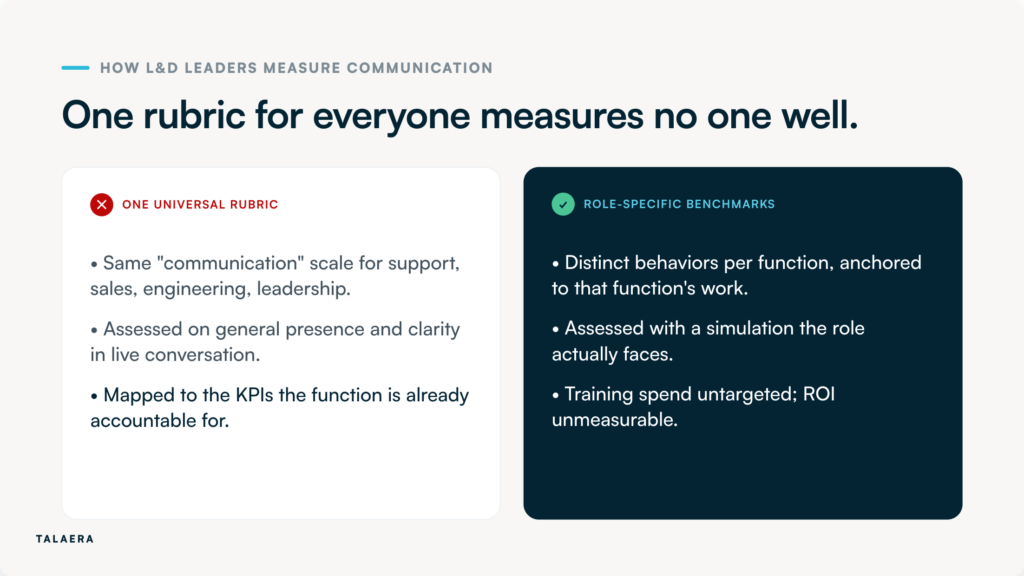
To assess these communication skills for customer service, use a simulated escalation scenario. Place the agent in a role-play where an angry customer describes an ambiguous product issue, and both parties are non-native English speakers. Score on three tiers. A developing agent reads from templates, misses emotional cues, and asks the customer to repeat information already provided. A proficient agent paraphrases the issue accurately, acknowledges frustration in their own words, and proposes a clear next step. An advanced agent does all of that while also adjusting vocabulary for the customer’s proficiency level and documenting the root cause pattern for the product team. This communication rubric gives managers concrete anchors instead of subjective impressions.
These behaviors connect directly to four KPIs. CSAT improves because customers feel heard rather than processed. SurveyMonkey’s research confirms that active listening, including repeating or summarizing what customers say, is a core driver of satisfaction scores. First-contact resolution rate rises when agents confirm understanding before jumping to solutions. Average handle time drops (counterintuitively) when agents get the issue right the first time instead of cycling through misdiagnoses. Escalation rate falls because agents who de-escalate effectively keep cases from climbing the chain.
For a deeper look at building training around these benchmarks, see Talaera’s customer service communication training.
Communication benchmarks for sales teams
Effective communication in sales means building trust through active listening, adapting messaging to the buyer’s context, and advancing deals through clear, confident articulation of value. Unlike support roles where communication is reactive, sales communication drives revenue by shaping how prospects perceive risk, urgency, and fit. The sales communication skills that move pipeline are about reading the room and responding with precision.
Observable behaviors separate strong sales communicators from those who rely on scripts. Watch for these patterns during live calls, recorded demos, and deal reviews.
- Discovery questioning: Asks open-ended questions and listens without interrupting, letting the prospect reveal priorities before pitching.
- Contextual tailoring: Adapts pitch language to the buyer’s industry and seniority, avoiding generic value statements that don’t land.
- Written follow-through: Summarizes next steps and commitments in writing after every call, reducing ambiguity about who owns what.
- Objection handling: Acknowledges the prospect’s concern before reframing, rather than jumping to counter-arguments that feel dismissive.
- Stakeholder code-switching: Moves between technical and business language depending on whether they’re speaking with an end user, a department head, or a CFO.
For non-native English speakers on global sales teams, code-switching across registers is often harder than vocabulary itself. A rep might handle a technical demo fluently but struggle to articulate ROI in executive-level language. Talaera’s sales communication training addresses this gap directly for international teams.
A strong assessment scenario for sales is a simulated discovery call with a skeptical prospect. Score on three tiers. A developing rep reads from a script without adapting to prospect cues or asks only closed-ended questions. A proficient rep adjusts messaging based on stated needs and handles one or two objections with composure. An advanced rep identifies unstated needs, reframes the value proposition in real time, and closes the call with a concrete next step tied to the prospect’s buying timeline.
The business KPIs that sales communication moves are win rate, deal velocity and sales cycle length, pipeline conversion by stage, and quota attainment. When reps communicate well during discovery, deals progress faster because prospects feel understood rather than sold to. Shorter cycles and higher conversion rates at each stage are measurable signals that your team’s communication is working.
Communication benchmarks for engineering teams
Effective communication in engineering means conveying technical complexity with precision and appropriate context, primarily in writing and async formats, so that decisions can be made without unnecessary meetings or rework. Engineering teams operate differently from every other function. Most of their communication happens in pull requests, design documents, Slack threads, and incident channels rather than live conversations.
Observable behaviors that distinguish strong engineering communicators show up in daily async work. Engineers who communicate well write structured pull request descriptions that explain the “why” behind changes, not only the “what.” Their code review comments are specific and actionable rather than vague (“this could be better”). When talking to product managers or designers, they translate technical constraints into business impact. Instead of saying “this requires refactoring the auth module,” they say “this adds two sprints but reduces login failures by 40%.”
They document decisions and rationale in async channels so teammates in other time zones can act without waiting for a sync meeting. When blockers arise, they raise them early with proposed solutions attached. During incidents, they adjust urgency and detail level depending on whether they’re updating other engineers, a VP, or affected customers.
The cost of getting this wrong is staggering. A PlanGrid and FMI study found that miscommunication and poor project data account for 48% of all rework on U.S. construction jobsites, representing over $31 billion in avoidable costs annually. Software engineering faces the same dynamic at a different scale. Every unclear design doc or ambiguous requirements thread generates rework that builds across sprints.
A practical assessment scenario for engineering communication skills is a simulated architecture review where the engineer explains a technical trade-off to a mixed audience of PMs, designers, and fellow engineers. On a five-point rubric, a developing communicator uses jargon without adjusting to the audience, leaving non-technical stakeholders confused about what the trade-off means for their priorities. An advanced communicator frames the same trade-off in terms each stakeholder cares about: timeline impact for PMs, UX implications for designers, and maintainability concerns for engineers.
The business KPIs that engineering communication moves are PR cycle time, rework rate, incident communication response time, and cross-functional project delivery time. When engineers write clear PRs, review cycles shorten because reviewers don’t need to ask clarifying questions. When they document decisions well, rework drops because fewer people build on outdated assumptions. For teams looking to build these capabilities systematically, improving communication in engineering teams requires targeting these async and written skills specifically rather than defaulting to generic presentation training.
Communication benchmarks for leadership roles
Effective communication in leadership means creating clarity, alignment, and psychological safety across teams through narrative framing, transparent decision-making, and the ability to adapt messaging across levels and cultures. This applies equally to executives addressing a board and to people managers running weekly one-on-ones. The difference between a leader who communicates well and one who doesn’t shows up directly in whether teams act on priorities or wait for clarification that never comes.
Observable behaviors separate leaders who create alignment from those who generate confusion. Leaders who communicate effectively frame strategic decisions with clear “why” context before the “what,” so teams understand the reasoning behind changes rather than receiving directives without rationale. They give direct feedback that is specific and actionable, not softened to the point of uselessness. They adjust their communication style depending on whether they’re addressing a board, individual contributors, or cross-functional partners. Their meetings have a stated purpose and produce clear outcomes. When delivering bad news, they lead with transparency and ownership rather than deflecting or burying the message in corporate language. For a deeper look at building these capabilities, leadership communication skills for global leaders covers the full development path.
Assessment for leadership communication works best through simulated high-stakes scenarios. Consider a simulated all-hands during organizational change. A leader at the developing level reads announcements without addressing team concerns, leaving people to fill in gaps with assumptions and anxiety. A leader at the advanced level anticipates questions, names uncertainties explicitly, and provides a clear framework for how decisions will be made going forward. That gap between developing and advanced communicators is what most affects team engagement during change.
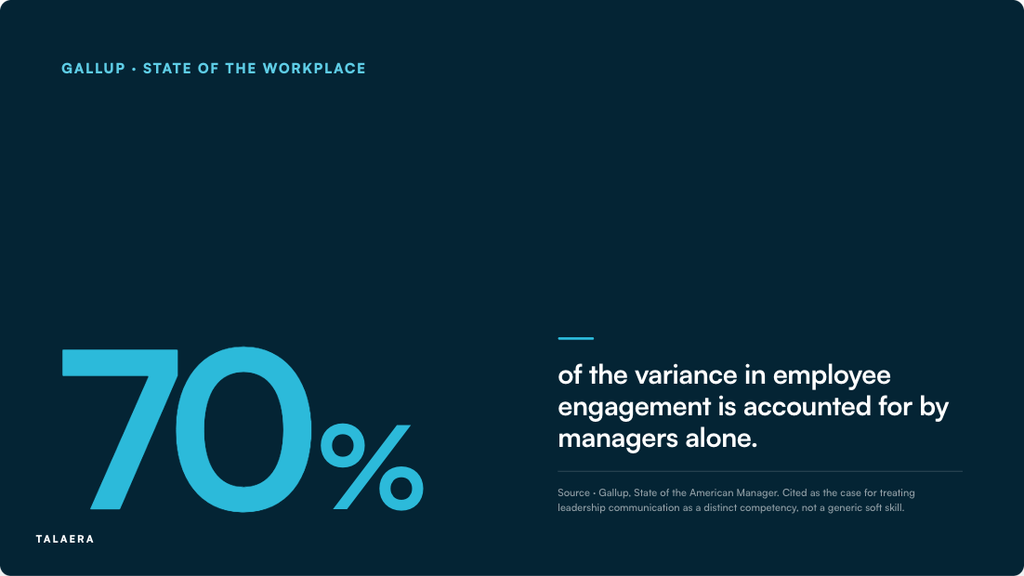
The business KPIs that leadership communication moves are eNPS, voluntary attrition, employee engagement scores, and speed of strategic alignment (measured by how quickly teams act on communicated priorities). Research from Axios HQ found that organizations increasing their investment in internal communication saw 68% report higher employee engagement and 68% report better retention. Yet the same report revealed a telling disconnect: 80% of leaders believe their messages are clear and engaging, but only 50% of employees agree. A Gallup study reinforces this, finding that managers account for 70% of the variance in employee engagement. When you’re measuring whether leadership communication training is working, these are the numbers that tell the story.
Communication skills matrix: all four roles compared
A single communication skills matrix reveals what generic frameworks hide. The same competency dimension looks fundamentally different depending on who’s doing the communicating and why.
| Communication dimension | Customer support | Sales | Engineering | Leadership |
|---|---|---|---|---|
| Primary channel | Live chat, phone, and ticket (synchronous + written) | Video calls, in-person meetings, and email sequences (synchronous-verbal) | Pull requests, docs, and async threads (written-async) | All-hands, 1:1s, and strategic memos (mixed, high-visibility) |
| Listening emphasis | Identifies unstated customer emotion and urgency behind the words | Detects buying signals, objections, and stakeholder power dynamics | Parses technical requirements and flags ambiguity before build | Reads team sentiment, surfaces unspoken resistance to change |
| Audience adaptation | Adjusts register and vocabulary to match customer technical level | Tailors value narrative to each persona in the buying committee | Translates technical detail for product, design, or business audiences | Shifts framing between board, peers, and frontline teams |
| Feedback style | Delivers resolution with empathy; closes loop on satisfaction | Reframes objections as collaborative problem-solving | Gives precise, evidence-based code or design critique in writing | Delivers candid performance feedback while preserving trust |
| Conflict and escalation | De-escalates frustrated customers using acknowledgment and pacing | Manages negotiation tension without damaging the relationship | Raises technical risk early with data, not blame | Addresses team conflict directly and models accountability |
| Documentation norms | Logs interactions with consistent tagging for trend analysis | Updates CRM with accurate deal context after every touchpoint | Maintains decision logs, architecture docs, and runbooks | Produces clear strategic briefs that drive aligned action |
Audience adaptation appears in every column, which is why it shows up in nearly every communication competency framework. But the audiences and stakes differ so much that training the skill generically wastes time. A support agent adapts vocabulary for a confused customer in real time. An engineer adapts a technical concept for a product manager in a design doc. It is the same underlying skill applied in very different contexts.
The sharpest divergence sits in channel emphasis. Engineering communication lives in written-async artifacts where precision and permanence matter most. Sales communication lives in synchronous conversation where tone, pacing, and real-time reading of the room drive outcomes. Training that treats “clear communication” as one skill ignores this gap entirely.
Proficiency levels (developing, proficient, advanced) still apply within each role, but the peak profile differs across them. A Level 3 communicator in engineering produces documentation that prevents rework and communicates technical risk to non-technical stakeholders with confidence. A Level 3 communicator in sales controls complex multi-stakeholder conversations and recovers stalled deals through reframing. Both are advanced. Neither could swap into the other’s context and perform at the same level without retraining. When you’re building your communication skills matrix, anchor each level to the observable behaviors in the relevant column, not to a universal rubric that flattens these differences.
How to calibrate communication expectations across functions
The strongest justification for different communication bars across roles is the business outcome each function exists to move. When you anchor expectations to KPIs, the conversation shifts from “why are standards inconsistent?” to “why would we apply the same standard when the work is fundamentally different?” An engineer who writes precise async documentation that prevents rework is meeting the communication bar for their function, even if they’re awkward in casual conversation. A support agent who charms colleagues in the break room but can’t de-escalate a frustrated customer is not. Tying each benchmark to its function’s metrics makes this distinction defensible.
L&D teams that define communication standards in isolation from functional managers end up with frameworks nobody uses. The people who observe communication in action daily (support team leads reviewing ticket quality, sales directors listening to recorded calls, engineering managers reading pull request comments) are the ones who know what “good” actually looks like in context. Start by conducting a training needs analysis with each function before writing a single rubric line. Functional managers validate whether your observable behaviors reflect real performance gaps or theoretical ideals.
When presenting role-specific standards to senior stakeholders, the comparison matrix from the previous section becomes your most effective tool. Showing all four roles side by side with their distinct behaviors, assessment scenarios, and KPIs makes the intentional differences visible. Stakeholders who might push back on “lower” expectations for one team can see that each role’s bar is adjusted to what drives results for that team. A communication skills assessment grounded in role-specific criteria carries more weight than a generic evaluation applied uniformly.
Reassess these benchmarks annually. Async platforms change how engineers communicate. AI tools reshape how support agents draft responses. Global expansion introduces new cultural communication norms. The standards you set this year should be treated as a working document, not a permanent policy.
From benchmarks to action
Role-specific communication benchmarks turn “improve communication skills” from a vague initiative into something you can actually measure and fund. Without them, training spend stays untargeted and ROI stays unmeasurable.
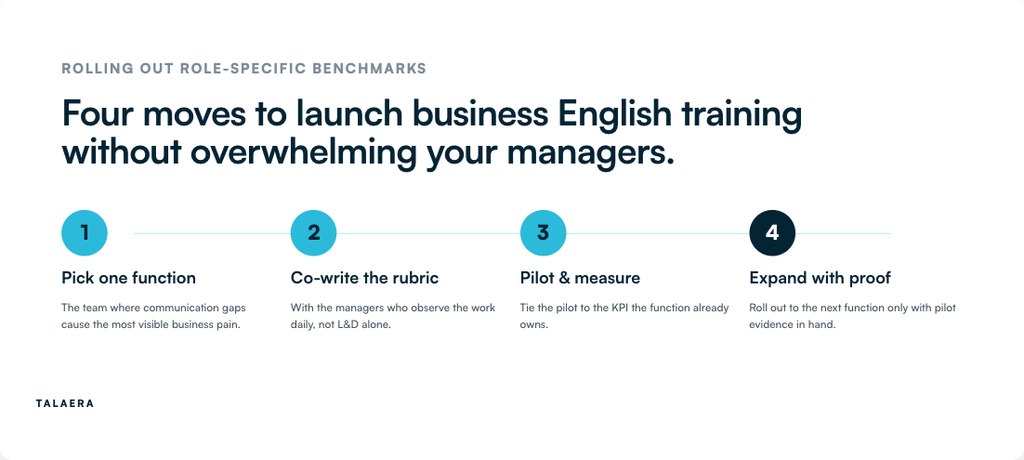
Resist the temptation to roll out all four role frameworks at once. Pick the function where communication gaps cause the most visible business pain, pilot the benchmarks there, and refine your rubrics based on what you learn. That pilot gives you the evidence to expand credibly to the next team. Trying to launch across support, sales, engineering, and leadership at the same time dilutes focus and overwhelms managers who need to adjust assessments for the first time.
If you’re ready to baseline where your team stands today, Talaera helps you map individual English skills against role-specific benchmarks so you know exactly where to invest.
Frequently asked questions
What does good communication look like for each role?
Effective communication looks different depending on the function. A support agent needs to resolve issues with empathy and clarity under time pressure, while a sales professional must ask strategic questions and handle objections persuasively. Engineers communicate well when they document decisions clearly and translate technical concepts for non-technical stakeholders. For leaders, good communication means aligning teams around priorities and delivering feedback that drives engagement and retention.
How do you measure communication competency at work?
Tie assessment to observable behaviors and the business KPIs each role influences. For support teams, track CSAT and first-contact resolution; for sales, measure win rates and deal cycle length. Engineering teams benefit from tracking rework rates and incident communication quality, while leadership communication connects to employee engagement scores and voluntary turnover. Role-specific scenarios scored on a 1–5 scale give you consistent, comparable data across functions.
What is a communication competency framework?
A communication competency framework defines the specific communication behaviors expected at each proficiency level for a given role. It goes beyond generic “good communicator” labels by describing what someone actually says and does in realistic work situations. The most useful frameworks pair those observable behaviors with assessment rubrics and business metrics so you can measure progress and justify training investments.
What communication KPIs matter most for engineering teams?
Incident communication quality, documentation completeness, and rework caused by miscommunication are the KPIs that matter most. Cross-functional collaboration scores also surface how well engineers translate technical detail for product, design, or leadership audiences. These metrics connect communication skill directly to engineering velocity and reliability.
How do you build a communication rubric for different departments?
Start by identifying the two or three highest-stakes communication moments for each function, then describe what poor, competent, and excellent performance looks like in those specific scenarios. A communication rubric for support will emphasize de-escalation and tone, while one for leadership will focus on strategic messaging and stakeholder alignment. Anchor each level to observable behaviors rather than subjective impressions, and validate with functional managers who see those interactions daily.