The best corporate English training for Brazilian companies depends on what your teams use English for, and this guide compares eight providers you can shortlist for inglês corporativo (corporate English) programs. If employees need to run meetings and client calls in English, choose a coach-led program built around workplace communication, such as Talaera. Berlitz is the only provider on this list that offers in-person classes at your offices. If you want to offer English to a large workforce as an employee benefit at a low cost per person, an app-led provider such as Fluencypass or a group-class model such as Open English fits better.
Table of Contents
Corporate English training providers for Brazilian companies at a glance
| Provider | Best for | Formats | In-person in Brazil | Reporting for HR | Watch out for |
|---|---|---|---|---|---|
| Talaera | Teams that work in English with clients and colleagues abroad | 1:1 coaching, small-group courses, AI coach, self-paced lessons | No | Company and team dashboards, monthly impact reports | English only, online only |
| Berlitz | In-person classes at Brazilian offices | In-person or online groups, private online lessons, self-study | Yes | Progress dashboard on its self-study platform | Custom material takes about four weeks |
| BES Brazil | Senior executives who need private coaching | Online 1:1 classes | No | Not published | Built for individuals more than company-wide programs |
| EF Corporate Learning | Large companies training in several languages | Online private and group classes, live classes 24/7, self-study | No | Real-time reporting, LMS integration | Global program, so check support in Brasília time |
| Fluencypass | English as a low-cost benefit for many employees | App and digital school, group conversation, private lessons | No | HR dashboard with progress by employee | Outcome figures are the company’s own claims |
| Open English | Large groups who want live classes at any hour | Live online classes 24/7, AI practice | No | Not published | Ask how classes connect to each team’s work |
| Preply Business | Small teams that want to choose their own tutor | 1:1 online tutoring, AI practice | No | Manager dashboard | Quality and structure depend on the tutor |
| Voxy | Companies that want AI learning paths plus live classes | AI-personalized platform, live group classes, 1:1 coaching | No | Reporting run by its Customer Success team | Check how much live speaking time each learner gets |
Why English training for Brazilian teams needs a speaking focus
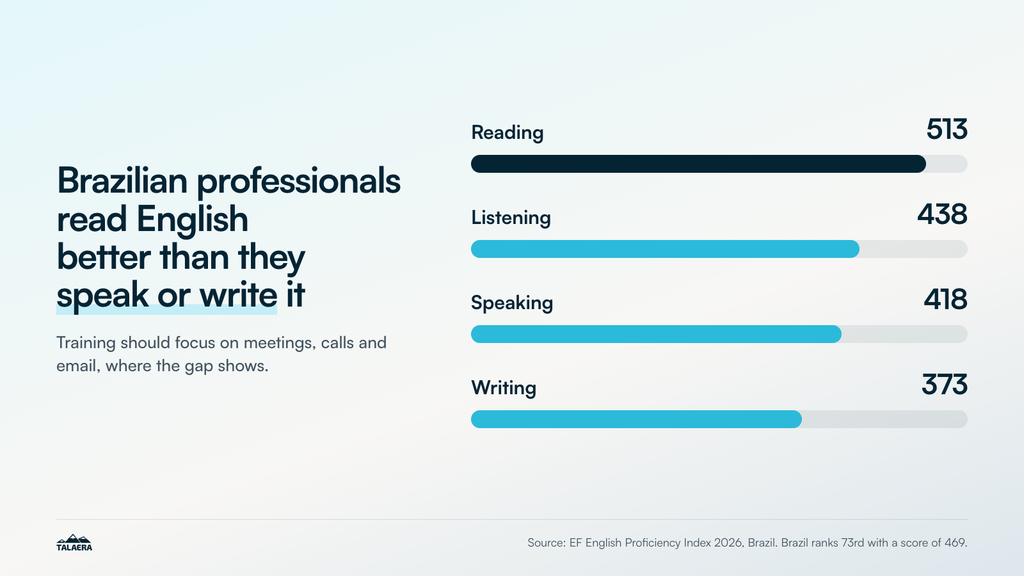
Brazilian professionals tend to read English far better than they speak or write it. In the EF English Proficiency Index 2026, Brazil ranks 73rd with a score of 469, down 13 points from the year before, which places it in EF’s low proficiency band. For HR, the skill scores matter more than the rank, because speaking and writing trail reading by a wide margin.
In the EF English Proficiency Index 2026, Brazil scores 513 in reading, 438 in listening, 418 in speaking and 373 in writing.
The same pattern shows up worldwide. EF’s 2026 report, based on 2.3 million adults in 117 countries and regions, found that reading is the strongest skill in four out of five countries and called on employers to invest in speaking, listening and writing. EF’s example is a professional who can read a contract in English but struggles to negotiate its terms. A program that spends most of its time on grammar and reading won’t do much for speaking. Look for one that puts employees in the situations where they lose ground: meetings, client calls, presentations and email.
Proficiency also varies a lot inside Brazil. In the same EF data, Porto Alegre scores 551 and Florianópolis 549, while Porto Velho scores 425. A company with a head office in the South or Southeast and plants or service centers elsewhere will usually find different starting levels across sites. Plan for a level test before you design the program, and expect to need more than one track.
Which Brazilian teams need corporate English training most
Four groups tend to drive demand for English training in Brazilian companies. The first is tech teams that serve US clients. Brazilian engineers often work in Brasília time (UTC-3), one or two hours ahead of US Eastern time depending on the season, so they join the same daily calls as their clients. Our guide for nearshore developers covers what it takes to speak up on those calls.
In Brazil offices of multinationals, English is the language of reporting lines, global meetings and promotions. Exporters and agribusiness companies need it to negotiate with buyers abroad, and customer support and sales teams need it to serve English-speaking customers.
Six criteria for evaluating corporate English training providers in Brazil
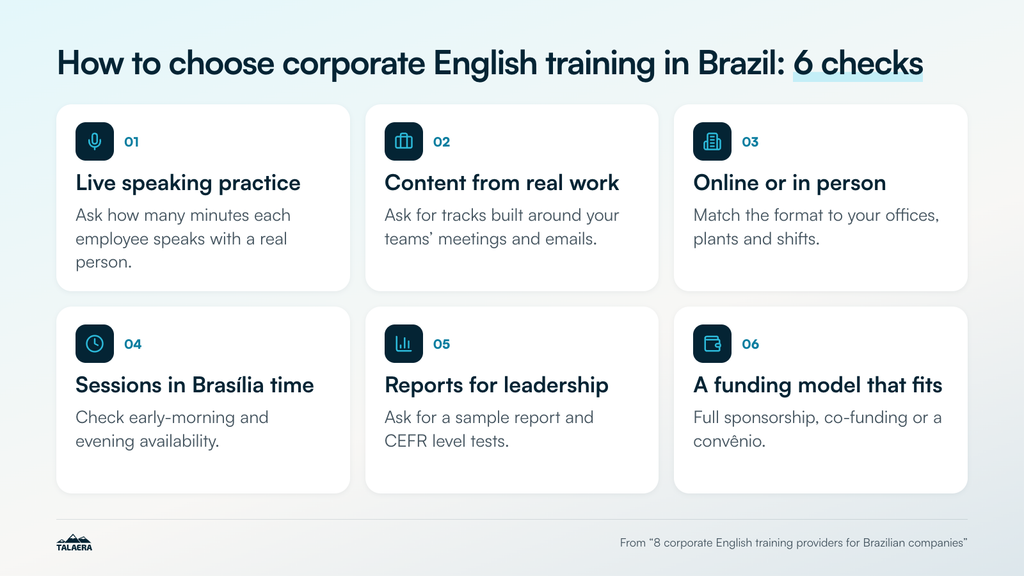
These criteria adapt the framework in our guide to the best corporate language training platforms to the Brazilian market.
- Speaking practice with real people. Ask how many minutes of live speaking each employee gets per week, and with whom. Self-study and AI practice help, but they don’t replace a coach who can push an employee through a difficult conversation.
- Content built on the employee’s job. Training built around the employee’s meetings, emails, client calls and presentations transfers to the job faster than a general English course. Ask for examples of role-based tracks for your functions.
- Online or in-person delivery. In-person classes suit a single office with a stable schedule. Online training is easier to run across several cities and for remote employees, and it fits around shift work.
- Live sessions in Brazilian working hours. Check that coaches or teachers are available in Brasília time, including early mornings and evenings for employees who can’t study during the workday.
- Reporting T&D can share with leadership. You will need attendance, progress and some measure of results to renew the budget. ROI has four measures: how often employees use new skills on the job, program health (attendance and session use), business outcomes such as fewer escalations or faster deals, and proficiency change from a level test at the start and end. Ask to see a sample report before you sign, and check whether the provider offers a CEFR-aligned level test.
- A funding model that matches your goals. Brazilian companies fund English in three common ways. Some sponsor the full program for selected employees. Some co-fund it, paying part of the cost while the employee pays the rest. Others set up a convênio, a partnership that gives employees a discount at a language school while the employee pays. Berlitz offers convênios in Brazil, and Fluencypass lets employees upgrade their plan or add family members at their own cost.
A convênio is cheap to run, but the company has little say over what employees learn. If English is a business requirement for a role, sponsor the training and tie it to that role’s work.
For a longer checklist, including questions to ask in each demo, see our guide to choosing English training for employees.
The 8 best corporate English training providers for Brazilian companies
Talaera comes first because we wrote this guide, and the other seven follow in alphabetical order.
1. Talaera
Talaera is a business English communication platform for professionals who already use English at work. Training is built around employees’ own meetings, emails and client calls, and it combines expert coaching, AI practice, small-group courses and self-paced lessons. More than 340 Talaera learners list Brazil as their home country, and they have completed over 1,350 live sessions. A data scientist at a public health organization in Brazil described their main challenge as “speaking spontaneously, expressing technical opinions and participating actively in meetings.”
Best for: Brazilian companies whose employees already work in English but struggle to speak up in meetings, client calls and negotiations with colleagues abroad.
Features:
- 1:1 coaching with a coach matched by role, background and goals. Coaches work across the Americas, Europe and Asia-Pacific, so sessions can run in Brazilian working hours.
- Talk to Tally, a voice AI coach for role-playing work scenarios 24/7 with instant feedback.
- Group courses for teams that share the same challenges, plus Speaking Club.
- Role tracks for software engineers, customer support, sales, and managers and leaders.
- Cross-cultural communication training, including lessons on direct and indirect communication and on speaking up in US business culture.
- A CEFR-aligned English assessment, SAML single sign-on, self-paced lessons as SCORM files for your LMS, and training analytics with company and team dashboards and monthly impact reports.
Strengths: Coaching, AI practice and group courses sit in one program, so HR manages one provider. In Talaera’s 2024 session data, 90% of booked 1:1 coaching sessions were completed, and Talaera reports that 85% of learners are active within 30 days.
Limitations: English only, so companies that also need Spanish or other languages will need a second provider. Fully online, with no in-person classes at Brazilian offices. LMS integration runs through SCORM rather than native connectors.
Pricing: Custom. Companies can start with a small pilot, and pilots carry no long-term commitment.
2. Berlitz
Berlitz is a language school founded in 1878 that operates in more than 70 countries and has a Portuguese corporate site for Brazil. It offers instructor-led group classes in person or online, private online lessons, self-study and convênios.
Best for: Companies that want in-person classes at their offices or a well-known school brand for an employee benefit.
Features:
- Group classes in person or online, from basic to advanced levels.
- Berlitz Flex for Business, which combines self-study with live private online lessons in English, Spanish or German.
- Berlitz On Demand, a self-study platform with a progress dashboard for the company.
- MyBerlitz Speaking Tutor, an AI chatbot for conversation practice at any hour.
- Programs tailored by industry, with custom material in about four weeks, plus leadership and cultural training.
Strengths: In-person delivery, many languages, and a convênio option for companies that want to offer discounted classes without running a program.
Limitations: The company dashboard covers the self-study platform, so ask how you will track progress in live classes. In-person schedules are harder to keep across several sites and shifts.
Pricing: Quote on request. Berlitz offers a free trial class.
3. BES Brazil
BES Brazil (Business English Solution) teaches executive English exclusively to Brazilians, online and one-to-one. Its clients include executives at GE, EMS, 3M, Corteva, KPMG and XP.
Best for: Senior leaders who need private coaching for high-stakes situations.
Features:
- Online 1:1 classes with native British and American teachers.
- A focus on business vocabulary and pronunciation.
- Job interview coaching, CV editing, presentation preparation and career planning.
Strengths: Built entirely around Brazilian learners, with experience in finance, law, oil and gas, and pharmaceuticals.
Limitations: Classes are 1:1 only, so BES suits a handful of executives more than a team rollout.
Pricing: Not published.
4. EF Corporate Learning
EF Corporate Learning is the corporate arm of EF Education First, the company that publishes the EF English Proficiency Index. It has worked with more than 3,000 organizations and offers all languages, with English as its focus.
Best for: Large companies that need one provider for several languages and countries.
Features:
- Fully online private and group lessons, with live classes available 24/7.
- More than 3,000 hours of content across 250 topics and 18 industries.
- Company-wide English testing to find skills gaps.
- Real-time reporting, integration with any LMS, and a dedicated Customer Success team.
Strengths: Scale, language range and benchmarking data. EF also publishes Portuguese versions of its corporate research, such as its Corporate Learning Maturity Report 2026.
Limitations: The corporate English program is global. Ask the local team about sessions in Brasília time, Portuguese-speaking support and Brazilian references.
Pricing: Quote on request.
5. Fluencypass
Fluencypass is a Brazilian provider that sells English as an employee benefit with per-employee licenses. Clients include Santander, G4 Educação and Pague Menos.
Best for: Companies that want to offer English to a large share of employees at a low cost per person.
Features:
- A digital school and app, with group conversation, private lessons, tutoring and study-abroad options.
- Eleven levels with a CEFR certificate at each level reached.
- An HR dashboard with enrollment, progress by employee and level distribution, plus one monthly invoice for the company.
- Licenses that HR can add or remove as headcount changes, and an account manager for HR.
- Employees can upgrade their own plan or extend access to dependents at their own cost.
Strengths: Simple administration for HR, and employees can extend access to their families.
Limitations: The outcomes on its page, such as reaching B2 in eight months or a 35% shorter time-to-hire, are the company’s own claims. Ask for the data behind them. Most learning happens in the app, so check how much live practice each license includes.
Pricing: Per employee. Fluencypass doesn’t publish a price list.
6. Open English
Open English is an online English school focused on Latin America, with more than 500,000 students in 26 countries. Corporate contracts make up about 30% of its revenue, and it runs the São Paulo state government’s Prontos pro Mundo English program.
Best for: Large groups of employees who need flexible schedules and want live classes at any hour.
Features:
- Live online classes with native English-speaking teachers, available 24 hours a day, every day.
- FluentIA, a method that pairs live classes with an AI tutor for pronunciation practice and feedback after classes (reported by Meio & Mensagem).
Strengths: Schedule flexibility for shift workers and busy managers, and a brand many Brazilian employees already know from its consumer advertising.
Limitations: Corporate reporting and role-based content aren’t published. Ask in the demo what data HR receives and how classes connect to each team’s work.
Pricing: Quote on request.
7. Preply Business
Preply Business is the corporate version of the Preply tutoring marketplace. Employees take 1:1 lessons with tutors they choose, and the company manages users and tracks progress in one dashboard. More than 2,000 companies use it.
Best for: Small and mid-sized teams that want flexible 1:1 lessons and a wide choice of tutors.
Features:
- 1:1 online lessons with tutors, plus AI-powered practice between lessons.
- A dashboard for managers to see engagement and progress.
- Courses in English and 11 other languages, including Spanish and Portuguese.
Strengths: Tutor choice, flexible scheduling and broad language coverage. Preply reports that around 90% of its business learners say their work performance improved.
Limitations: Lesson quality and structure depend on the tutor each employee picks, so results vary across a team.
Pricing: Quote on request.
8. Voxy
Voxy is an English training platform that uses AI to build personalized learning paths, with live classes and coaching on top. It has several Brazilian case studies and has hosted events for HR leaders in Brazil.
Best for: Companies that want a platform-led program with role-based courses and a provider that manages engagement for them.
Features:
- AI learning paths drawn from more than 5,000 lessons, with AI chat and voice practice for work scenarios.
- Live group classes, plus 1:1 and small-group coaching with certified instructors.
- Role-based courses such as English for HR, finance, customer service, sales, tech and leadership.
- A Customer Success team that runs program design, engagement campaigns and reporting.
Strengths: Several Brazilian references. Iteris, an IT services company with about 900 employees in Brazil and the US, reports a 209% return on investment and 86% of students active. Pulp producer CENIBRA used Voxy for a plant in Minas Gerais with no English instructors nearby.
Limitations: Much of the learning happens in the platform, so check how much live speaking time each learner gets at your budget.
Pricing: Quote on request.
Four English challenges Portuguese speakers face at work
Brazilian professionals with good English still run into a few predictable problems at work. Training can target them directly, using each employee’s own meetings and messages.
- False friends. Words that look like Portuguese words but mean something else cause confusion in emails and meetings. “Actually” means “in fact,” while atualmente means “currently.” “Eventually” means “in the end,” while eventualmente means “occasionally.” “Pretend” means to act as if something is true, while pretender means “to intend.” “I will eventually send the report” sounds to a US colleague like “someday,” when the writer meant “if needed.”
- Extra vowel sounds. Many Portuguese speakers add a short vowel to words that end in a consonant, so “Facebook” sounds closer to “Facebooky.” It rarely blocks understanding, and pronunciation coaching can target it directly.
- Indirect disagreement. In many Brazilian workplaces, people soften bad news with phrases like “We can try” or “That could be difficult.” US colleagues often take these at face value and expect delivery. Our guide to Brazilian work culture covers how to read and adjust these signals on both sides.
- Emails that sound too formal. Written English can come across as more formal than the writer intends. Clients in the US usually expect shorter messages with the request in the first line.
These patterns vary by person and industry, so treat them as starting points for a level test and a needs analysis. Training that also covers high-context communication helps both sides spot these signals before they turn into missed deadlines.
Which corporate English provider fits each type of team
- Teams that work with US or European clients: Talaera, for coaching built around client calls, meetings and cross-cultural communication.
- In-person classes at your offices: Berlitz.
- A few senior executives: BES Brazil or Talaera 1:1 coaching.
- Several languages across many countries: EF Corporate Learning or Berlitz.
- English as a low-cost benefit for a large workforce: Fluencypass or Open English.
- Small teams that want to pick their own tutor: Preply Business.
- A platform-led program with a provider that runs engagement: Voxy.
Whichever you choose, start with a pilot of 20 to 50 employees for four to 12 weeks, test their level at the start and end, and ask them how often they now use English in meetings and client calls. That gives you enough evidence to decide whether to scale.
Cambridge English estimates that it takes about 200 guided learning hours to move from one CEFR level to the next, counting lessons and supervised study.
An employee who studies three hours a week would need more than a year to move up a full level, so it helps to set goals around specific work tasks, such as leading a client call, alongside a CEFR target.
If your teams need to sound as capable in English as they are in Portuguese, book a demo with Talaera to see how a pilot would work for your company.
Frequently asked questions about corporate English training for Brazilian companies
What is the best corporate English training for Brazilian companies?
For teams that need to communicate with clients and colleagues abroad, a coach-led program focused on workplace communication, such as Talaera, is the strongest fit. Berlitz is the only provider in this comparison that offers in-person classes. For a low-cost benefit across a large workforce, Fluencypass and Open English are common choices.
What English level do Brazilian professionals have?
Brazil ranks 73rd in the EF English Proficiency Index 2026, with a score of 469, in EF’s low proficiency band. Reading (513) is much stronger than listening (438), speaking (418) and writing (373), so most employees need more help speaking and writing than reading.
Should Brazilian companies choose online or in-person English training?
Choose online training when employees work across several cities, in shifts or remotely, or when you need sessions outside office hours. In-person classes suit a single office with a stable schedule. Some companies combine online coaching with occasional in-person workshops.
How do Brazilian companies usually pay for English training?
The three common models are full sponsorship for selected employees, co-funding where the company and employee share the cost, and convênios, partnerships with language schools that give employees a discount. Full sponsorship gives the company the most control over what employees learn and how progress is measured.
About the author

Paola Pascual is Marketing Director at Talaera, where she leads the company’s content and hosts the Talaera Talks podcast. She is also Content Director at LAIRE, a digital marketing agency. She holds a master’s degree in organizational psychology, has a background in translation and linguistics, and has lived and worked in six countries. Her writing on communication in global teams has also appeared in Training Industry.