A colleague sends you the presentation for next week’s client meeting, and at first glance it looks great, with 15 slides, a clean structure and confident language. Once you read it properly, though, you notice that the recommendations could apply to any company, two of the figures have no source, and you still can’t tell what your colleague wants the client to do.
You need to say something, and “this looks like AI slop” is probably the first phrase that comes to mind. It’s also one of the least useful things you could say, because it suggests they cut corners without telling them what to fix. The polish makes the problems harder to spot in the first place: in an Atlassian Teamwork Lab experiment with 903 knowledge workers, reviewers were 22% less likely to catch a fundamental flaw when the draft had been polished with AI.
It’s harder still on a global team. At Talaera, we work with a lot of professionals who use English as a second language, and in a conversation like this, knowing what’s wrong with the work is only half of it. You also have to find English that’s clear without being harsh, for a colleague who may expect feedback to be far more direct, or far more gentle, than yours.
At a glance: If a coworker’s work looks like AI slop, start by working out what’s wrong with it instead of accusing them of using AI. Be specific about the problem, explain why it matters, and describe what needs to change. Generic recommendations, incorrect information and unnatural writing each need different feedback.
Table of Contents
What is AI workslop, and how do you recognize it?
AI slop is the broad term for low-quality AI content. Workslop is the workplace version: researchers at BetterUp Labs and the Stanford Social Media Lab use it for AI-generated work that looks finished but lacks the substance to move a task forward, so someone else has to do the missing work.
In their survey of 1,150 full-time US desk workers, 40% said they had received workslop in the previous month, and respondents estimated it took about two hours to deal with each instance. These are self-reported estimates, so treat them as a sign of how people experience the problem.
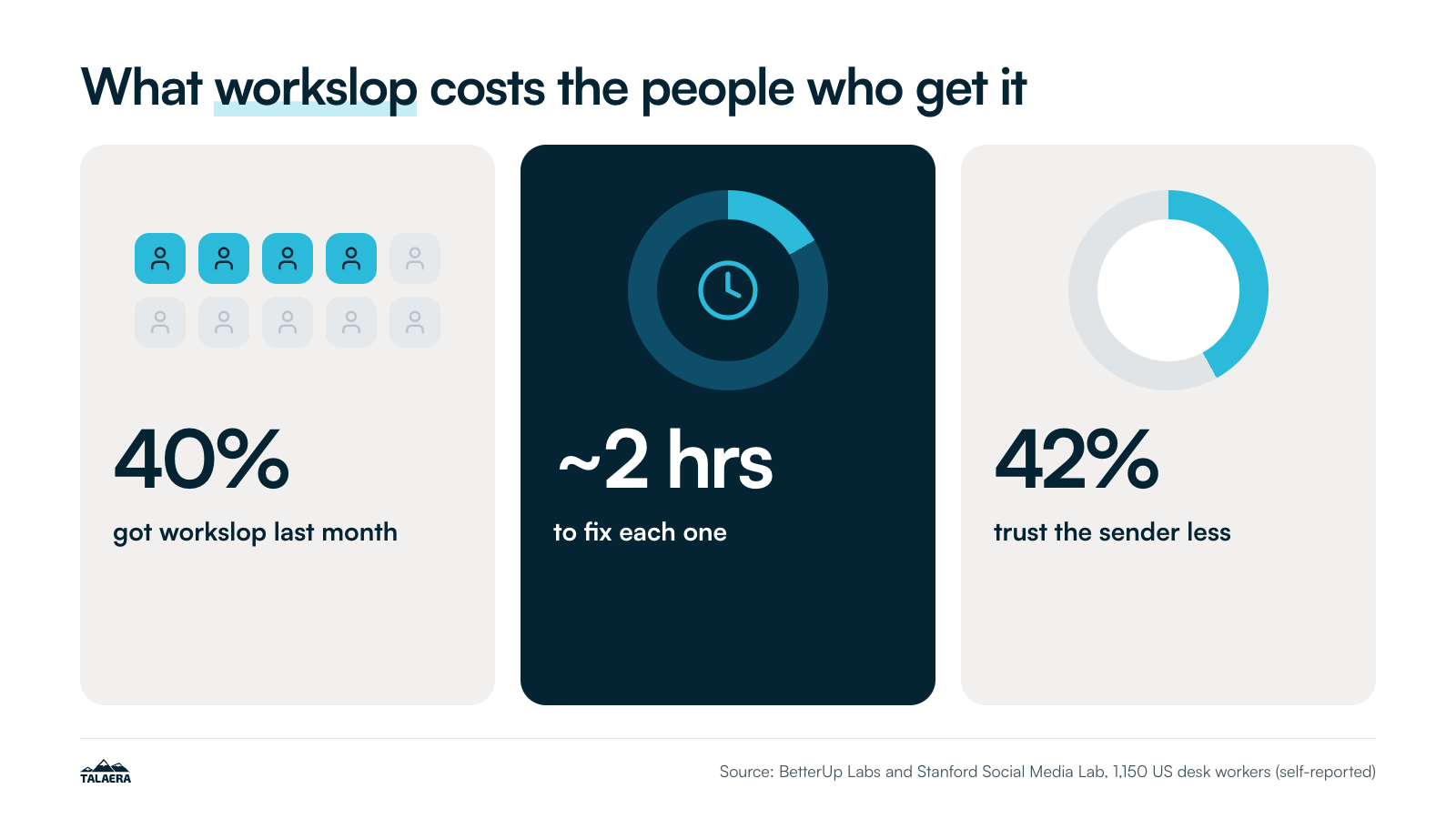
Workslop also costs the sender. About half of recipients said they saw the sender as less creative, capable and reliable, and 42% saw them as less trustworthy. So when you raise a quality problem, the other person may hear a verdict on their competence.
Keep one distinction in mind: AI use isn’t evidence of poor quality, and poor quality isn’t evidence of AI use. People produced weak work long before ChatGPT existed.
6 quality problems people call AI slop
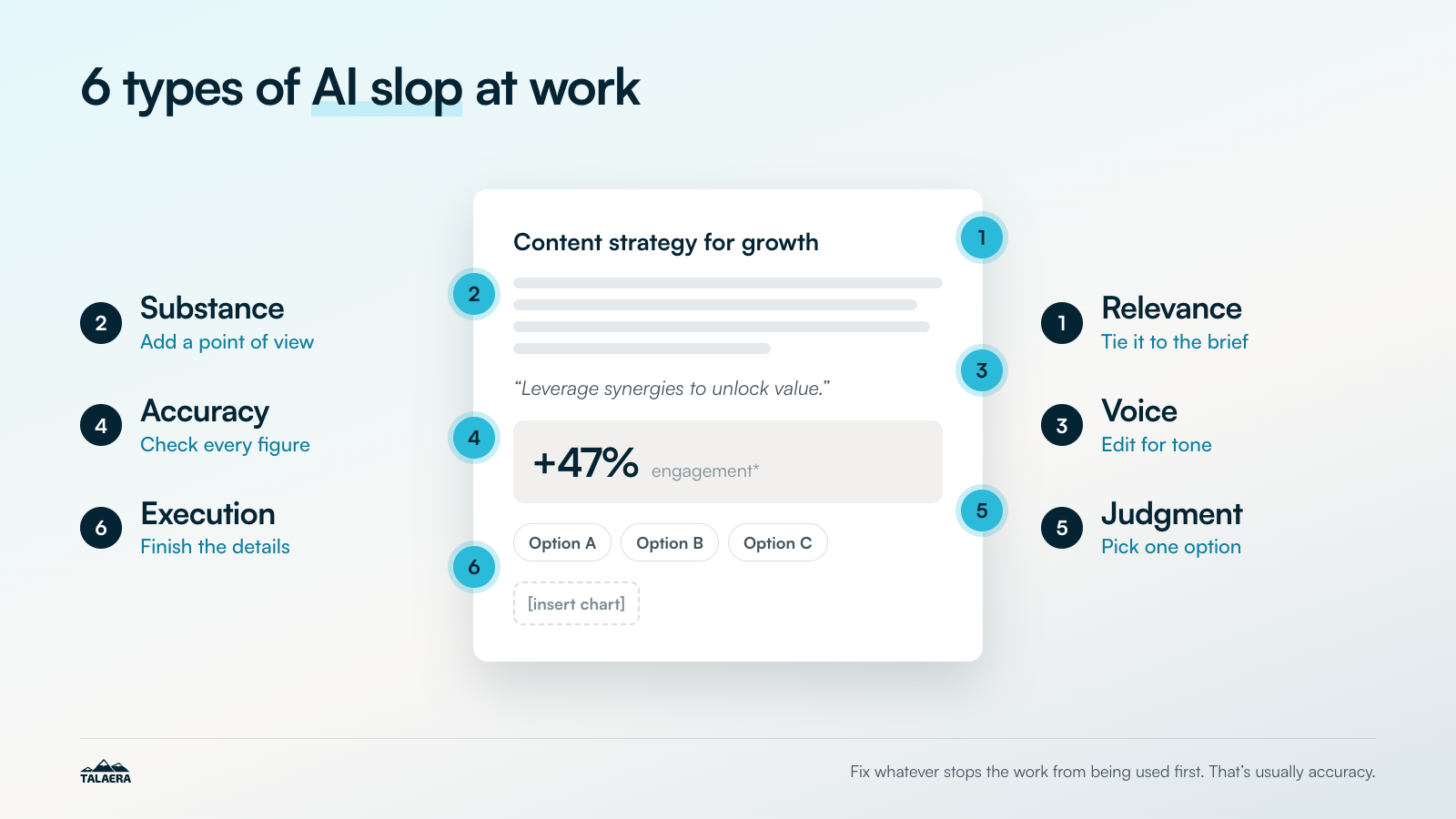
When something feels like AI slop, try to pin down what bothers you: the ideas, the wording, the facts or the structure. Each problem needs a different fix, and it’s much easier for someone to fix a problem you can point to.
| Problem | What you’ll notice | Ask yourself | What to fix |
|---|---|---|---|
| Substance | It reads smoothly, but you learn nothing new | Could this apply to any company? | Go back to the research and find a specific point |
| Voice | Good ideas that don’t sound like you or your team | Would you keep the ideas and change the words? | Edit the wording and keep the ideas |
| Accuracy | Numbers, quotes or details that are wrong or can’t be traced | Can you trace each claim to a source? | Check every claim against its source |
| Judgment | It lists options but never picks one | Does it say what to do and why? | Ask for a clear recommendation and the reason |
| Relevance | A good answer to a different question | Does it answer the question that was asked? | Go back to the brief and rework the answer |
| Execution | You have to dig to find the main point | Can you find the main point in 30 seconds? | Put the main point first and organize around it |
Use the table as a practical checklist. It fits research by Shaib and colleagues, who found that people disagree about what counts as “slop” but tend to react to the same things, such as whether the text hangs together and stays relevant.
If you spot several problems, start with the one that stops the work from being used. That’s usually accuracy, since there’s little point polishing a paragraph built on a wrong number.
The same document can fail in different ways:
- Strong recommendations, poor voice. An article has sharp ideas but stiff, generic writing, so it needs editing and the thinking can stay as it is.
- Beautiful writing, no substance. A document reads smoothly but says nothing a reader couldn’t guess. It needs research and a point of view, and better sentences won’t help.
- Strong thinking, inaccurate claims. A report makes useful recommendations based on figures nobody has checked, so the facts need verifying before anyone discusses style.
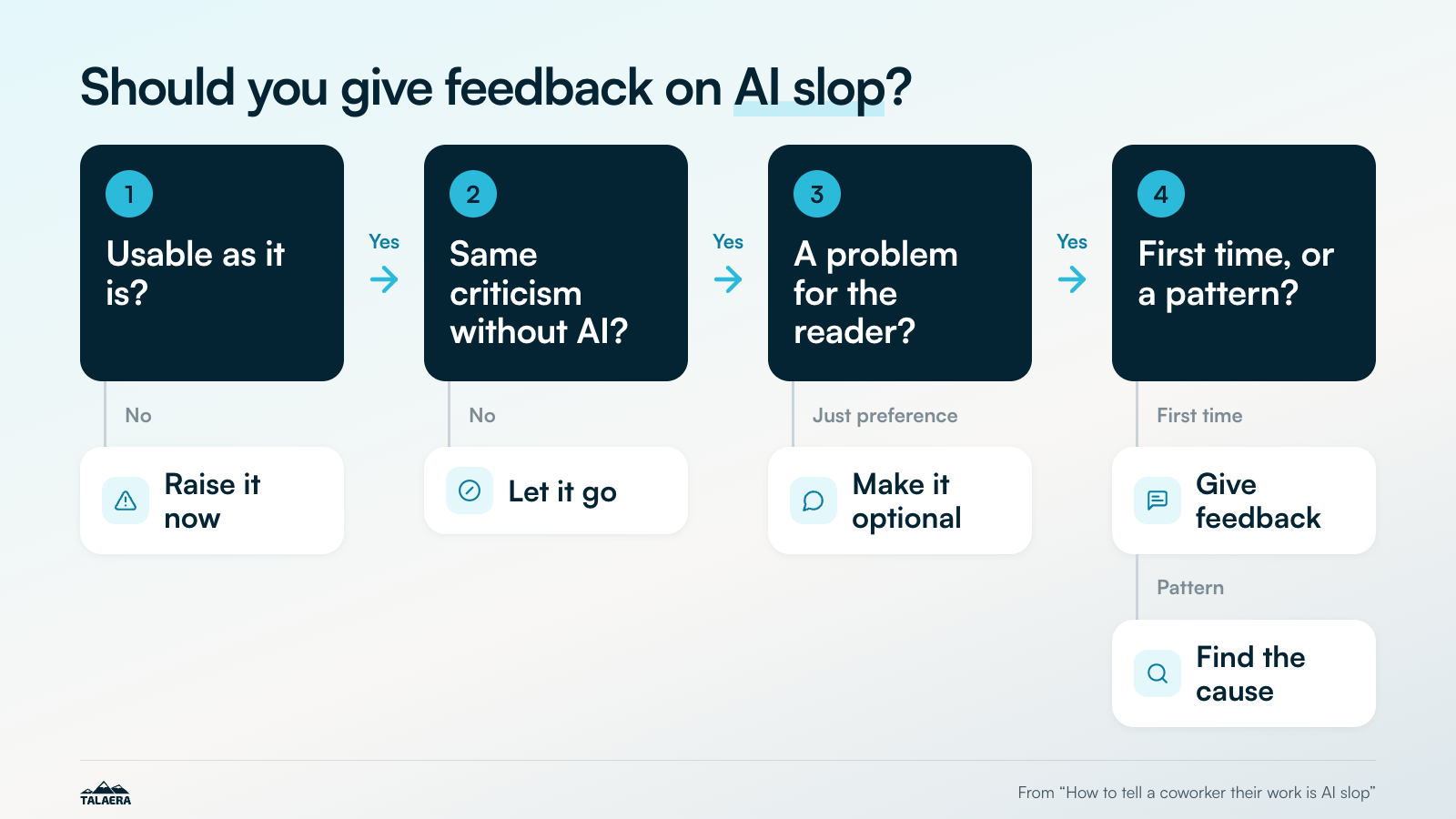
Before you raise anything, ask yourself one question: If you didn’t know whether AI was involved, would you still have the same criticism? If yes, you’ve found a quality issue worth discussing. If no, you may be reacting to the tool more than the work.
What to say when a coworker sends you AI slop
Once you know the problem, the words come more easily. Each example describes the problem, says why it matters and points to a next step. Adapt them for a meeting, Slack, email or a document comment.
| Problem | What you could say | What it asks for |
|---|---|---|
| Substance | “The article reads well, but I’m not sure what we’re adding to the conversation. Most of the recommendations could apply to any company. Can we go back to the research and find what makes this specific?” | More research and a specific insight |
| Voice | “The recommendations are really good, especially in section three. I wouldn’t change the thinking. The issue is how it’s written. It doesn’t sound like us, so I’d focus the next round on making the language more natural.” | Line editing |
| Accuracy | “I like the direction, but we can’t use this until the claims are checked. Two statistics don’t match the original sources, and I can’t find where the competitor data comes from.” | Fact-checking first |
| Judgment | From a manager: “I understand the options, but I still don’t know which one you’d recommend or why. That’s the decision we need you to make.” From a peer: “I can see the options, but I can’t tell which one you’d pick. Which way are you leaning, and why?” | A decision with reasons |
| Relevance | “This is a good explanation of the topic, but it doesn’t answer the client’s question. They want to know which option makes sense for their situation.” | Rework against the brief |
| Execution | “The information is useful, but the structure makes it hard to see the main point. Could we bring the recommendation forward and organize the evidence around it?” | Restructuring |
Saying “two statistics” tells the person exactly what to check. The peer version of the judgment example ends with a question, because peers can ask for a decision but rarely demand one.
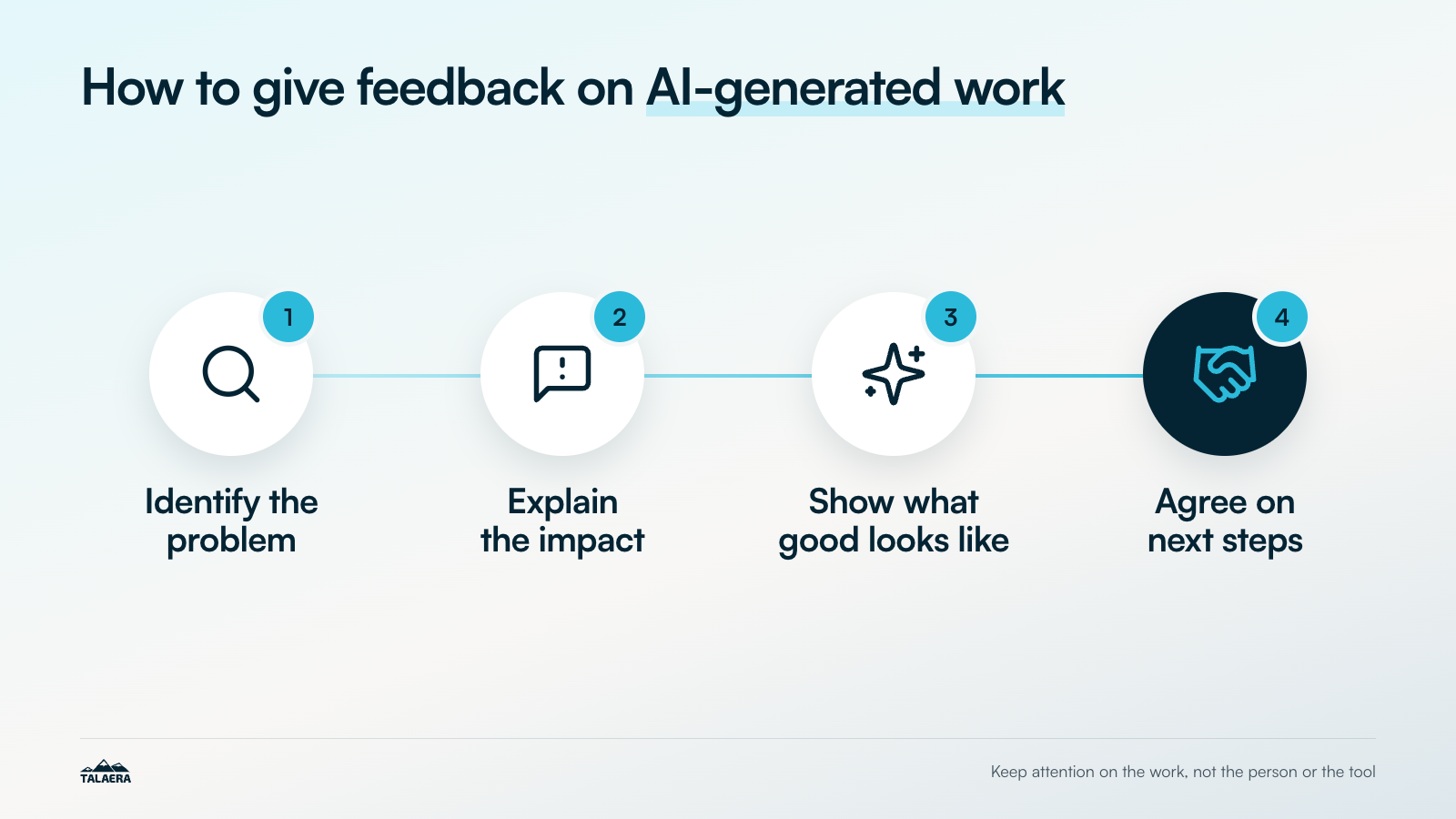
How to give feedback on AI-generated work that helps
Describe the quality problem instead of your suspicion about AI
An accusation tends to pull the conversation away from the work. The other person defends themselves (“I spent hours on this”), and now you’re arguing about how they worked instead of what needs to improve.
In four experiments with more than 4,400 participants, Reif, Larrick and Soll found that people who use AI at work expect to be judged as lazier and less competent, and others do judge them that way. So “this feels AI-generated” can sound like “you’re lazy.”
In a large meta-analysis, Kluger and DeNisi found that feedback made performance worse in more than a third of cases. It worked less well the more it pulled attention from the task toward the person. Saying “the figures on slide 6 have no source” keeps attention on the task, while “Did you just use ChatGPT?” puts it on the person.
Explain what the unfinished work costs you
Much of the cost of workslop is transferred effort. The work looks finished, but the reviewer ends up doing the research, checking or decision-making that should have happened before it was submitted. Saying so explains why the standard exists, which “this isn’t good enough” doesn’t.
From a manager: “I spent about 45 minutes reviewing this, and most of that time went into checking claims and figuring out the main argument. That’s work I’d expect to be done before it reaches review.”
Between peers, that can sound like a complaint, so a softer version works better: “I spent a while checking the figures and trying to find the main argument. Could you do a pass on those before the next version comes to me?”
Keep this in proportion, since not every document that needs editing is workslop.
Show the difference between acceptable and good
People often can’t see what’s missing until they see a better version. Compare two recommendations from a made-up client project:
Weak: “Create engaging, high-quality content that addresses customer pain points and builds trust.”
Better: “The client’s product pages explain technical specifications but don’t address buyers’ installation concerns. Start with three pages answering the questions sales hears most often, using input from the sales team and product specialists.”
The second version identifies a specific gap and gives someone a task they could start tomorrow.
Agree on what needs changing and who will do it
End with something vague like “make it more strategic” and the next version will probably have the same problems. Before you finish, check that the other person knows:
- What doesn’t meet the standard, and why it matters
- Whether the work needs editing, research, rethinking or rebuilding
- What the revised version needs to accomplish
- Who does the next step, and by when
For the fundamentals, see our guide on how to give constructive feedback.
How to give feedback in English across cultures
When feedback crosses languages and cultures, watch for three problems.
Being so indirect that the message disappears
“This is interesting. Maybe we could explore a few other directions?” sounds like a small suggestion. If you mean the recommendation isn’t ready, say so: “The recommendation is still too general for this client. We need to make it more specific before we send it.” You can be respectful and clear at the same time. Our guide to high- and low-context communication explains why listeners can understand the first version so differently.
Sounding more accusatory than you intend
“You clearly just used ChatGPT for this” is blunt in any language, and “clearly” makes it worse. Ask about the reasoning instead: “I’m struggling to see how these recommendations connect to the client’s situation. Can you walk me through your reasoning?”
Mistaking language confidence for competence
A colleague may struggle to explain their reasoning on the spot in English even when their thinking is sound. Send questions before the meeting, leave time for answers, and follow up in writing.
Avoid guessing someone’s communication style from their nationality. Adapt to the person in front of you and check that you’ve understood each other. Our guide to giving feedback across cultures goes deeper.
What if your coworker gets defensive when you give them feedback?
“But I spent hours working on this”
Acknowledge the effort and keep the feedback: “I know you put a lot of time into this. It still isn’t ready, so let’s work out what needs to change.”
“You told us we should use AI”
This is fair when a company encourages AI without defining good output. Agree, then return to the standard: “Yes, and I still want us to use AI. We just need to check what it gives us and make sure it answers the brief. The tool can help, but the final recommendation still has to come from us.” For better output from the start, share these AI prompts for professionals.
“I don’t agree that there’s a problem”
Go back to the purpose of the work: “That’s fair. Let’s look at what the client asked for and compare it with what we’ve produced. I think we’re missing a clear recommendation. Do you see it differently?” Then listen, because sometimes the reviewer is wrong. For more phrases, see our guide to agreeing and disagreeing at work.
A full feedback conversation on AI slop
You: Have you got 15 minutes to go through the client deck before it goes out?
Colleague: Sure. Is something wrong?
You: The structure’s clear and the research section is useful. My main concern is the recommendation. Slides 12 to 14 list three options, but I can’t tell which one we’re recommending or why. That’s what the client asked us for.
Colleague: I thought it was better to give them the options and let them decide.
You: I see why. But they asked us to pick one, so if we don’t, they’ll come back with the same question. Which option would you go with?
Colleague: Probably the second one. It’s cheaper to roll out.
You: Great, that’s the argument I want to see. Can you rebuild those three slides around option two and use the cost comparison as your evidence? And can you check the two market figures on slide 6? I couldn’t find the source.
Colleague: OK. I can have it ready by Thursday.
You: Thursday works. Send it to me first and I’ll look at it before it goes to the client.
The reviewer starts with what works and points to one problem on specific slides. When the colleague pushes back, the reviewer asks for their view, which turns the disagreement into a decision, and the conversation ends with a clear task, an owner and a deadline.
Why do people keep producing AI workslop?
If the same person keeps sending weak work, think about what might be behind it before you respond. The four causes below can overlap, and you may only find out which ones apply by talking to the person.
They may not have the skills yet
They may know what good looks like but not yet know how to produce it. Guidance, examples, training and chances to practice usually help more than repeated criticism.
They may mistake plausible for good
AI output sounds confident, so it’s easy to assume it’s already strong. One useful question is “What would you change about this if you had another hour?” Treat the answer as a clue. Specific improvements suggest they can see what’s missing and may have run out of time. “Nothing” might mean they don’t see it yet, or that they’re unsure what you expect. Either way, comparing alternatives together and talking through the trade-offs helps.
They’re rewarded for speed
Some teams push AI use without defining good output. In a 2026 survey of 962 US desk workers by the same BetterUp and Stanford team, sending workslop was more common where organizations encouraged AI use, where people had little say over how they used it, and where psychological safety was low. These findings are associations and don’t prove cause, though they suggest workslop is sometimes a team problem.
They know the standard and don’t meet it
If someone knows what’s expected, has the resources and still falls short, it becomes a performance issue for their manager, though it’s worth ruling out the other causes first. Managers who need to document it can use these performance review phrases.
How to prevent AI workslop at work
Agree on what good work looks like
Review strong and weak examples together and write down what good looks like. In a small Atlassian pilot built on this idea, 94% of the 31 participants said they felt more comfortable giving feedback on AI-generated pages afterward. The results weren’t statistically significant, so treat it as an idea to test with your team.
Define what’s ready for review
Agree on three stages: Draft, Ready for review, and Ready to deliver. Some teams like to use green, yellow, red as markers to indicate how ready an asset is.
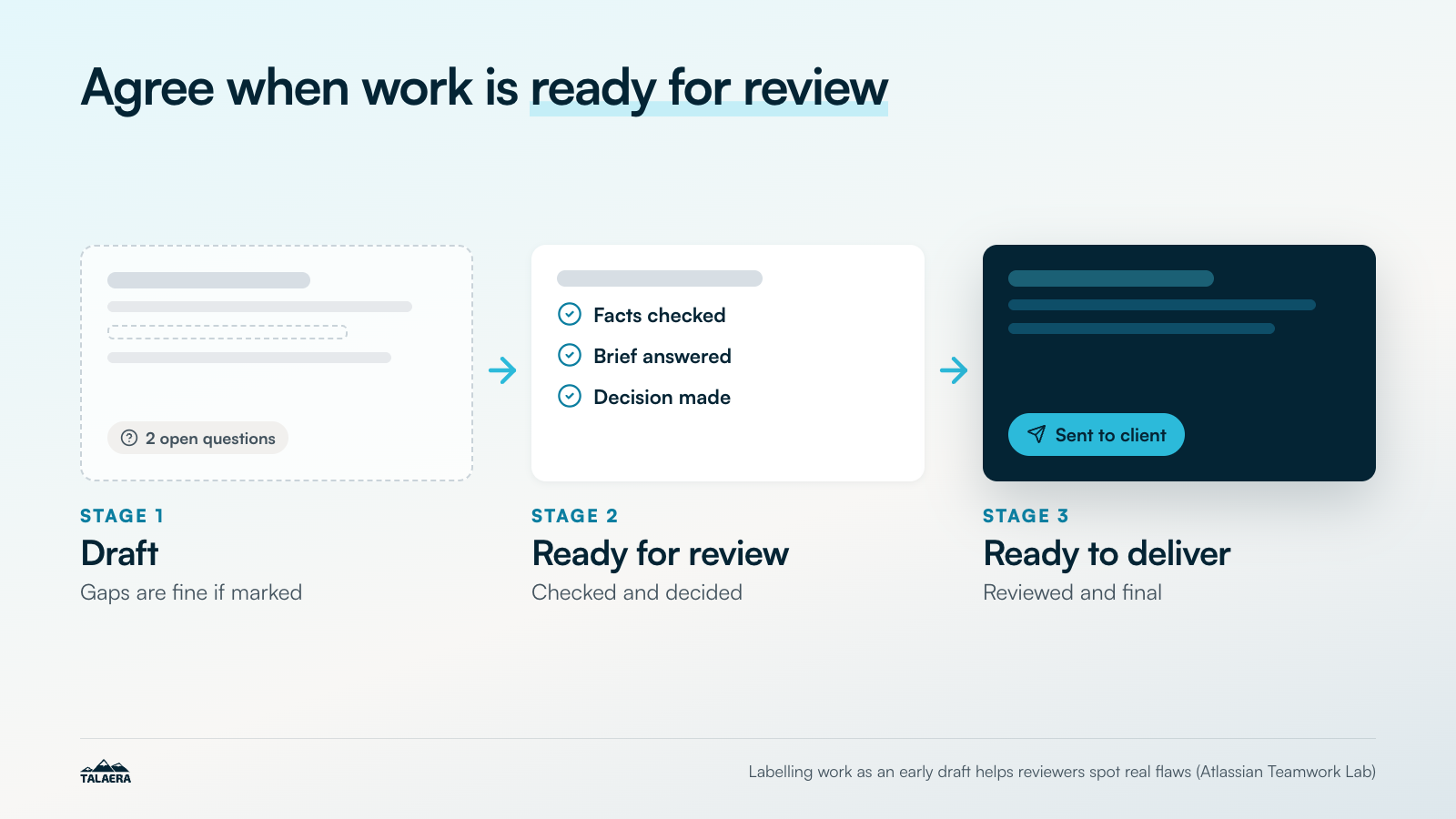
Labels help reviewers too. In Atlassian’s polish experiment, adding an “Early Draft” label to the AI-polished proposal almost entirely removed the drop in flaw-spotting.
Stop fixing other people’s work for them
If you keep filling the gaps yourself, the sender may never learn the work was incomplete. Editing each other’s work is normal, as long as you say what was missing. A peer can explain what they need from the next version, and a manager can clarify the standard and address repeated problems. Our peer feedback guide covers how to raise it with a colleague.
Hold people accountable for what the work does
You don’t need to prove your colleague used AI, guess how much effort they put in, or end up doing their work for them. What helps is identifying the problem, explaining it clearly and agreeing on what changes next. Don’t make people defend how they produced the work. Make them accountable for what it accomplishes.
All of this gets harder when you’re working in English as a second language. Finding words that are clear without sounding harsh takes more effort, and a single word like “maybe” or “clearly” can change the whole message. Like any communication skill, it gets easier with practice.
Seeing workslop across your global teams? Talaera’s business English training helps international teams handle work conversations in English, with expert coaching and practice built around the situations your teams face at work. Book a demo for your team
Want to work on your business English skills? Talaera’s expert coaches and AI tutor help you role-play real workplace conversations in English and give you feedback on clarity, vocabulary, tone and cultural cues. Start practicing today
Frequently asked questions about AI slop at work
How do you politely tell someone their work sounds AI-generated?
Describe the language instead of the tool, and point to specific lines: “Some of these sentences sound very formal for our readers. Could you rewrite the intro the way you’d explain it on a call?”
Should you ask a coworker if they used ChatGPT?
It’s most useful when there’s a reason beyond quality, such as a disclosure policy or confidential client data. Keep it neutral: “Did you use any AI tools for this? I need to check it against our data policy.” If your concern is quality, focus on the output.
What if your manager sends you AI slop?
Ask for what you need to do your job: “Which of these three options should I prioritize?” or “Could you point me to the source for these figures?” Questions about next steps are usually easier for a manager to hear than criticism.
Is work automatically AI slop if it was generated with AI?
No. AI slop describes the quality of the output. Work made with AI can be accurate and useful if the person checked it and added their own judgment. Work written entirely by hand can still be generic or wrong.
Should you give feedback on AI slop in writing or in person?
It depends on the person and the size of the change. Small fixes, like wording or a figure to check, often work as comments. If someone needs to rethink the work, a short call tends to go better. Either way, a written summary of what you agreed helps, especially for colleagues working in their second language.
What if the work isn’t bad, just different from how you’d do it?
Run the self-check first. If it turns out to be a preference, say so: “This works. If it were mine, I’d move the example up, but it’s your call.”
About the author

Paola Pascual is Marketing Director at Talaera, where she leads the company’s content and hosts the Talaera Talks podcast. She is also Content Director at LAIRE, a digital marketing agency. She holds a master’s degree in organizational psychology, has a background in translation and linguistics, and has lived and worked in six countries. Her writing on communication in global teams has also appeared in Training Industry.