Workplace communication is the exchange of information, expectations and feedback between people in a professional setting across every channel and direction. Language proficiency and cultural norms shape that exchange as much as individual clarity does for multilingual or distributed teams, and structural factors such as time zones add another layer. Talaera’s coaching data shows the main gap has moved from grammar to hesitation under pressure, and reading breakdowns in global teams as four factors working at once explains why generic communication training misses part of the problem.
What workplace communication involves and why breakdowns cost $1.2 trillion a year
Workplace communication covers every interaction where professionals exchange information and set expectations. That includes scheduled meetings and formal presentations. It also includes Slack threads and hallway check-ins, plus the quick “got a minute?” exchanges that shape how work moves. Limiting communication to meetings and email leaves out many places where breakdowns occur.
According to Grammarly’s 2023 report, poor communication costs U.S. businesses an estimated $1.2 trillion a year, or roughly $12,506 per employee in lost productivity. Gallup’s research adds that managers account for 70% of the variance in team engagement, so how managers set expectations and give feedback carries weight across a whole team.
Four interconnected factors sit behind much of the damage in global teams. Language proficiency covers whether someone can express an idea precisely while communication skill and confidence cover how they structure and deliver it. Cultural norms govern how colleagues read directness and silence. Structural context, from time zones to tooling, decides whether the message reaches the right person at the right time.
Poor communication in a global team can be read as four overlapping gaps in language, skill and confidence, culture and structure, and each gap needs its own fix.
Types of workplace communication differ by channel and direction
Every message travels through a channel and in a direction, and it lands either in real time or with a delay. Channel type is the usual starting point for a taxonomy. Direction and timing matter as much for global organizations, because each combination creates distinct failure points.
Verbal communication carries the high-stakes moments
Verbal communication is the exchange of information through spoken words, from formal meetings to hallway conversations. It carries high-stakes moments such as quarterly reviews and client calls. For non-native speakers, spontaneous Q&A and fast-moving discussions raise the difficulty because pauses between speakers are short. The gap between understanding a question and formulating a response in a second language can make capable professionals look less confident or less knowledgeable than they are.
Written communication leaves tone to the reader
Written communication covers any message delivered through text (email and chat). In distributed teams, written channels carry a large share of daily interactions because people work across time zones and can’t always meet live. Without voice or facial cues, readers fill in the tone themselves, which is where misreads and ambiguity start. A two-line Slack message meant to be efficient can read as curt to someone whose cultural norm expects more context and warmth.
Nonverbal cues change meaning across cultures
Nonverbal communication covers body language and tone of voice. These cues carry significant meaning in face-to-face and video interactions and often reinforce or contradict what someone says. Norms vary across cultures in ways that create misunderstandings. Sustained eye contact signals confidence in some cultures and aggression in others, and silence after a question can indicate thoughtful consideration or disagreement depending on who is in the room.
Visual communication reduces dependence on language precision
Visual communication uses slides and dashboards, among other graphic formats, to convey information. For multilingual teams, well-designed visuals help align understanding when fluency varies across the group.
Direction shapes the skill a message demands
Who a message goes to changes what it needs. Upward messages to senior stakeholders call for conciseness and a frame built around business impact, while downward messages from managers depend on clear expectations and follow-through. Across functions, lateral messages tend to fail when teams lack shared terminology or context. External messages to customers and partners carry higher stakes because misunderstandings directly affect revenue and trust.
Timing separates synchronous from asynchronous communication
Synchronous communication (live meetings and phone calls) works best for decisions that need real-time input and for sensitive conversations. Asynchronous communication (email and recorded updates) suits status updates and decisions that benefit from reflection. It fails in global teams when writers omit context or assume shared knowledge. Organizations managing across time zones need clear async communication norms to prevent these breakdowns.
Four channels and four directions produce eight types
Each channel and direction carries its own pitfalls for global teams, as the table below shows. Choosing the right channel and timing for each message is itself a communication skill that works best as a shared team norm.
| Type | Best used for | Common pitfalls | Global-team consideration |
|---|---|---|---|
| Verbal | Decisions, brainstorming, sensitive topics | Excludes those who need processing time | Non-native speakers struggle with speed and spontaneous input |
| Written | Documentation, async updates, detailed instructions | Tone misreads, ambiguity, over-reliance on text | Brevity norms differ across cultures |
| Nonverbal | Reinforcing spoken messages, reading engagement | Cues misinterpreted across cultures | Eye contact and silence carry different meanings across cultures |
| Visual | Data presentation, process explanation, alignment | Over-designed slides that obscure the message | Reduces language-dependent ambiguity |
| Upward | Status updates, proposals, escalations | Burying the key point, insufficient framing | Hierarchy expectations shape how direct people are with senior colleagues |
| Downward | Expectations, feedback, strategic direction | Vague instructions, assumed understanding | Explicit follow-up matters more across language gaps |
| Lateral | Cross-functional coordination, project handoffs | Jargon, missing context, unclear ownership | Teams in different regions may not share terminology |
| External | Client communication, partner alignment | Inconsistent tone, unmanaged expectations | Cultural mismatch with customers adds brand risk |
Communication styles in the workplace shift with cultural context
Communication style shapes how people give feedback and interpret silence. It operates independently from channel choice, so two people can use the same video call and still miscommunicate because their styles clash. Culture is one source of friction in global teams, next to organizational norms and personality.
Direct and indirect feedback styles get misread in both directions
Direct vs. indirect communication styles show up clearly in feedback on a missed deadline. A direct communicator might say, “You missed the deadline, and it delayed the entire release,” and intend that as respect for the colleague’s time. An indirect communicator might say, “You might want to consider whether the data fully supports your point,” and expect the listener to read the full message behind the softer words. Each listener hears the other style through their own default, so the direct phrasing can sound confrontational and face-threatening while the indirect phrasing can sound like a mild suggestion. This mismatch is a frequent source of tension that L&D teams are asked to resolve, and neither style is wrong.
Cultural norms about directness and silence shape how colleagues read each other, though they can’t predict how any one person will behave. Calling a style clash an individual failing (“she needs to be more direct”) hides a team-level pattern behind a personal label.
High-context and low-context cultures read the same words differently
Erin Meyer’s Culture Map framework maps these differences across eight dimensions (including communicating and evaluating). One of the most useful distinctions is between high-context and low-context cultures.
High-context communication relies on shared understanding and what remains unsaid, while low-context communication puts meaning in the words themselves.
In a cross-functional global team, low-context communicators often find their high-context colleagues vague or evasive, and high-context communicators often find their counterparts blunt. L&D and People teams can map and train for these patterns. Shared awareness across teams keeps any one culture’s norms from becoming the default.
Workplace communication examples show where breakdowns cluster
Communication problems show up differently depending on the situation, so the fix differs too. The scenarios below are composites of patterns that recur in global teams, and they show why generic advice falls short when language and culture intersect.
Fast meetings hide the best ideas
Meetings reward whoever speaks first, which hides ideas from people who need a moment to form them in English. A team member with strong technical ideas stays silent through an entire strategy discussion because no natural opening appears in a fast-paced conversation. By the time they formulate their point, the group has moved on. Others do speak up with an indirectly framed contribution, and colleagues who expect proposals to sound like assertions overlook it. Either way, the organization loses the best idea in the room.
Among professionals starting 1:1 coaching with Talaera, 36% say they rarely speak up in meetings in English (a self-rating of 1 or 2 out of 5 in a survey of 297 learners). A software engineer in India working with a US team described the experience this way, “I understand English, but I pause frequently and struggle to form sentences when answering unexpected questions.”
A polite yes hides delivery risk
Accepting a deadline out of politeness hides a delivery risk until the work slips. A team member agrees to a timeline they know is unrealistic because declining feels risky, and the manager hears a firm commitment. It surfaces only when the work arrives late.
Customer calls reward empathy as much as technical accuracy
Customer calls expose the gap between diagnosing a problem and resolving the emotional friction around it. A support agent correctly diagnoses a technical issue but can’t match the customer’s urgency with the right language. They say “the system will be restored” when the customer needs to hear “I understand this is affecting your team right now, and here’s exactly what happens next.” That escalation traces back to communication, since the diagnosis itself was sound.
Handoffs break on implicit assumptions
Implicit assumptions travel badly across regions. A product team writes detailed requirements, but phrases like “standard error handling” or “user-friendly flow” carry different meanings for the engineering team interpreting them in another region. What felt explicit to the writers had gaps for the readers. Weeks of development pass before the misalignment surfaces.
Unscripted questions test senior presenters
The unscripted follow-up question tests a presenter more than the prepared material does. A senior individual contributor presents rigorous analysis to executives and handles the prepared material well. Then a VP asks an unexpected question, and the presenter hesitates or qualifies excessively. Credibility can drop in seconds because the spontaneous answer undermines otherwise strong analysis.
Workplace communication barriers stack on top of each other
Communication failures in global organizations often involve several barriers at once, which makes the root problem hard to diagnose and harder to fix with generic training. Talaera’s analysis of 2,000 coaching plans written between 2019 and 2026 shows meetings named as a key situation in 68.4% of plans in 2026, up from 36.8% in 2019, while cross-border work with colleagues in other countries almost tripled and hesitation overtook grammar as a diagnosed gap. These trends moved together over the same years, though the data does not show that one causes another.
Language gaps go deeper than fluency
Conversational English and business communication proficiency are different skills, and the difference catches organizations off guard because the employee “speaks English well” by casual standards. What they lack is communicative competence in high-stakes professional contexts, which matters for L&D teams designing training programs.
Social fluency lets someone handle small talk, while professional communication proficiency lets them negotiate and answer pointed questions under pressure.
Hesitation has overtaken grammar as the gap coaches diagnose
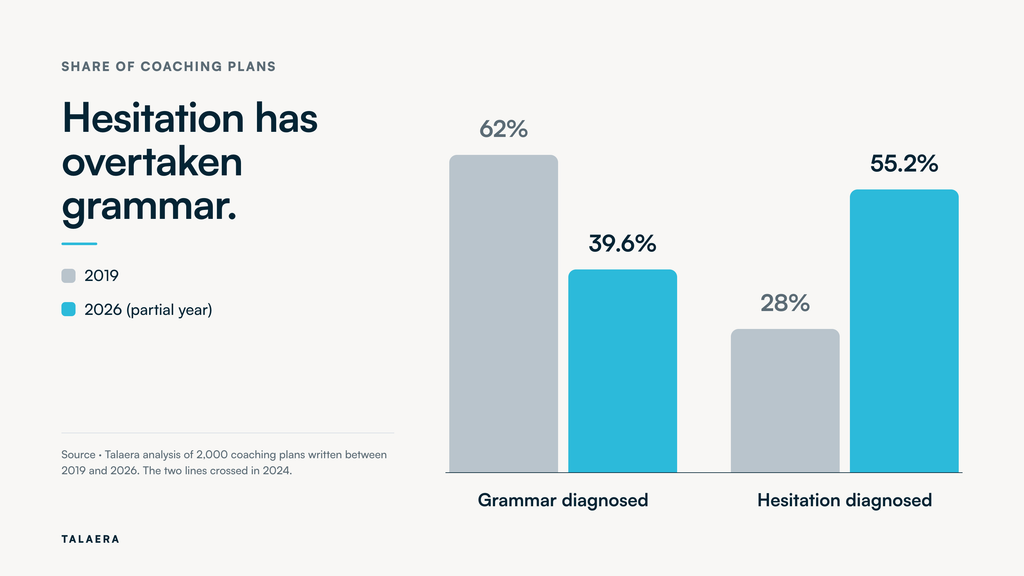
Talaera’s analysis of 2,000 coaching plans written between 2019 and 2026 (2026 is a partial year) shows grammar diagnosed in 62% of plans in 2019 and 39.6% by 2026, while hesitation, such as searching for a word or translating in your head, rose from 28% to 55.2%. The two lines crossed in 2024, when accuracy stopped being the main gap. As one L&D lead at a global IT services company put it, “They know how to speak the language, but where we need help is aspects like speaking up in meetings and communicating effectively.”
Cultural norms get misread as personal intent
Cultural norms about directness and feedback differ across groups in ways that repeat across organizations, and the Culture Map framework describes many of these tendencies. Silence in meetings and the meaning of “yes” vary by cultural context, and so do expectations about who speaks first and how disagreement gets expressed. Without shared awareness of these patterns, colleagues can misread each other’s intentions as personal.
Confidence blocks expertise from surfacing
Technically skilled professionals sometimes can’t convey what they know. Anxiety and past negative experiences presenting in a second language can cause them to freeze during spontaneous questions or to stay silent when their input would change a decision.
Talaera’s analysis of 2,000 coaching plans written between 2019 and 2026 shows that confidence is a diagnosed barrier in 43.1% of plans for learners assessed as Advanced or Nearly Native, up from 34.2% before the pandemic. Among plans for the most fluent learners, the share that names a confidence gap is growing, so more language study alone does not close it. Plans naming the leadership team as the audience rose from 6% in 2019 to 33.2% in 2026, which is why Talaera treats fluency as a seniority skill and not only a language skill.
Structural friction degrades signal quality
Time zones push teams toward async communication, so a question asked in one region gets answered the next morning in another and arrives stripped of tone and context. When documentation norms are missing, critical decisions can live in Slack threads that some team members never see, and updates scatter across several tools with no single source of truth. Remote and hybrid setups also remove the informal hallway conversations that build context and trust.
These barriers rarely appear alone
What makes communication barriers hard to address at scale is that they can arrive together. One composite case involves a software engineer joining a sprint retrospective with teammates in two other regions. She faces a language gap when articulating technical trade-offs, a cultural mismatch around how directly to challenge a senior colleague’s decision, a confidence deficit from earlier meetings where her contributions were talked over, and a structural disadvantage because the meeting falls at the end of her workday.
From an organizational perspective, this reads as “she doesn’t participate in meetings.” Her silence has four layers, and each calls for a different response.
How to improve workplace communication across global teams
Effective workplace communication starts with explicit norms. Global teams often run on unspoken rules inherited from whichever office or culture dominated the company’s early growth.
Written norms replace unspoken rules
When one office assumes “urgent” means “respond within the hour” and another reads it as “prioritize this week,” the friction gets mistaken for a performance problem. Teams reduce that ambiguity by writing down when to use async versus sync channels, how decisions get documented, what response times apply at each urgency level and how feedback is delivered. Written norms matter most across time zones, where real-time clarification isn’t always possible.
Training works when it mirrors Monday-morning situations
Communication training is most useful when it targets the business scenarios where breakdowns happen. Grammar drills and vocabulary lists don’t prepare someone to push back on a stakeholder’s timeline in a quarterly review or to de-escalate a frustrated customer. Correctness can be studied and tested, while fluency under pressure is a performance skill that builds through live, repeated practice with someone watching. Communication training that works addresses meetings and difficult conversations with practice in those exact contexts.
Managers shape how a team communicates
Managers set the tone for whether team members speak up and whether meetings produce decisions or fill calendars. Useful manager training covers clear feedback across cultures and meetings where non-native speakers have space to contribute. It also teaches managers to recognize when a team member’s silence points to a communication barrier, which is easy to mistake for a competence gap. Talaera sees the strongest outcomes when learners are actively supported by their managers.
Global English habits include everyone
Adopting Global English principles (a plain, idiom-light style of English) keeps every channel inclusive while keeping the content precise. That means reducing idioms and culturally specific references and defaulting to written summaries for decisions and action items. When a VP says “let’s punt on this” in a meeting with colleagues who learned English as a second language, some may not know whether the project is delayed or cancelled. Replacing that phrase with “we’ll revisit this decision in two weeks” removes the ambiguity.
Asking for clarification becomes standard practice
Teams benefit when asking “can you clarify what you mean by X?” becomes standard practice. In many teams, requesting clarification feels like admitting you don’t understand, which carries social risk, especially for non-native speakers and junior employees. When managers model this by asking for clarification in front of the team, they signal that precision matters more than appearing knowledgeable. That shift surfaces misalignment before it becomes a missed deadline or a customer escalation.
How to measure workplace communication effectiveness with business data
Training completion rates and test scores show who attended, and they say little about who communicates better at work. L&D reports often center on attendance and pre/post assessment scores. These numbers satisfy a reporting requirement, but they don’t answer the question executives ask, which is whether communication is improving in ways that affect the business.
Communication quality shows up in metrics your organization already tracks, such as escalation rate and CSAT for support teams and rework requests after handoffs for product teams. A clean test ties one metric to one situation and compares the quarter before practice begins with the quarter after. Behavior metrics work too, and in Talaera surveys of learners starting and finishing 1:1 training, 56% of finishers said they speak up in meetings often or always, compared with 30% of starters (two different groups, self-reported). Operational metrics can show the effect too, and in Talaera’s published WOW24-7 case study the median time to close a ticket fell from 15m 38s to 13m 02s (17% faster) after a five-session group course for support agents. That is a number finance already understands, and it gives L&D a result to report beyond attendance.
Role-specific measurement matters because a support agent handling live chat needs different communication skills than an engineering lead presenting a technical roadmap to senior stakeholders. Blanket proficiency scores flatten those differences into a single number that hides the gaps that matter. Running a communication skills audit across teams surfaces the specific gaps that affect performance in each role. Product managers might struggle with concise written updates while a sales team might lose deals during spontaneous Q&A. Identifying those patterns lets L&D target training where it changes outcomes.
Diagnosis comes first, then norms, then practice in real situations
Communication breakdowns in global teams usually have several causes at once, and shared norms address only some of them. Practice in real situations and measurement address the rest. A product manager and an engineer in different regions can miscommunicate when nobody has established shared expectations for how decisions get documented or how feedback gets delivered.
Useful first questions include which meetings produce rework and which handoffs need follow-up. Once those contexts are named, a communication skills audit gives L&D a map of the gaps, and implementation will look different for each team. L&D teams that want to see how Talaera trains these situations can book a Talaera demo.
Frequently asked questions
What do you mean by workplace communication?
Workplace communication is the exchange of information and expectations between people in a professional setting. It spans verbal and written messages as well as nonverbal cues and visual formats, and it moves up and down the org chart as well as across functions. For global organizations, it also requires managing differences in language proficiency and cultural norms.
What are the 7 C’s of communication in the workplace?
The 7 C’s are clarity, conciseness, concreteness, correctness, coherence, completeness and courtesy. They provide a useful baseline for evaluating any message. Applying them across multilingual teams requires cultural awareness, because conciseness in one culture can feel abrupt in another and courtesy looks different in direct and indirect communication cultures.
What is the root cause of poor communication in the workplace?
Poor workplace communication usually has more than one cause. In global organizations, breakdowns typically come from language proficiency gaps and underdeveloped communication skills interacting with mismatched cultural expectations and structural friction such as time zones. Treating any one factor in isolation, such as offering English classes without addressing cultural norms around feedback, usually leaves part of the problem in place.
How can you improve communication in a global team?
Diagnosing where breakdowns occur comes first, ahead of any generic training. Explicit norms for meetings and written decisions come next, followed by targeted training that addresses language proficiency and communication skills together. Measuring progress against business outcomes such as fewer escalations and faster decision cycles shows whether the effort works.
We used AI tools to support drafting and checked every statistic against Talaera data or its primary source.