
The meeting ends. People close their laptops and move to the next task. Ten minutes later someone messages the group chat asking what the final decision was. This situation happens in many organizations. The conversation felt productive during the meeting, yet people walk away with different interpretations of what was decided, who owns the next step, and when the deadline actually is.
A short meeting summary prevents that confusion. When someone closes the meeting with a clear recap, the team leaves aligned and ready to act.
In this guide you’ll learn a simple framework for summarizing meetings clearly. You’ll also see practical phrases and examples you can use in both spoken wrap-ups and written meeting recaps.
Why a Good Meeting Summary Matters
Meetings rarely fail because people did not talk enough. They fail because people leave with different interpretations of the same discussion.
When a meeting ends without a recap, each participant reconstructs the conversation differently. Over time those interpretations drift further apart, and the team loses time clarifying what was meant in the first place.
- Different interpretations → each person walks away with their own version of “what was decided.”
- Repeated conversations → you cover the same ground in future meetings.
- Missed deadlines → nobody remembers who owns what.
- Frustrated teams → time and energy are wasted on clarifying instead of progressing.
In fact, research shows poor communication costs organizations 7.5 hours per employee per week. That’s almost a full day lost. Every. Single. Week.
This is why experienced managers close meetings with a summary. A short recap creates a shared understanding of what happened and what comes next.
On the flip side, the benefits of clear summaries are plenty:
- Create alignment → everyone leaves on the same page.
- Build accountability → names and deadlines are clear.
- Speed up progress → less back-and-forth, more action.
- Boost credibility → when you wrap up well, you sound polished and professional.
A meeting summary captures what matters for action rather than everything that was said.

Why Live Summaries Still Matter Even With AI Notes
AI tools can generate transcripts and written summaries after a meeting. Those tools help document discussions, but they do not replace the value of a live wrap-up.
Timing plays a major role. AI summaries arrive after the meeting ends, which means participants may already leave with different interpretations of the discussion.
A live recap closes that gap immediately. When someone summarizes the meeting out loud, the team can confirm whether the recap matches their understanding.
A spoken wrap-up also signals ownership. The person summarizing demonstrates that they understand the discussion and can translate it into clear next steps.
Meeting summaries create alignment in real time while documentation tools record the conversation afterward.
That’s why Talaera created the Filter → Frame → Forward method. It gives you the confidence to close meetings in the moment, while AI handles the documentation afterward. Think of it as teamwork: AI for notes, you for leadership.
Summarize Meetings In 3 Steps Framework
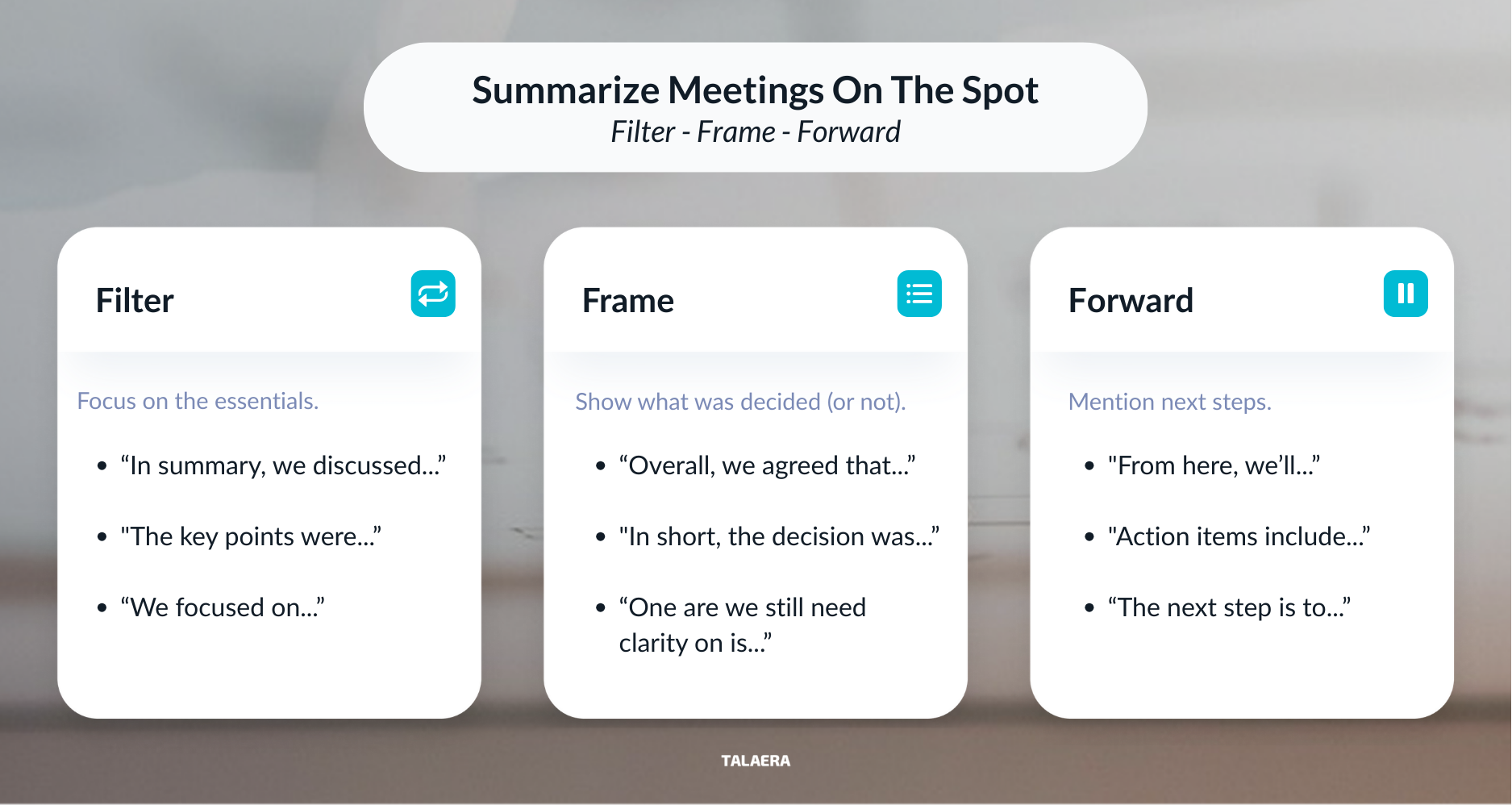
Most professionals overcomplicate meeting recaps. Some repeat every detail while others skip the summary entirely.
A simple structure helps avoid both problems. The Filter Frame Forward method keeps the recap focused and actionable. The method has three stages that move the discussion from conversation to action.
1. Filter the discussion to the essential ideas
The first step is to capture the central themes of the conversation. The goal is not to repeat every viewpoint but to highlight the ideas that shaped the outcome.
During meetings many perspectives appear, yet only a few influence the final direction. A summary focuses on those influential points so the team understands the context behind the decision.
Filtering helps participants see the discussion as a whole rather than remembering isolated comments.
Common phrases that help filter a discussion include:
- “In summary, we discussed three options for the rollout…”
- “The central issue we addressed was…”
- “Key themes that came up include…”
2. Frame the decisions and areas of agreement
After summarizing the themes, the next step is to clarify where the group landed. This stage prevents participants from filling gaps with their own assumptions.
Framing focuses on the outcome of the conversation. Even when the team does not reach full agreement, the summary should reflect the direction of the discussion.
Phrases that help frame the outcome include:
- “Overall, we agreed that…”
- “The common thread was…”
- “One area we still need clarity on is…”
- “In short, the decision was to…”
Framing turns a discussion into a clear takeaway that everyone can recognize.
3. Forward the discussion into concrete next steps
The final step connects the meeting to future action. Without this step, the summary describes a conversation rather than moving the project forward.
A strong closing recap identifies the next tasks, who owns them, and when progress will be reviewed.
Useful phrases include:
- “The immediate next step will be…”
- “Action items include…”
- “By Friday, Sarah will draft the revised plan…”
- “We’ll revisit this in our next meeting on Monday.”
Forwarding the conversation ensures that the meeting produces visible progress rather than remaining a discussion.
Useful Phrases to Summarize Meetings
Sometimes you know what you want to say, but you need the right wording. Here’s your toolbox:
Filter (recap essentials)
- “To recap the main points discussed…”
- “The central issue we addressed was…”
- “The discussion focused on…”
- “We explored several perspectives, mainly around…”
- “Overall, the conversation centered on…”
Frame (highlight agreements or tensions)
- “What we agreed on is…”
- “The consensus reached is…”
- “A point of alignment was…”
- “One area we still need clarity on is…”
- “In short, the decision was to…”
- “This means, in practical terms…”
Forward (next steps, owners, timelines)
- “The immediate next step will be…”
- “Action items include…”
- “By [date], we’ll have…”
- “We’ve assigned responsibility to…”
- “We’ll revisit this in our next meeting on…”
- “I’ll follow up with a written summary and action list.”
Use them as plug-and-play phrases until they start sounding natural in your own voice.
Meeting Summary Examples (Spoken and Written)
Let’s put the framework into practice.
Messy Discussion (raw version)
- Alex: “We should launch in September—it’s ambitious, but I think doable.”
- Priya: “That’s risky. The product still needs testing.”
- Sarah: “I’m fine with September if we add a QA sprint.”
- David: “We also need marketing alignment. Otherwise, even if it’s ready, we won’t get traction.”
Spoken Meeting Wrap-Up
“Alright, let’s wrap this up. We discussed the launch timeline and considered both September and October (Filter). The group leaned toward September, provided we add an extra QA sprint and coordinate with marketing (Frame). Next step: Sarah will outline the QA plan by next Wednesday; David will sync with marketing, and we’ll review both updates in next week’s meeting (Forward).”
Written Meeting Recap (email/post-meeting note)
Subject: Recap – Launch Timeline Discussion
Hi team,
Here’s a quick recap of today’s discussion:
- We debated September vs. October launch dates.
- Consensus: September works if we add a QA sprint and ensure marketing alignment.
Next steps:
- Sarah to draft QA plan by Wed, Sept 15.
- David to confirm marketing readiness by next meeting.
- Group to review progress on Monday, Sept 20.
This shows how you can translate a spoken summary into a written one. Polished, scannable, and actionable.
Best Practices for Summarizing Meetings
Strong meeting summaries rely on consistent habits rather than perfect wording. Professionals who summarize discussions regularly tend to follow a few patterns.
Before looking at the habits themselves, remember that the goal is clarity rather than completeness. A recap should highlight outcomes rather than reproduce the entire conversation.
Several habits make meeting summaries more effective.
- Volunteer to summarize discussions: Offering to wrap up meetings signals clarity and initiative.
- Keep the recap short: Most effective wrap-ups take less than one minute to deliver.
- Use familiar recap phrases: Consistent language helps participants recognize when the meeting is closing.
- Follow up with written notes: Spoken summaries fade quickly while written recaps remain visible.
- Practice in low stakes meetings: Regular practice builds confidence in high stakes discussions.
Over time these habits make summarizing meetings feel natural rather than performative.
Final Takeaway
Summarizing a meeting is all about making sure people walk away aligned and ready to act. Remember the three steps: Filter → Frame → Forward.
- Filter → boil down to essentials.
- Frame → highlight agreements and challenges.
- Forward → assign next steps and timelines.
One minute of clarity now can save hours of wasted effort later.
So in your next meeting, raise your hand and say: “Let me wrap this up.” Then follow with a quick written recap. You’ll look polished, your team will thank you, and your projects will actually move forward.
💡 Pro tip: If you want to take this skill further, practice by summarizing podcasts, articles, or even conversations with friends in three sentences. It sharpens your thinking—and makes you a stronger communicator in every setting.
Want more practical tools like this? Talaera offers 1:1 coaching, group workshops, and self-paced lessons to help global professionals communicate with confidence. Find your program
Frequently Asked Questions
What is the difference between meeting minutes and a meeting summary
Meeting minutes record the details of a meeting, including comments, discussion points, and formal motions. A meeting summary focuses on the outcomes of the conversation such as decisions and next steps. Most professional teams rely on summaries because they are faster to read and easier to act on.
How long should a meeting summary be
A meeting summary should usually fit within a few short paragraphs. The goal is to capture decisions and responsibilities without repeating the entire discussion. In many cases a recap of five sentences or less provides enough clarity.
When should you send a written meeting recap
Send the recap on the same day whenever possible. When the summary arrives quickly, participants can confirm that the recap reflects their understanding of the discussion.
Who should summarize a meeting
The meeting organizer often summarizes the discussion, but anyone in the group can offer the recap. Many professionals volunteer to summarize because it demonstrates clarity of thinking and helps move projects forward.
How does Talaera help professionals improve meeting communication
Talaera helps professionals practice the communication skills that make meetings clearer and more productive. This includes summarizing discussions, presenting ideas concisely, and confirming next steps so teams stay aligned. Through coaching, workshops, and self-paced lessons, professionals learn how to communicate clearly in real workplace situations.
What phrases does Talaera teach for summarizing meetings in English
Talaera teaches practical phrases that professionals can use during meetings to recap discussions and confirm next steps. For example, professionals learn how to restate key themes from a discussion, confirm decisions, and assign clear action items. These phrases help meetings end with clarity instead of confusion.