Writing professional emails shouldn’t feel risky, but for many non-native English professionals, it does. Most email problems at work have nothing to do with vocabulary. They come from uncertainty about how your message will be interpreted. You know what you want to say, yet you still pause before hitting send because you’re unsure how your words will land. You’re not sure if you sound too direct, too vague, or not professional enough.
That’s why email phrases help. They reduce risk when you’re unsure. This article gives you 150+ practical email phrases you can use immediately, and shows you how to stop relying on copying phrases so you can write emails with confidence.
“Talaera helped me become more assertive in English, both in speaking and writing. I now express myself clearly and politely via email, which has made it easier to influence others and get results.” – Manager at Ciena
Table of Contents
Why professional emails feel risky
Email writing feels harder than it should because tone is invisible. The same sentence can sound efficient to one reader and abrupt to another. When you don’t control that interpretation, you start to hesitate, look for phrases online, or ask ChatGPT to write the email for you.
This works in the short term. It also explains why even experienced professionals still spend too long rewriting emails.
If you’re copying phrases because emails still feel risky, there’s a better way. Access our email writing course with plans starting at $8 and start using English with confidence at work.
Trusted by thousands of professionals at Microsoft, OpenAI, Notion, AWS, and many more.
How this post will help you
This post will help you write professional emails that sound more natural and get faster replies.
- Make your emails more natural and varied. Say goodbye to robotic or repetitive language. You’ll get fresh alternatives to common phrases so your emails feel more human and engaging.
- Avoid awkward translations. No more copy-pasting from Google Translate. Use phrases that native speakers actually say, with confidence that they’re clear and appropriate.
- Get replies faster. The right words lead to action. These phrases are designed to make your requests more effective and improve your chances of getting timely responses.
- Improve your professional English. Learn real-world expressions used in international workplaces. With regular use, you’ll build vocabulary, tone awareness, and confidence.
Want all these phrases in one handy reference? Download the free Professional Email Toolkit, with 150+ phrases, ready-to-use templates, and a tone guide in one PDF. Download free PDF.
Quick Business Email template
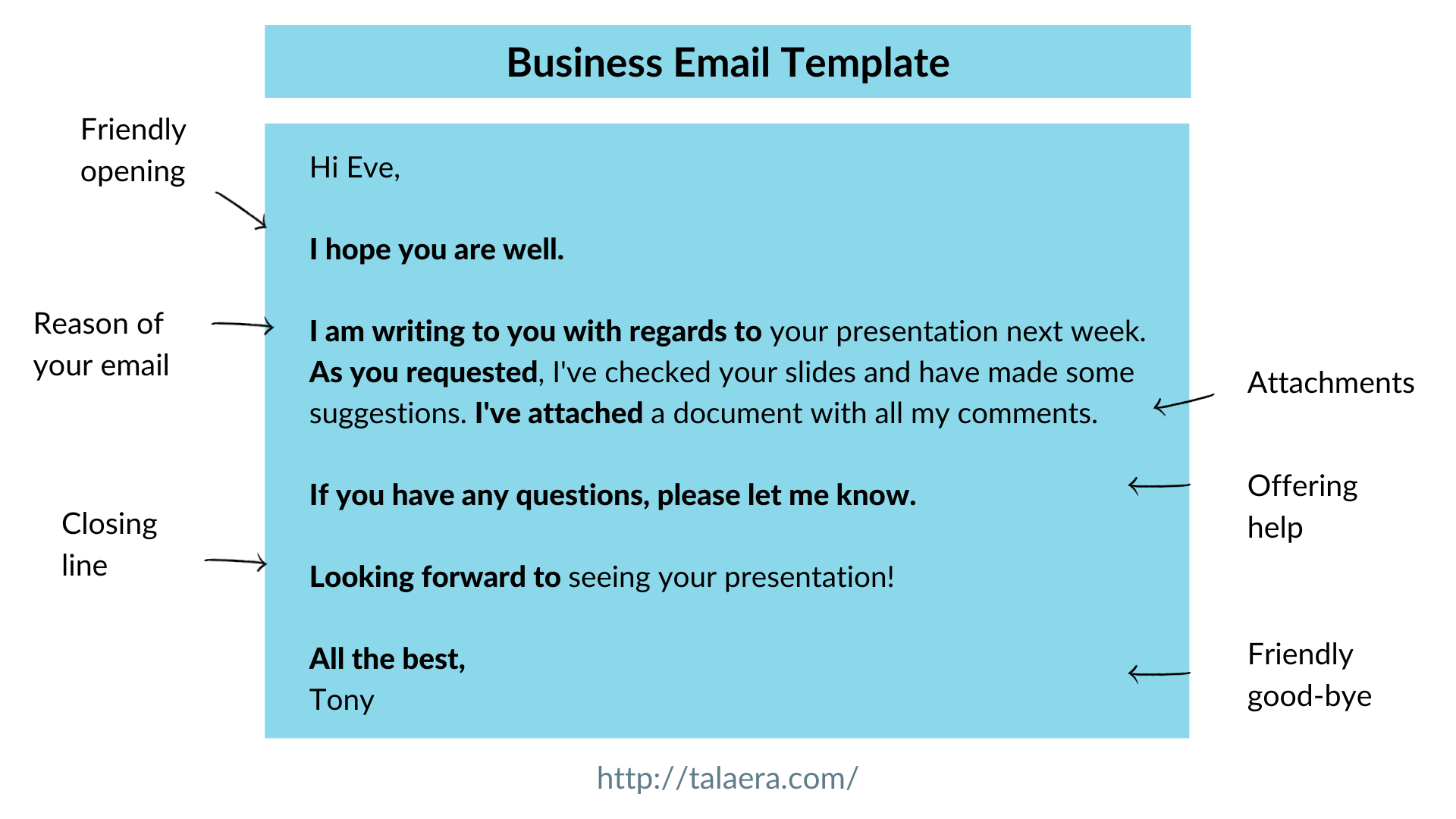
Before we begin, below is a quick template you can use for your professional emails. Following a standardized email template, along with a few simple email tips, will help your readers follow your message with ease. Business email messages should be structured and to the point. The clearer your email is, the more likely your readers will act on it. Here’s a simple email writing format you can adopt:
- Greeting
- Opening line: Be polite or get to the point
- Body: Give context, ask clearly, share info
- Closing line: Summarize, offer help, or request a reply
- Sign-off: Keep it professional (or friendly, if needed)
Polite and professional email openings
Your opening sets expectations for the rest of the message. A clear, neutral opening helps your email land professionally without sounding stiff or overly formal.
If you are looking for ideas for your email opening and email greetings, here you have different types of opening sentences.
Social email opening lines
An email starting line will help you sound more friendly and social. “I hope this email finds you well’ should be the opening phrase in emails, but not always. Here are some alternative email greeting lines:
- I hope this email finds you well.
- I hope you had a good weekend.
- I hope you had a great trip.
- Hope you had a nice break.
- I hope you are well.
- I hope all is well.
- Hope you’re enjoying your holiday.
- I hope you enjoyed the event.
- I’m glad we had a chance to chat at the convention.
- It was great to see you on Thursday.
- It was a pleasure to meet you yesterday.
Opening lines expressing the reason for the email
Tell them why you’re writing this email.
- I am writing to you about our last meeting/your presentation yesterday/our next event.
- I am writing to you with regards to/regarding/concerning/in connection with…
- I am writing to ask/enquire/let you know/confirm/check/invite you to/to update you on/ask for a favor…
- I am writing you to follow up on…
- I am contacting you to inform…
- I am reaching out because…
- This is just a quick note to…
- This is just a quick reminder…
- I wanted to let you know that…
- Might I take a moment of your time to… (very formal)
- It’s [Your Name] from [Your Company].
- This email is just to let you know that…
Opening lines when you reply to emails
- I just got your request for…
- I just read your email about…
- As we discussed, I would like to send you…
- Thank you for your email about…
- Thanks for your email this morning/yesterday/on Wednesday/last month…
- Thanks for your feedback on/your invitation/your suggestion
- Thanks for sending/asking about/attending
- Thanks for your quick reply.
- Thanks for getting back to me so quickly.
- Thank you for reaching out (to me).
Email opening lines to apologize
- Sorry for my late reply.
- Sorry that it took me so long to get back to you.
- I apologize for the late response.
- Sorry it’s been so long since my last email.
- I was sorry to hear about…
- Please accept our apologies for any inconvenience caused.
These phrases work because they provide context immediately. The reader knows why you’re writing before they process the request.
Email body lines
Email phrases for attachments and sharing information
- I’ve attached…
- Please find [file] attached.
- I’m enclosing [file].
- Please see the information below for more details about…
- The parts in bold/in red/in blue are my comments/are the changes we made.
- Here’s the document that you asked for,
- I’ve attached [file] for your review.
- I’m sending you [file] as a pdf file.
- The attached file contains…
- Could you please sign the attached form and send it back to us by [date]?
- Here’s the [document] we discussed.
- [file] is attached.
- Please take a look at the attached file.
- Take a look at the [file] I’ve attached to this email.
- I’ve attached [file].
- More information is available at www.talaera.com.
- Please note that…
Email phrases to make requests without sounding demanding
Requests are where tone anxiety shows up most clearly. Direct wording can feel risky, but indirect wording can feel weak. The phrases below balance clarity with courtesy.
- Could you please…?
- Could you possibly tell me…?
- Can you please fill out this form?
- I’d really appreciate it if you could…
- I’d be very grateful if you could…
- It would be very helpful if you could send us/me…
- I was wondering if you could/if you would be able to…
- If possible, I’d like to know (more) about…
- Please find my two main questions below.
Multiple versions can be correct at the same time. The difference is context. Choosing the right one depends on urgency, hierarchy, and your relationship with the reader.
Seeing many “correct” options is exactly why emails feel harder, not easier. In this free email lesson, see how experienced professionals decide which request sounds right, and why.
Email phrases to ask for clarification
- I didn’t/don’t fully understand [something]. Could you please explain that again?
- I didn’t quite get your point about [something]. Could you be more specific?
- Could you repeat what you said about…?
- Could you give us some more details on…?
- If you could please shed some light on this topic, I would really appreciate it.
- Could you please clarify [something]?
- Could you please clarify when you would like us to finish this?
- When exactly are you expecting to have this feature?
- Here are the details on…
- Could you please clarify what you would like us to do about…?
- If I understood you correctly, you would like me to…
- What exactly do you mean by [something]?
- Could you explain what you mean by [something]?
- In other words, would you like us to…
Email phrases to share information
Use these helpful phrases when you need to give or receive some information (or when you have already done so).
- Thank you for letting me know.
- Thank you for the heads up.
- Thank you for the notice.
- Please note…
- Quick reminder…
- Just a quick/friendly reminder that…
- Thank you for sharing.
- I’d like to inform you that…
- Just a quick heads up –
- Thanks for keeping me in the loop.
- Please keep me informed/posted/updated/in the loop.
Email phrases to clarify expectations
Many email misunderstandings happen because next steps stay implicit. These phrases help you make responsibility clear without sounding controlling.
- Please let me know if this is OK with you.
- Please let me know what you think.
- What are your thoughts (on this)?
- What do you think?
- We just need the thumbs up/the green light. (=we’re waiting for approval)
- You (totally) have the green light!
- Please guide me in this regard.
- He approved of it, so you can go ahead with the project.
Scheduling meetings via email
- I’d like to schedule a meeting on [day] if you are available/free then.
- I am available on [day], if that’s convenient for you.
- Would you be available on [day]? If so, I’ll send you an invite shortly.
- Can you make it on [day]? If so, I’ll book accordingly.
- I’m afraid I can’t make it on [day]. How about…?
- (Due to…) I’m afraid we need to reschedule/delay/postpone/put back/cancel/call off/move/rearrange our meeting.
- We are sorry to inform you that the interview/meeting scheduled for [day] will have to be rescheduled.
Learn 4 phrases to apologize for delayed email responses.
Email phrases to give bad news
- Unfortunately, …
- Unfortunately, we cannot/we are unable to …
- I’m afraid it will not be possible to…
- Unfortunately, I have to tell you that…
- I’m afraid that we can’t…
- We regret to inform you that…
- I regret to inform you that (due to…) …
- After careful consideration, we have decided (not) to …
- Due to [reason], it won’t be possible to…
- It’s against company policy to…
- I tried my best, but…
- Despite my best efforts, …
- I can’t see how…
- I’m sorry but it’s out of my hands.
- I’m afraid I won’t be able to…
- I’m sorry to tell you that…
Useful email closing lines
Closing emails clearly and professionally
Your closing reinforces the tone you’ve set. Choose one that matches your intent and level of urgency. Do you need a reply? Are you asking for a favor? These sentences are perfect for those moments!
- Looking forward to hearing from you soon.
- I look forward to hearing from you soon.
- Please let me know if this works/if you are available/if that sounds good/if you can/if you can help/if you need to reschedule…
- I look forward to seeing/meeting you.
- See you on Thursday/next week.
- Thanks.
- Thank you in advance.
- Thank you for everything.
- Cheers.
- Any feedback you can give me on this would be greatly/highly/much appreciated.
- If you could have it ready by tomorrow/the end of next week, I would really appreciate it.
- I would appreciate your help in this matter.
Closing your email by offering help or information
- I hope you find this helpful.
- I hope it’s clearer now.
- I hope that answers all your questions.
- If we can be of any further assistance, please let us know.
- Let me know if you need any help.
- For further details…
- If you have any (more) questions (about)…
- In the meantime, if you need any more information,
- If you need more information/more info/further information,
- I know that’s a lot to take in, so let me know if anything I’ve said doesn’t make sense.
- … please do not hesitate to contact me.
- … please feel free to contact me/to get in touch.
- … please let me know.
- … drop me an email/drop me a line.
Closing email phrases to apologize (again!)
- Thank you for your understanding/for your patience.
- Thanks again for your understanding/for your patience.
- Once again, please accept our apologies for any inconvenience caused/for the inconvenience caused/for the delay/for the misunderstanding.
- I hope this is okay with you.
- I really hope we can find a solution soon.
- I hope you can understand.
- Sorry I couldn’t be of more help.
Friendly ways to say ‘bye’ in an email
- Best regards,
- All the best,
- Best wishes,
- Cheers, (*common in the UK and Australia, informal in other countries)
- Have a great weekend!
- Have a wonderful day!
Why email phrases help, and why they’re not enough
Email phrases reduce immediate risk. They don’t build long-term confidence. Confidence comes from understanding how tone, context, and hierarchy shape interpretation.
Professional email confidence isn’t about memorizing phrases. It’s about knowing how your message will land before you send it.
Professionals who rely only on templates often keep second-guessing themselves. Professionals who understand tone choose language faster and write with less friction.
Stop guessing how your emails sound in English
You’ve seen 150+ useful phrases. The next step is learning how to choose the right one without rewriting every message.
If you want to go beyond phrases and build real, lasting email confidence (knowing exactly why certain words land better than others) Talaera’s Professional Email Writing course was built for exactly that. Stop guessing how your email sounds, and start writing emails in English with confidence.
Prefer something you can keep as a reference? 👉 Download our free guide on professional email writing.
Frequently Asked Questions
H
How do I avoid sounding rude in professional emails?
To avoid sounding rude, focus on clarity rather than softness. Direct messages that include context and polite framing usually sound professional, not aggressive. Most email friction comes from missing context, not from direct wording.
Why do professional emails still feel hard even when my English is good?
Professional emails feel hard because they require tone judgment, not just correct language. Even fluent speakers hesitate when writing to senior, external, or unfamiliar audiences. The difficulty is situational, not always purely linguistic.
Do email templates actually improve writing skills?
Email templates reduce risk in the moment, but they don’t automatically improve writing skills. Skill development comes from understanding why certain phrases work in specific situations. Templates help execution, not judgment.
How can I improve my professional emails long term?
The most effective way to improve is to study real examples and learn how tone changes across situations. Talaera helps professionals build this judgment through practical email lessons that show how experienced communicators choose wording in real workplace scenarios.
What’s the difference between sounding polite and sounding professional in emails?
Politeness focuses on softening language, while professionalism focuses on clarity and intent. A professional email is clear, respectful, and context-aware, even when it’s direct. Over-politeness can sometimes reduce clarity.
How formal should my emails be at work?
Your email formality should match your relationship, company culture, and the situation. When in doubt, neutral and clear wording is safer than overly casual or overly formal language. Adjust as you observe how others communicate.
Why do I keep rewriting emails before sending them?
Repeated rewriting usually comes from uncertainty about tone. When you’re unsure how a message will be interpreted, you compensate by editing repeatedly. Developing tone judgment reduces hesitation and speeds up writing.
Can email tone affect how competent I seem at work?
Yes. Email tone influences how confident, reliable, and professional you appear. Clear, well-framed emails tend to signal competence more strongly than overly cautious or vague messages.
How can Talaera help with professional email writing?
Talaera helps professionals move beyond templates by teaching how tone works in real workplace emails. Through practical lessons and real examples, learners build the judgment needed to write clear, confident emails without second-guessing.
Related: