Why L&D Must Shift from Training to Performance Now
The future of L&D isn’t about course completions. It’s about business outcomes, AI disruption, and closing critical skills gaps.
Learning & Development is at a crossroads. As 360Learning’s Chief Learning Officer David James opened, the brief has changed: organizations now expect predictable, reliable, demonstrable impact from L&D, not just more courses. AI is reshaping how work gets done, global teams are the norm, and the skills mix is moving fast.
As David noted on the session, almost four in ten key skills are expected to change by 2030, and closing skill gaps could unlock trillions in economic value. The message: the stakes are higher, and the timeline is shorter.
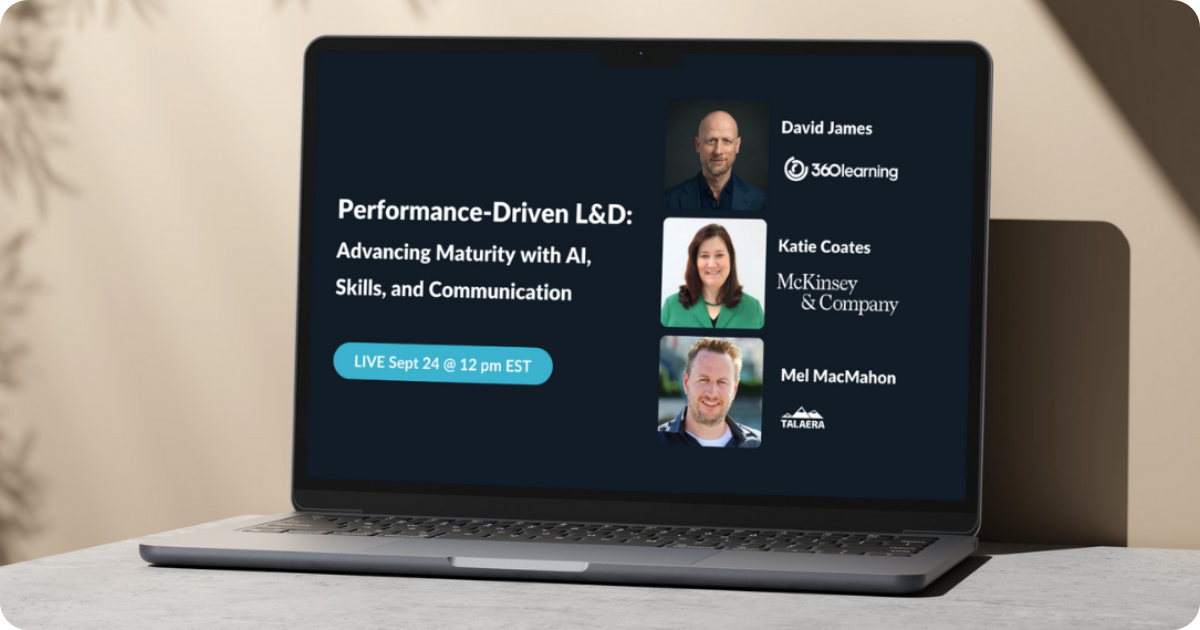
Yet inside many companies, we still celebrate completions, logins, and hours learned. Useful? Sometimes. Sufficient? Not anymore. This panel, with McKinsey’s Director of Learning Katie Coates, 360Learning’s CLO David James, and Talaera’s CEO Mel MacMahon, mapped a practical path for maturing L&D from training delivery to business performance.
Training vs. Performance: What’s the Real Difference?
Courses and platforms vs. measurable outcomes like faster onboarding, fewer errors, and stronger collaboration.
If “training” is mostly courses, enrollments, and content platforms, “performance” is about outcomes: faster time-to-competency, less rework, clearer collaboration across cultures, and line-of-sight to revenue or risk.
The expected version of L&D is courses; the required version is impact. If your narrative to leaders sounds like “we’ll provide learning to everyone,” it lands like a perk. When budgets tighten, perks get cut. Performance doesn’t.
Embedding Learning in the Flow of Work
Katie Coates, McKinsey’s Director of Learning, shared how integrated teams and AI help cut time-to-competency from two years to six months.
McKinsey Director of Learning Katie Coates has been pushing for years to make learning happen in the flow of work. The breakthrough now is that AI and better data plumbing finally make this scalable.
Her north star is simple: “work is learning; learning is work.” To get there, McKinsey builds integrated teams that co-design roles, workflows, and development: Talent, Recruiting, L&D, and People Analytics sit at the same table with leaders and subject-matter experts. They decide where AI agents should support work, when multiple agents should “swarm,” and where the knowledge base still carries the load, at least for now.
Using Data to Drive Learning and Forecast Skills
McKinsey envisions fluid data streams —performance reviews, surveys, simulations— fueling predictive skill insights.
Katie’s longer-term vision is fluid data: bringing together signals from skills practice, simulations, credentialing, performance reviews, and pulse surveys. With that, you can forecast skill needs, target development in the moment for a population, and personalize support for individuals.
This isn’t theory. In one case, a role that used to take two years to reach competency was redesigned with embedded performance support and learning from real work (not topic catalogs). Time-to-competency dropped to six months. That single result earned L&D the seat at the table.
Why Communication Training Is Now a Business Priority
Talaera’s CEO explained how miscommunication costs global companies millions and why communication is no longer a perk, but a business capability.
Mel MacMahon, CEO at Talaera, reframed communication, especially cross-cultural communication, as a hard business driver. The everyday frictions we shrug off become a hidden tax at scale. In a global company of ~10,000 people, he said, those frictions can add up to tens of millions in lost value each year.
Why now? Post-pandemic, companies learned to operate globally and functionally integrate distributed teams. An engineering lead in Bangalore manages peers in the U.S.; service hubs in Manila and Johannesburg partner with London HQs over Zoom or Teams. Add language differences, different cultural norms, fewer in-person cues, and the room for misinterpretation grows.
Cross-Cultural Communication: From Hidden Tax to ROI
Global collaboration, AI tools, and cultural awareness make communication a measurable business driver.
AI has made excellent communication skills more urgent and more measurable. Asynchronous writing looks better than ever (thanks to tools), so expectations rise. But in live conversations, the cracks show. For the first time, AI also lets organizations link communication gaps directly to revenue, so L&D can quantify both the loss and the ROI of fixing it.
Awareness → Practice → Reinforcement.
- Awareness: Baseline current behaviors and hot spots.
- Practice: Use simulations (increasingly AI-driven) that mirror real situations, like negotiations, stakeholder updates, cross-cultural feedback.
- Reinforcement: Add in-flow coaching right after meetings (“Here’s what happened, here’s what to adjust next time”) so behaviors stick.
Building L&D Credibility with Impact
David James outlined why L&D maturity starts with credibility, outcomes, and stakeholder trust, not shiny tech.
With many AI features still on roadmaps, leaders need to be critical and outcome-first. Maturity isn’t a tool choice, it’s a stance: stop waiting for perfect conditions (line managers who always reinforce, a top-down learning culture, universal C-suite cheerleading). Instead, earn access by solving real problems and showing impact on metrics the business already cares about.
That requires more than instructional skill. It demands consultative chops, stakeholder alignment, and the ability to turn messy, incomplete signals into a baseline you can move and measure.
A 3-Step Playbook to Shift L&D from Training to Performance
The three panel perspectives converge into a simple, scalable loop.
1) Diagnose where performance is really lost
Don’t start with content. Start with work. Baseline skills and communication frictions with diagnostics, simulations, and available performance signals (reviews, survey items, customer outcomes, rework rates). Your goal is a small set of high-leverage problems.
2) Practice in the flow of work
Swap one open-enrollment course for team-based, workflow-anchored practice. Use AI simulations to prepare people for the exact conversations and tasks they face next week – negotiating scope with a German client, presenting trade-offs to a U.S. VP, giving upward feedback to a UK manager. Design the work so learning happens inside it.
3) Reinforce with timely feedback and data
After the meeting, debrief in minutes: What happened? What landed? What to try differently? Use AI coaching and lightweight manager prompts so change sticks. Track business metrics (time-to-competency, rework, CSAT, cycle time, retention). Report those, not completions.
Common Pitfalls When Scaling L&D with AI
Don’t let AI flatten culture
Mel warned that auto-translation and generic prompting can strip idioms and local nuance. Build culturally aware prompts and content so you preserve the diversity that drives better outcomes.
Avoid HQ bias
Katie noted that global organizations drift toward North America–centric approaches. Bring all regions into design and review so people feel included, and so solutions actually work.
Design for resilience
David pointed out how fragile it is to rely on line managers to “carry” learning after events. Build reinforcement into the workflow so it doesn’t live or die on individual manager enthusiasm.
30-Day Action Plan for L&D Leaders
- Run a baseline in one priority team. Use a quick diagnostic to surface skill and communication hot spots tied to real outcomes.
- Replace one course with team-based practice tied to a live deliverable (e.g., customer readout, internal steering).
- Add one reinforcement loop (AI meeting debriefs, structured recaps, or peer reviews).
- Report one slide to leaders: Baseline → Intervention → Outcome (e.g., time-to-competency, rework, CSAT). Keep it about performance, not participation.
Final Takeaway: Stop Counting Courses, Start Proving Impact
L&D maturity means measurable business performance, embedding learning into work, using AI wisely, and keeping culture alive.
The future of L&D maturity isn’t about bigger libraries, it’s about designing work so learning happens inside it, then proving what changed. That means diagnosing the real problems, practicing in context, reinforcing with timely feedback, and respecting the cultural texture of global teams.
Or as the panel made clear: stop counting courses. Start proving impact.
🎥 Watch The Full Session
Connect with speakers on LinkedIn:
- Mel MacMahon, co-founder and CEO of Talaera
- David James, Chief Learning Officer at 360Learning (or explore their L&D Performance Academy)
- Katie Coates, Director of Learning at McKinsey & Company
Find the Hidden Skills Gaps in Your Team
Want to see where communication and skills gaps are holding your team back?
Talaera is offering a free enterprise-level diagnostic to help you baseline performance in English communication skills, whether you’ve got 2 people or 20,000. It’s a quick way to spot hidden gaps, prove ROI, and start shifting from training to performance. Book your free diagnostic here