Managers get more from non-native speakers in meetings when they change how the meeting runs and give the team live practice for their own meetings. Meeting design gives people time to prepare and a fair way into the conversation. Coaching builds the speed and confidence that let them use that opening once it’s there. Below you’ll find five changes you can make this week, followed by the coaching approach that makes them last.
Why capable people go quiet in English meetings
Non-native speakers who stay quiet in meetings usually know the topic and have something to add. Among professionals starting 1:1 coaching with Talaera, 36% say they rarely speak up in meetings in English. These are working professionals who already use English on the job. A software engineer in India working with a US team described how it feels. “I understand English, but I pause frequently and struggle to form sentences when answering unexpected questions.”
What holds them back has changed over the last few years. Talaera’s analysis of 2,000 coaching plans written between 2019 and 2026 shows hesitation (searching for a word, translating in your head, trailing off mid-sentence) rising from 28% to 55.2% of plans, while grammar fell from 62% to 39.6%. The two lines crossed in 2024. Researchers have studied the emotional side of this since Horwitz, Horwitz and Cope described foreign language anxiety in 1986, with fear of negative evaluation as one of its core parts.
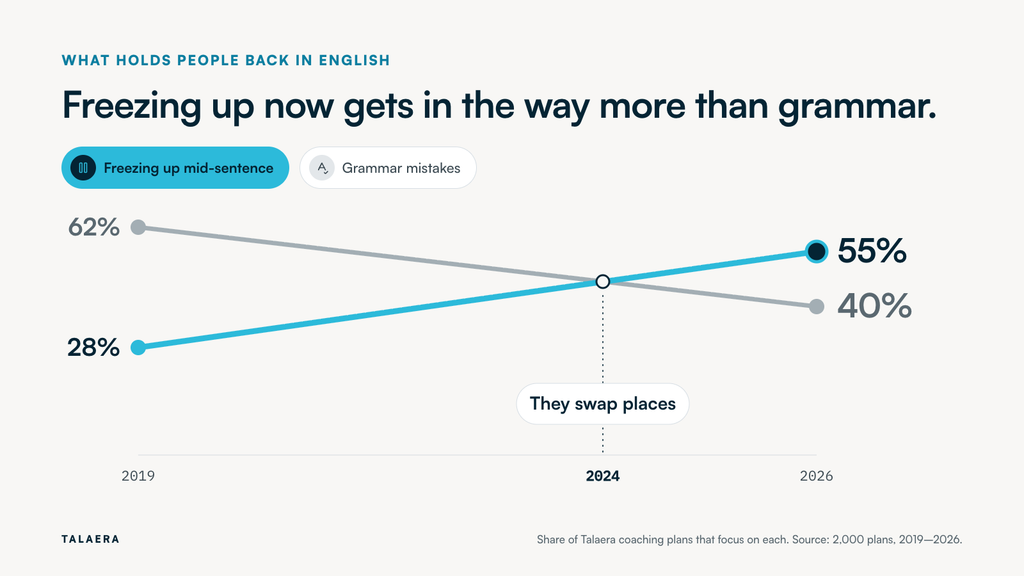
Language anxiety in meetings is a performance problem that appears under time pressure. A professional who freezes in a fast discussion usually knows what they want to say and needs more time, or more practice, to say it at speed.
When the people closest to the work stay silent, decisions get made on partial information and the cost of miscommunication adds up meeting after meeting. Gallup estimates that low engagement cost the world economy about $10 trillion in lost productivity in 2025. On the career side, one HR director put it plainly to us. “English isn’t a hiring problem. English is a leadership pipeline problem.” Meeting habits shaped by power distance norms can make that silence even more likely.
Meeting design and live practice work as a pair
Better participation comes from two levers working at the same time. Meeting design is the part you control as a manager, and it pays off immediately. Skill building is the part your team develops through coaching and practice, and it pays off over a quarter.
Each lever covers what the other can’t. A pause gives someone time, but it won’t give them the phrase for disagreeing with a senior stakeholder. Coaching gives them the phrase, but a meeting that rewards the fastest voice will still shut them out.
| Lever | Who drives it | What it includes |
|---|---|---|
| Meeting design | The manager, starting this week | Pre-reads with the actual questions, a five-second pause after questions, specific invitations, written input that counts, 1:1 debriefs |
| Skill building | The employee with a coach, over a quarter | 1:1 coaching or group courses built around their real meetings, plus short AI practice with Talk to Tally between sessions |
Lever 1: Five meeting changes you can make this week
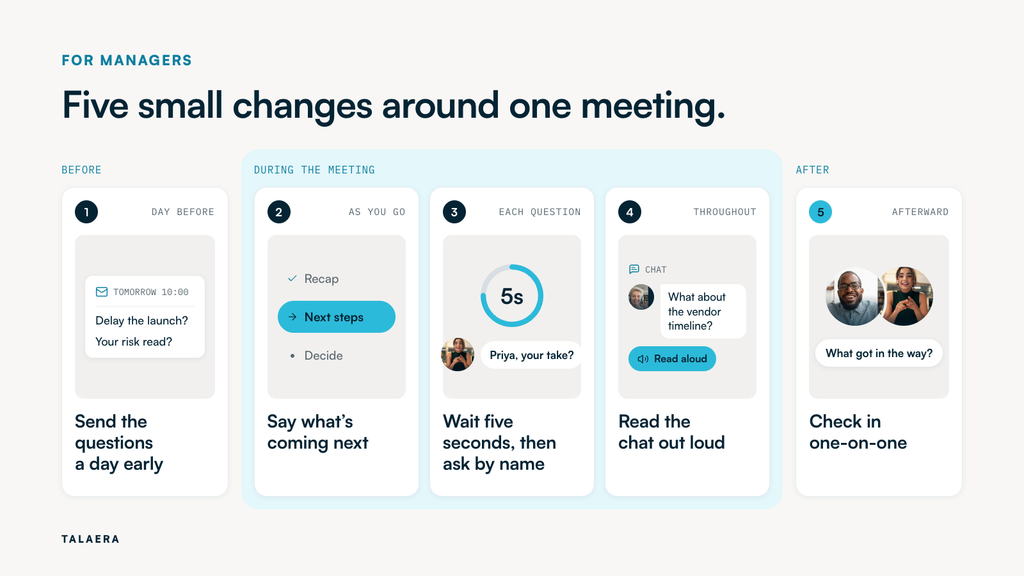
These changes cost nothing and need no one’s approval but yours. Each one gives non-native speakers more processing time or a clearer way in, and native speakers tend to benefit from them too.
Send a pre-read with the actual questions 24 hours ahead
A useful pre-read tells people what they’ll be asked to contribute, so they can prepare their words as well as their position. It lists the decisions on the table and the questions you want each person to weigh in on. Any acronyms or technical terms that will come up get a one-line definition. A pre-read that says “Q3 planning discussion” gives nobody anything to prepare with. One that says “We’ll decide whether to delay the product launch by two weeks, and I’d like each team lead to share their risk assessment” lets every participant walk in with a point ready.
Advance notice matters because real-time processing in a second language takes extra effort. With 24 hours, people can look up vocabulary, rehearse how they’ll phrase their point and decide where they stand before the pressure starts. Pre-reads help even more in inclusive virtual meetings because hallway conversations and whiteboard context are missing.
Pause five seconds after a question and invite people by name
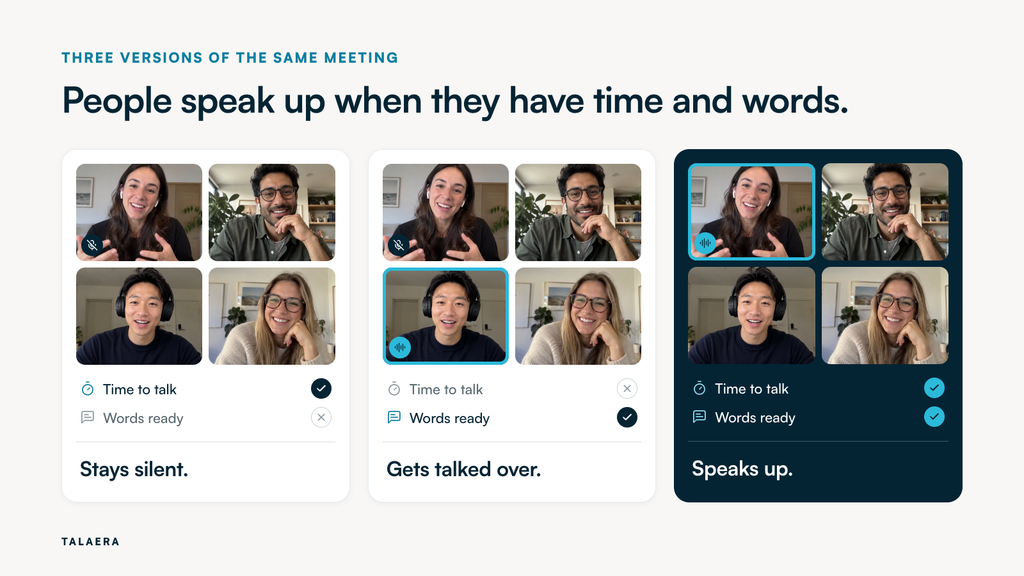
A five-second pause after each question gives non-native speakers the time they need to organize a thought and decide to speak. It’s easy to move on after a second or two by answering your own question or calling on the first hand. In Talaera’s coaching work, silence while someone forms a sentence is normal, and people who seem to freeze usually know what they want to say.
Inviting people by name works better than “Any thoughts?” because an open floor goes to the fastest and most fluent speakers. Try “Priya, what’s your read on this timeline?” or “Tomás, you’ve worked closest with this client. What would you add?” When someone contributes, take the point into the decision out loud (“Good point, let’s factor that into the timeline”), which shows the room that substance counts more than delivery speed.
Signpost the meeting out loud
Signposting means saying where the conversation is going before you go there. A line like “I’m going to recap what we’ve agreed so far, and then I’d like to hear from each of you on next steps” makes the meeting’s structure audible, so non-native speakers can follow transitions instead of guessing at them.
Most advice on signposting targets the employee, with phrases like “I’d like to add something” or “Going back to the earlier point.” When the manager models it consistently, clarity becomes a team norm. Talaera coaches report that learners respond well to signposting phrases and structured speaking frameworks, and hearing them used in real meetings reinforces what they practice.
Count chat and written input as contributions
Written channels give people a way to contribute without the pressure of speaking live. Present chat messages and shared documents as valued input rather than a fallback for people who didn’t speak up. In virtual meetings, read chat contributions aloud and build on them. “Yuki raised a good question in the chat about the vendor timeline. Let’s take that now.” That small act makes written input part of the official discussion.
Use 1:1s to find out what got in the way
A short one-on-one debrief after key meetings often surfaces the ideas that never made it into the room. Ask whether the pace was too fast, whether any vocabulary was unclear, and whether they had a point they didn’t get to share. Then agree on one small goal for the next meeting, such as raising one point during the brainstorm section, instead of a vague request to “speak up more.”
Talaera sees its strongest outcomes when learners are actively supported by their managers, and the 1:1 is where that support becomes concrete. Following up on what people did say in meetings also shows them that their contributions lead to outcomes.
Lever 2: Build meeting skills through live, coached practice
Meeting skills improve through repeated live practice in the exact situations people face at work. Disagreeing with a senior stakeholder or summarizing a decision under time pressure are performance skills, and phrase lists alone won’t build them. An academy lead at a Nordic software group said this after testing a self-paced course. “Most participants already have a good ability to read, understand and write English. However, many still experience uncertainty when speaking English in meetings, presentations and spontaneous discussions.” Talaera’s English for meetings guide is a good resource to share, and practice is what turns those phrases into habits.
English communication training built around workplace scenarios closes that distance. Talaera coaches open each session with two questions, “What skill are we working on today?” and “Where will you use this at work this week?” A product manager preparing for a cross-functional review practices that review. Between sessions, Talk to Tally, Talaera’s AI coach, gives short practice right when it’s needed. A learner can open it five minutes before a meeting and ask, “How can I push back on this deadline politely?”, then get feedback on things like clarity and tone.
Learners finishing Talaera training report speaking up in meetings far more often than learners starting it (56% vs. 30% often or always). One learner described the moment it clicked. “In the weekly sales meeting, I expressed my different opinion that changed our sales target to a more reasonable figure, which never happened before as [I lacked the] confidence to express disagreement.”
Speaking up in meetings is a trainable skill. It improves fastest when people rehearse their real meetings with a coach and then use what they practiced in a meeting that gives them room to speak.

Manager habits that make non-native speakers go quieter in English meetings
Some well-meant habits cancel out good meeting design. Most come from misreading silence or from letting speed decide who gets heard.
Silence doesn’t mean agreement or a lack of ideas. Confidence shifts with the topic and with who else is in the room, so attributing someone’s quietness to their background or nationality hides the barrier you could fix. When you manage a multilingual team, treating each person’s participation pattern as individual keeps you focused on what helps. Calling someone out with “You’ve been quiet, what do you think?” feels inclusive, yet it puts a spotlight on their silence and can trigger the anxiety that kept them quiet. Pre-submitted input and private follow-ups reach the same goal without the public pressure.
Watch who shapes your team’s decisions. If the fastest speakers consistently drive outcomes, you’re selecting for verbal speed rather than the strongest thinking. Pausing before a decision and asking for written input both rebalance the room.
Fluent delivery and good judgment are different things. Teams that let the fastest speaker win make decisions with less of the expertise they’re paying for.
Start with this week’s meeting, then add coaching
Meeting design is the fastest place to start, and coaching is what makes the change last. The first step this week is sending pre-reads 24 hours before your next meeting and adding a five-second pause after each question. Neither needs a budget, and both open space for more voices right away. Over the next quarter, look at which team members would benefit most from structured coaching on the moments they find hardest, such as disagreeing under pressure.
Published results point the same way. At TD SYNNEX, 81.5% of participants in Talaera’s group workshops said they contribute more in meetings. How you combine the levers will depend on your team’s size and time zones. If you’d like to see how a program could fit your team, you can book a Talaera demo.
Frequently asked questions
How do I encourage non-native English speakers to participate without singling them out?
Design meetings so everyone has a structured way to contribute. Share pre-reads with the actual questions 24 hours ahead and pause five seconds after each question. Written input should count as a contribution too. These changes help every participant while giving non-native speakers the processing time they need.
Why do non-native speakers stay silent in meetings even when they know the topic?
Silence usually comes from processing speed and fear of negative evaluation, not a lack of knowledge. Forming ideas in a second language while keeping pace with a fast discussion takes extra effort, and the risk of a visible mistake in front of peers makes staying quiet feel safer. Slower meeting pacing and targeted practice address both causes.
What is the best way to build confidence speaking English in meetings?
Practice that mirrors real meetings builds confidence fastest. Talaera’s 1:1 coaching focuses on the specific moments people find hard, such as interrupting politely and disagreeing constructively. Between sessions, learners rehearse with Talk to Tally, Talaera’s AI coach, which helps them prepare in the minutes before an important meeting.
How do I run inclusive meetings for remote and hybrid teams?
Remote and hybrid formats make turn-taking harder because visual cues disappear and audio lag interrupts the flow. Use chat as a parallel input channel and assign someone to bring written contributions into the discussion. Recording meetings lets participants revisit complex points, and smaller breakout rooms make it easier for quieter people to speak.