L&D trends for 2027 point to fewer, more focused training programs built around the human skills AI can’t replace, with judgment and live communication at the top of the list. These eight L&D trends explain where training priorities are heading and what they mean for your next planning cycle.
1. AI is shifting skill demand toward judgment and live communication
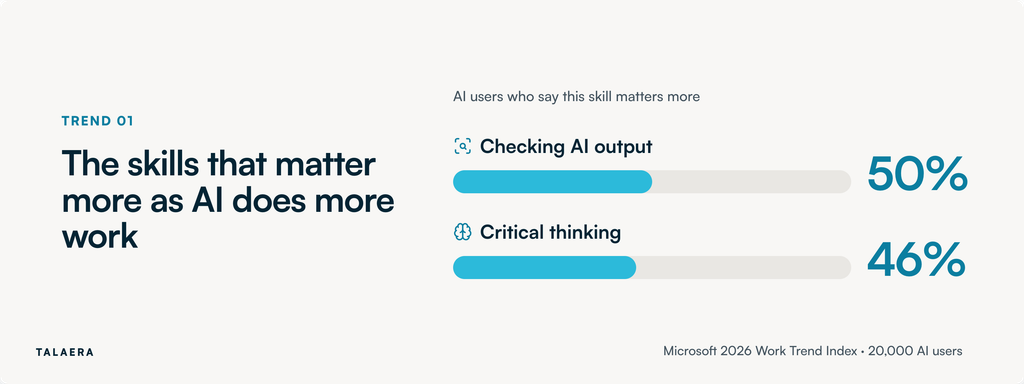
As AI takes over routine production work, the skills employees need most are the ones AI can’t perform for them. In Microsoft’s 2026 Work Trend Index, AI users mentioned quality control of AI output (50%) and critical thinking (46%) as the human skills that matter more as AI takes on work. On the L&D side, 91% of professionals in LinkedIn’s 2025 Workplace Learning Report say human skills are increasingly important.
Talaera’s coaching data shows what this looks like for global teams. Only 11.2% of 2026 coaching plans include a writing gap, down from 35.6% at the 2020 to 2021 peak, while 70.4% of plans now focus on speaking alone. AI absorbed much of the email work, so demand moved to meetings and client calls, where no tool speaks for you.
For 2027 planning, it’s worth checking how much of your communication budget still targets written tasks that AI tools now cover. Programs built around live practice, such as handling pushback in a meeting or explaining a decision to senior stakeholders, match where employees struggle today. Talaera’s guide to AI-era communication skills breaks down which ones to prioritize.
AI is moving training demand away from work software can produce and toward skills people must perform live in front of others.
2. Fewer, differentiated skills will replace broad content libraries
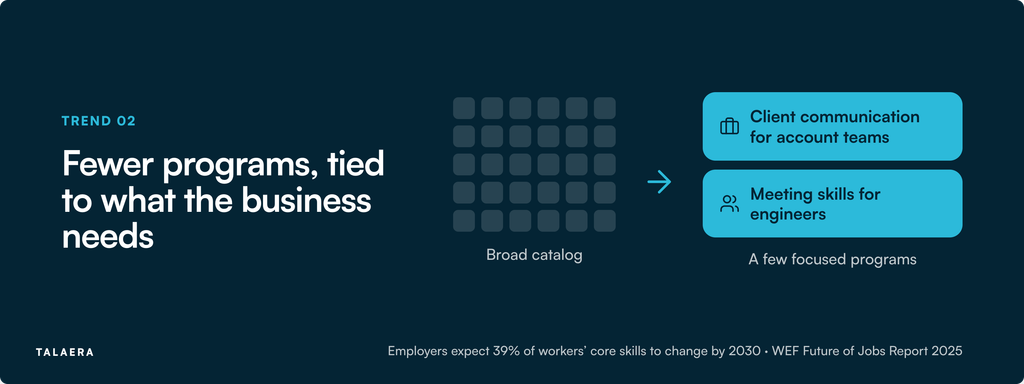
Gartner’s 2027 CHRO priorities ask HR to focus workforce skills on what sets the organization apart, instead of trying to build every skill at once. That pushes L&D away from all-you-can-eat content catalogs and toward a short list of programs tied to specific business capabilities. Employers in the WEF Future of Jobs Report expect 39% of workers’ core skills to change by 2030, which makes it harder to justify spreading budget across hundreds of generic courses.
Talaera hears the same shift in buyer conversations. One large healthcare company canceled its LinkedIn Learning subscription because no one was using it. An L&D lead at a 4,500-person fintech told us the team no longer hands everyone a LinkedIn Learning license and instead picks what the organization needs.
Before a content platform comes up for renewal in 2027, comparing license count with active use will tell you most of what you need to know. Low usage is a signal to redirect spend toward a few role-specific programs with a clear skill outcome, such as client communication for account teams or meeting skills for engineers. If business communication is one of your priorities, learn what a more targeted training program could look like.
3. Managers will carry more of the AI adoption load
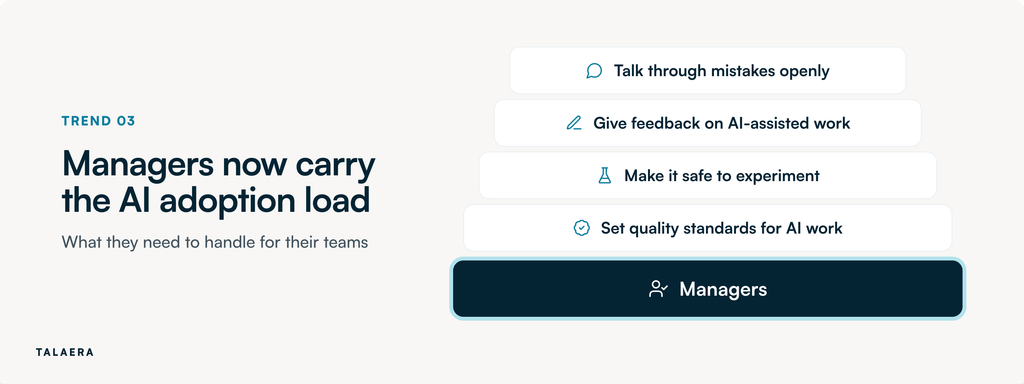
AI agents are shifting judgment and recovery work onto employees, and Gartner says human accountability for AI is one of four CHRO priorities for 2027. According to Gartner’s survey, only 24% of leadership teams agree on who should be accountable for AI agents. Managers fill that gap day to day, often while organizations cut some middle-management layers and expect more productivity from the ones who remain.
Manager behavior makes a visible difference. In a Microsoft study of 1,800 employees, people whose managers actively used AI reported a 17-point lift in the value they got from AI and a 30-point lift in trust in agentic AI. Microsoft’s 2026 survey also found that only 26% of AI users say their leadership is clearly and consistently aligned on AI.
Manager development in 2027 will need to cover AI coaching skills, such as setting quality standards for AI-assisted work and making it safe for teams to experiment. Those are communication skills as much as technical ones, since managers have to explain expectations, give feedback on AI-assisted output and talk through mistakes openly.
4. Leadership development will focus on disruption and senior communication
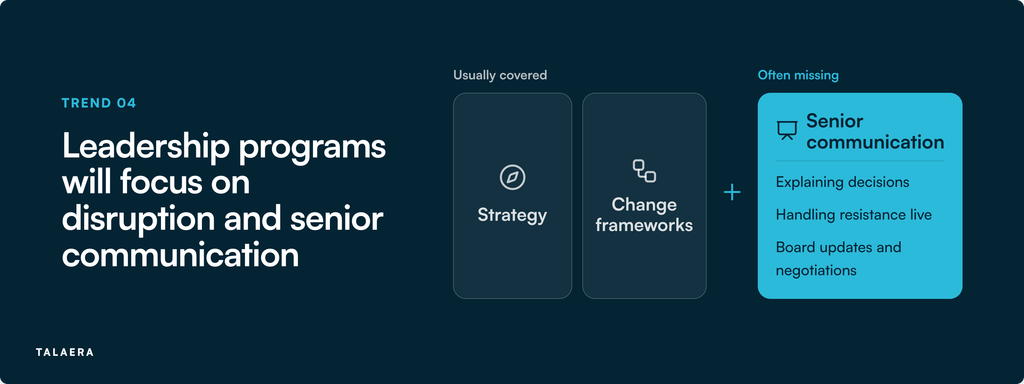
Gartner’s fourth 2027 priority asks HR to help leaders practice what it calls deliberate disruption, which means continuously dropping outdated behaviors and ways of working. CEO ambitions currently outpace what many leadership teams can deliver, and 63% of CEOs and senior executives say they are radically redesigning their operating model to speed up returns from AI. Leading that kind of change depends on how clearly senior people explain decisions and handle resistance in real time.
Talaera’s coaching data shows communication development moving up the org chart. Coaching plans mentioning the leadership team as the audience grew from 6% in 2019 to 33.2% in 2026. Senior professionals rarely want to feel like they’re taking a language class, so these programs work best when framed around executive presence and influence.
If your 2027 leadership curriculum stops at strategy and change frameworks, it misses the live moments where change succeeds or stalls. Board updates and cross-border negotiations are communication tasks, and they deserve dedicated practice.
Leading change depends on explaining it clearly in live settings, which makes senior communication a core part of leadership development in 2027.
5. Speed to value will replace activity metrics
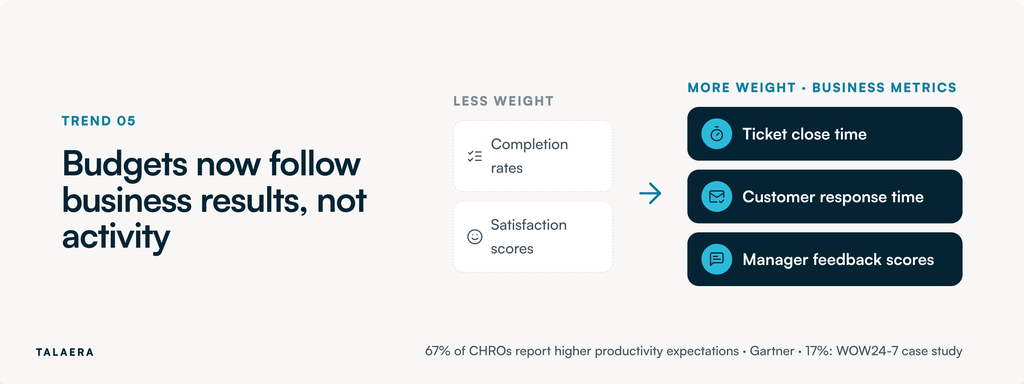
Gartner’s top CHRO priority for 2027 is speed to value, which means delivering business results faster instead of only making HR processes more efficient. Gartner also found that 67% of CHROs report higher expectations for employee productivity. Completion rates and satisfaction scores will carry less weight in budget conversations than a business metric that moves.
One operational metric paired with a short learner survey is often enough. In Talaera’s WOW24-7 case study, median time to close a support ticket fell from 15 minutes 38 seconds to 13 minutes 2 seconds after a five-session group course, which is 17% faster. Talaera also moved from separate pre- and post-training surveys to a single end-of-program survey that asks learners to rate “before” and “now” side by side, because many learners answered only one of the two.
Specifying that metric before a program launches keeps the scope tight. Customer response time and manager feedback scores both work, and Talaera’s guide on how to measure training effectiveness walks through more options.
The strongest case for an L&D budget in 2027 is one operational metric chosen before launch, paired with a short before-and-now learner survey.
6. AI practice and human coaching will work as one system
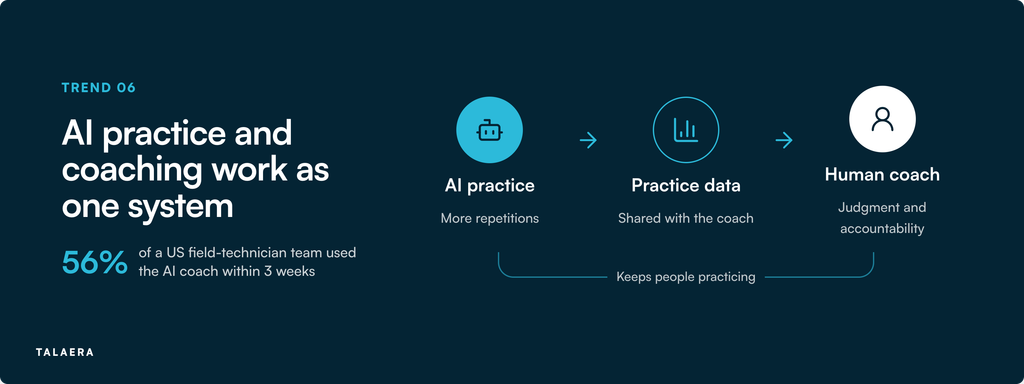
More L&D buyers now ask how AI and human coaching connect, rather than which one to choose. Short AI practice sessions give employees more repetitions between live sessions, while human coaches provide the judgment and accountability that keep people practicing. One HR buyer told us they want the human in the mix, and Talaera’s overview of AI in language training explains how the two formats fit together.
AI practice also reaches employees that desk-based training often missed. At a US field-technician team, 56% of learners used Talaera’s AI coach within three weeks of launch, practicing workplace instructions, feedback to employees and pricing objections with customers. One HR leader described her company’s workforce as “super blue-collar” and said there is “virtually nothing on the market designed for them.”
A useful question for any 2027 vendor review is whether AI practice data reaches the human coach and the program owner. If it doesn’t, the AI tool works as a separate product rather than as part of a coaching model. To see what an integrated approach looks like, you can book a demo of Talaera’s AI practice and human coaching business English programs.
7. Training budgets will sit outside the L&D department
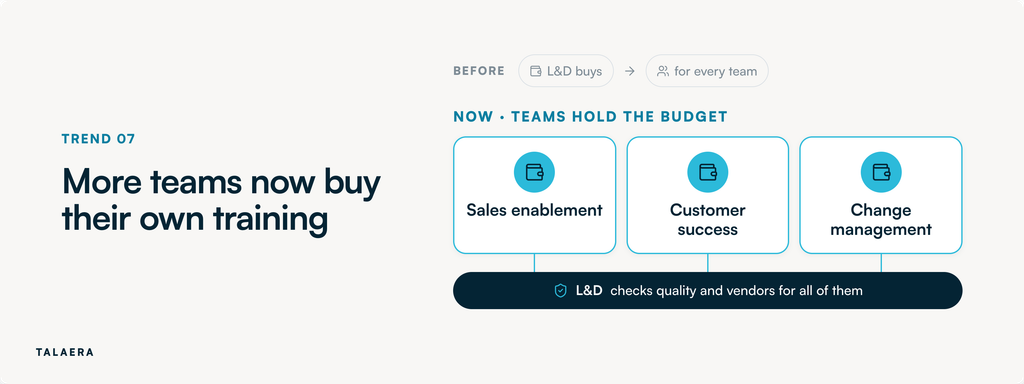
More training purchases now start in sales enablement, customer success and change management teams instead of central L&D. A learning-platform partner told us that traditional, centralized L&D buying is fading, with deals increasingly coming through those functions. Departments with their own budgets want specific outcomes faster than a central request process can deliver them.
This shift gives L&D a different role as a strategic performance partner. “Old-school L&D (feel-good initiatives) is dead. Modern L&D is a learning business partner,” an L&D lead at a fintech told us. In practice, that means acting as the quality and vendor-evaluation layer for every budget holder rather than owning every purchase.
A good first step for 2027 is mapping which departments already buy training on their own. Visibility into those purchases prevents duplicate vendors and gives L&D a seat in conversations it used to miss.
8. Learning will stay a retention and career lever
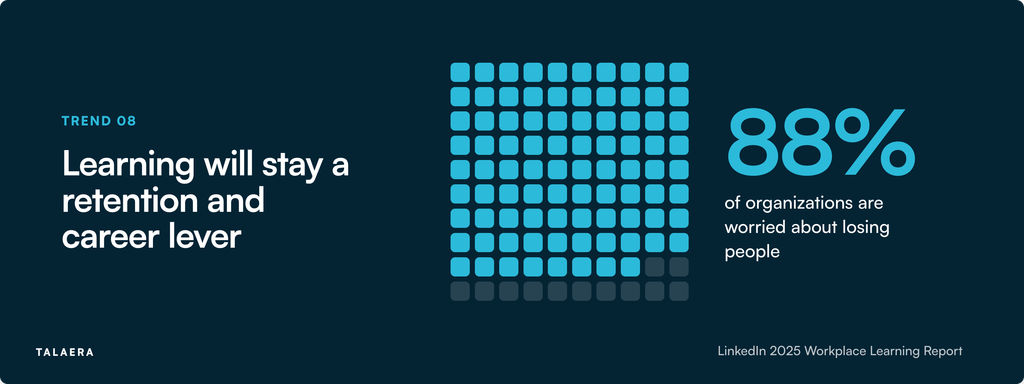
Retention pressure keeps learning on the budget even when other costs get cut. LinkedIn’s 2025 Workplace Learning Report found that 88% of organizations are concerned about employee retention, and providing learning opportunities is their number one retention strategy. Career progress is also employees’ number one motivation to learn.
Talaera sees this in which programs survive budget cuts. After layoffs, one company cut 70% of its L&D budget, and Business English was the first line it restored because demand was so high. “English isn’t a hiring problem. English is a leadership pipeline problem,” an HR director at a software consultancy told us.
Development requests framed around retention and promotion readiness tend to land better with finance than requests framed around completions. Talaera’s piece on the impact of L&D covers how to connect programs to those outcomes.
How to prioritize L&D trends in 2027
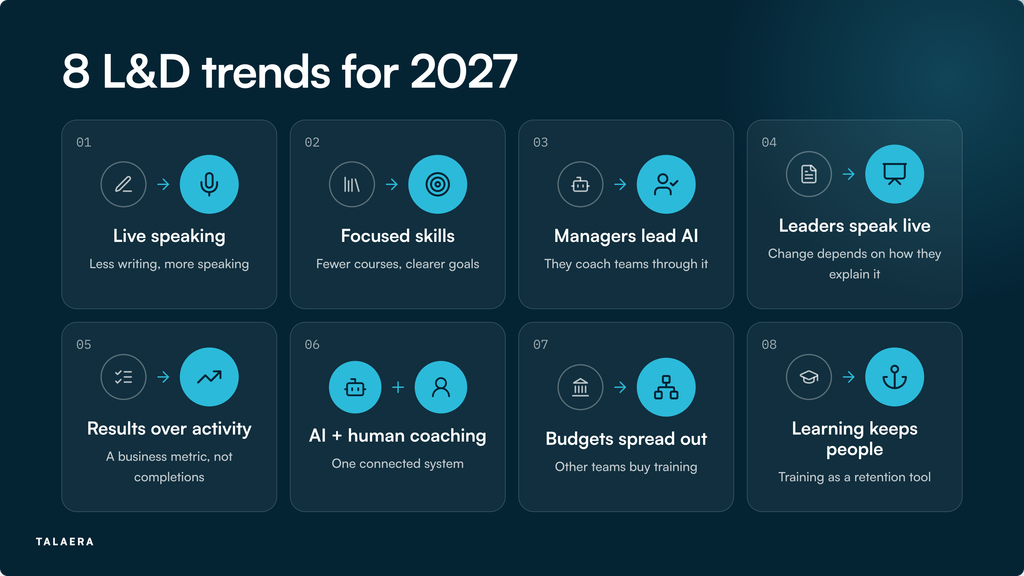
Acting on all eight trends at once isn’t realistic for most teams. These five questions give your next planning conversation a concrete starting point.
- Written vs. live skills: If most of your communication budget still targets writing, check whether AI tools already cover that need. Moving hours toward live speaking practice matches where employees now struggle.
- Skill focus: A short list of skills tied to business capabilities is easier to fund and measure than a broad catalog.
- Manager readiness: Managers now carry AI adoption and team performance at the same time. Programs that build their coaching and communication skills protect both.
- One metric per program: Choosing the metric before you design the training keeps the scope tight and the results easy to report.
- Purchases outside L&D: Other departments may already buy training without your knowledge. Finding them early saves duplication and protects quality.
Most teams will find that two or three of these questions point to the same gap. That overlap is usually the best place to start your 2027 plan.
| Shift | What’s driving it | Planning question for 2027 |
|---|---|---|
| Judgment and live communication | AI handles routine production work | How much of your budget still targets tasks AI now covers? |
| Fewer, differentiated skills | Gartner’s call to focus on what sets you apart | Which skills tie directly to your business capabilities? |
| Managers carry AI adoption | Unclear accountability for AI agents | Are managers trained to coach AI-assisted work? |
| Leading through disruption | CEO ambitions outpace delivery | Does leadership development include live communication? |
| Speed to value | Higher productivity expectations | Which business metric will each program move? |
| AI practice plus human coaching | Demand for more practice at scale | Does AI practice data reach the human coach? |
| Buying outside L&D | Departments with their own budgets | Who else in your company buys training? |
| Retention and careers | Retention concern and career motivation | Can you link programs to promotion readiness? |
Evidence will decide which 2027 programs get funded
Every trend on this list points in the same direction: budget is moving toward fewer programs aimed at the human skills AI can’t cover, each with a business result attached. L&D teams that bring that kind of evidence into planning conversations will be in a stronger position than teams that report activity alone.
How you apply these shifts depends on your workforce and on how AI is changing each role. If communication training is on your 2027 roadmap, you can book a demo to see how Talaera combines AI practice with human coaching to help global teams improve their business English communication.
Frequently asked questions
What are the top L&D trends for 2027?
The biggest L&D trends for 2027 are a shift toward human skills AI can’t cover and a move to fewer, more targeted skill programs. Managers are also taking on a larger role in AI adoption. Leadership development and measurement are moving closer to business results. Gartner’s 2027 CHRO priorities and Microsoft’s 2026 Work Trend Index both point in this direction.
How is AI changing corporate training?
AI is taking over routine production tasks such as drafting emails and summaries, so training demand is moving toward judgment, review of AI output and live communication. Many organizations now pair short AI practice sessions with human coaching, which gives employees more repetitions without losing expert feedback. AI hasn’t replaced training. It has moved the target.
Which skills will L&D prioritize in 2027?
Gartner recommends focusing on the few skills that set your organization apart rather than building a broad catalog. Across the research, human skills such as critical thinking, reviewing AI output and communicating in high-stakes live settings are rising in importance. The WEF also lists leadership and social influence among the top 10 skills on the rise through 2030.
How do you measure training ROI in 2027?
Pairing one operational metric with a short before-and-now learner survey gives budget owners enough signal to judge impact. Talaera’s WOW24-7 case study used median ticket close time, which fell 17% after a five-session course. A number your CFO already tracks is easier to defend than a dashboard of activity metrics.
How we researched this article
This article combines published workforce research with Talaera’s own training data and conversations with L&D buyers to identify the eight trends shaping 2027. Our external sources include Gartner’s July 2026 survey of 297 CHROs on their 2027 HR priorities, Microsoft’s survey of 20,000 AI users for its 2026 Work Trend Index, the World Economic Forum’s Future of Jobs Report 2025, and LinkedIn’s 2025 Workplace Learning Report.
Talaera’s findings come from an analysis of coaching plans for thousands of business English learners who started training between 2019 and 2026, as well as conversations with L&D buyers. When we report the frequency of a skill, the percentage represents the share of coaching plans mentioning that skill, not the share of all learners. Data for 2026 covers a partial year.
We used AI tools to help draft this article and checked every statistic against its original source.
This article builds on our earlier analysis of 2026 L&D trends.