If you’re working out how to manage a multilingual team, the most useful shift is to treat language as part of how you design the team. That puts the fixes in your team’s habits, like how you run meetings, record decisions and judge performance, rather than in any one person’s English. It also helps with a pattern many managers miss. Your strongest non-native English speakers are often the ones going quiet in the room.
What breaks first when you manage a multilingual team
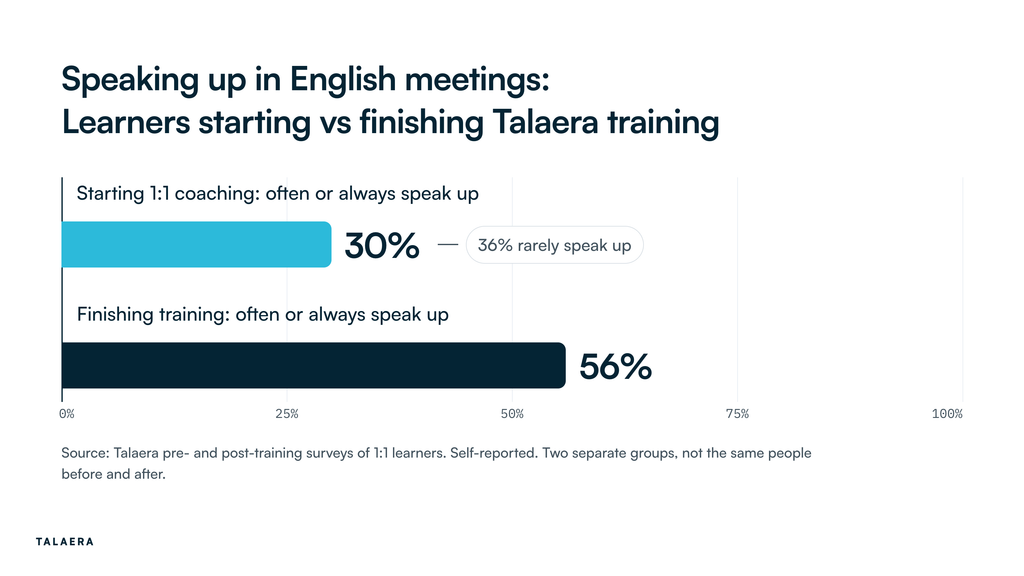
A multilingual team is any team whose members have different first languages and share a working language, usually English. On these teams, participation slips long before grammar becomes a problem. Capable people stop offering ideas in meetings because speaking up in a second language feels riskier than staying quiet. When professionals start 1:1 coaching with Talaera, 36% tell us they rarely speak up in meetings in English.
Silence rarely travels alone, and the other signs of miscommunication in multicultural teams follow close behind. Polite yeses replace real commitments, so people agree in the meeting and leave with different ideas of what was decided. Instructions that felt clear to the person giving them land differently for the person receiving them, and rework follows. Side conversations in other languages can also start to split the team, usually because people switch to the language where they think fastest.
How to agree on a team language charter
English became the working language on most teams when the first international hire joined, and nobody revisited the choice as the team grew. A team charter is narrower than a company-wide English policy, so you can agree on one this month.
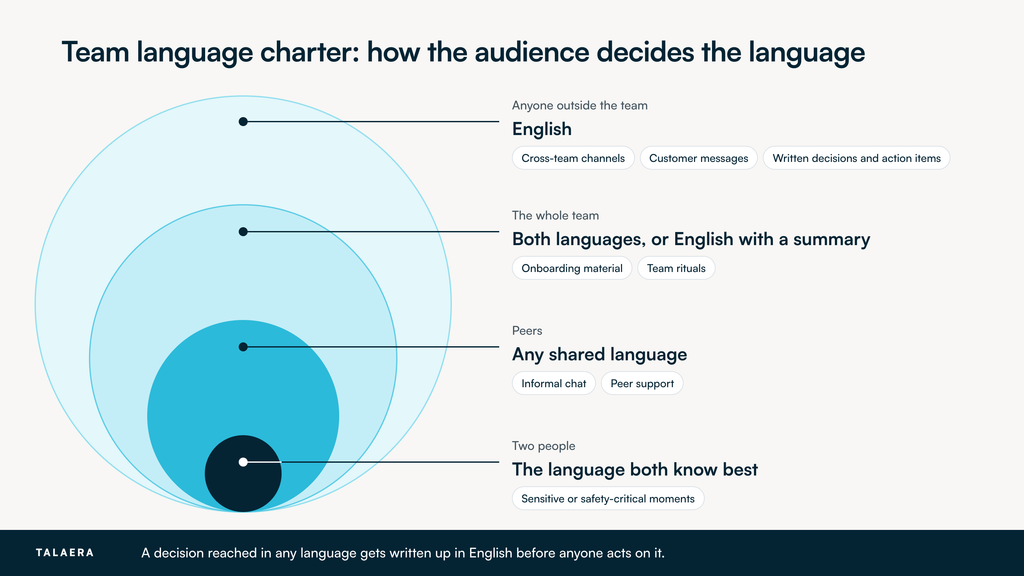
A team language charter is a short written agreement that maps each language to a purpose, so people stop guessing when English is required and when their first language is welcome.
Which language belongs in which channel
A charter answers one question for each channel your team uses. English is required wherever someone outside the team needs to read or act on the message. Local languages are welcome in informal chat and in moments where comfort and precision matter more than shared access, such as a sensitive personal conversation or a safety-critical instruction on site. Shared rituals and onboarding material work best in both languages, or in English with a translated summary.
| Situation | Language | Why it works |
|---|---|---|
| Cross-team channels and customer messages | English | People outside the team can read and act on them |
| Written decisions and action items | English | Everyone works from one shared record |
| Informal chat and peer support | Any shared language | People think fastest in their first language |
| Sensitive or safety-critical moments | The language both people know best | Precision and comfort come first |
| Onboarding material and team rituals | Both, or English with a summary | Newer and less confident speakers can follow |
Side conversations in other languages are a normal part of multilingual team communication. A good charter keeps them fair with one rule, which is that a decision reached in one language gets written up in English before anyone acts on it. That rule matters most when managing global teams, where one decision can pass through several languages before anyone records it. Drafting the charter together in a 30-minute team meeting builds more buy-in than handing it down, and a quarterly check keeps it current as people join.
Clear English is everyone’s job, native speakers included
Much of the English on a global team happens between two non-native speakers, and native speakers aren’t always the easiest people to follow. Mayflower College research on 1,000 nonnative English speakers, reported by SHRM, found that 88% find it harder to communicate with a native English speaker than with another nonnative speaker. According to the article, native speakers often don’t know how to adjust their English for their audience.
Your charter needs a writing norm that applies to everyone, including the people who grew up speaking English. Short sentences help. So does swapping idioms for literal words, so “kick off” becomes “start” in a team update. A message that’s clear to a non-native speaker is clear to everyone, especially in async channels. Talaera’s guides to internal communication strategy and async communication habits cover the wider system.
How to run meetings that work across English levels
Meeting design matters more than any one person’s fluency. Open-floor discussion rewards whoever processes English fastest, so silence often means someone is still forming a sentence rather than agreeing.
A day-ahead agenda gives everyone time to prepare
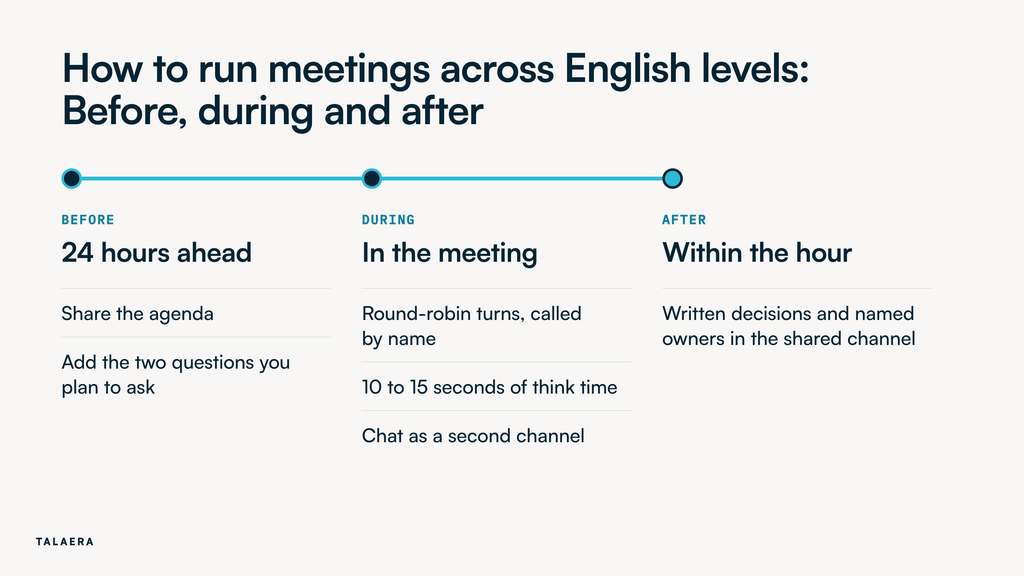
Sending the agenda 24 hours ahead gives people time to prepare. Adding the two questions you plan to ask helps even more, such as “What’s one risk you see in the launch plan?”, because each person can think through an answer in their own time. People can look up unfamiliar terms the night before instead of decoding them live. Everyone arrives ready, so the meeting reaches real discussion faster.
Round-robin turns and think time even out who speaks
During the meeting, round-robin input draws out more voices than open-floor questions. Calling on each person by name, with 10 to 15 seconds of think time, gives second-language speakers a fair chance to answer. A line like “Take a few seconds to think, then I’d love your view” makes the pause feel welcome. That pause is often the difference between a real answer and a polite nod. In larger calls, the chat works as a second channel for anyone who’d rather type a point than say it.
Written decisions close the loop
Closing every meeting with written decisions and named owners, posted in the shared channel within an hour, protects everyone who followed the discussion at a different speed. Spoken agreements fade fast. A short written record prevents the “I thought we agreed on X” conversation two weeks later.
Enter, Land, Frame builds the speaker’s side
Meeting design fixes the room, yet the people in it still need the speaking skills to use their turn. Talaera’s framework for virtual meetings, Enter, Land, Frame, covers that side. Enter is about getting into fast, messy group talk. Land covers how your message feels to the people hearing it, while Frame is about making your ideas register as strategic.
Meeting design decides who gets a fair turn. Speaking skill decides what people do with it.
Managers can support all three by mentioning them in feedback. Telling someone they entered the discussion early, or that their point landed with the client, makes the skill visible and repeatable.
How to get real commitments instead of polite yeses
A “yes” on a multilingual team can mean “I heard you,” “I’ll try,” or “I don’t want to disagree in public.” Managing a multicultural team adds one more layer, because communication norms around directness and hierarchy shape how people signal agreement. Erin Meyer’s The Culture Map places cultures on a scale from confrontational to avoids confrontation, which is a useful way to describe styles without predicting what any one person will do. Our cross-cultural communication guide covers these styles in more detail.
Directness can mean different things even inside one company. An L&D lead at a Dutch fintech with 4,500 people in 27 countries told us that “be direct” is the company’s first value. It worked at 2,000 employees and became a problem after headcount doubled. In the lead’s words, “People in Singapore will not be direct.” The lead added that New York counts as direct by US standards, yet not by global ones.
A confirmation loop closes the gap between a polite yes and a real commitment. At the end of each meeting, every person restates their action and deadline in their own words. Doing it as a whole team, every time, means nobody feels singled out. A follow-up message within the hour, with a line inviting changes by end of day, gives people room to raise a disagreement they would not voice live. Our guide to leading across cultures goes deeper on the cultural side, while the piece on power distance explains why some people avoid disagreeing with a manager in a group.
How to keep 1:1s and reviews fair when fluency isn’t competence
Fluency bias is the tendency to rate people who sound fluent as more competent or more promotable, whatever their actual results.
An article from Queen’s University’s Smith School of Business on accent bias at work reports that people with non-standard accents are judged as less competent and sometimes less promotable, with no evidence to back that judgment up. It also notes that the bias is stronger in jobs with higher communication demands, a group that includes many management and client-facing roles. As an HR director at a software consultancy told the Talaera team, “English isn’t a hiring problem. English is a leadership pipeline problem.”
A fair review separates what someone delivered from how they sounded while delivering it. Assessing outcomes first, before any comment on communication, keeps the two from blending. In review discussions with peers, it helps to ask out loud whether you would rate this person differently if they had a different accent. During 1:1s, communication feedback is most useful when it names a specific skill, such as presenting quarterly results to the board, instead of a vague note to “improve communication.”
When a real gap shows up, targeted support helps more than a blanket weakness on the review form.
How to spot language gaps without singling anyone out
Pointing at one person’s English creates stigma, and ignoring the gap leaves them unsupported and stuck. A team-wide baseline avoids both, because everyone takes the same assessment as a development step for the whole group. Offer everyone the same baseline evaluation, framed as a development tool for the whole group rather than a remedial test for one individual.
Talaera’s free Business English Assessment is a short adaptive test aligned to CEFR, the standard scale for language proficiency. Most people finish it in under 10 minutes. A proficiency result shows where people stand on language, so it is most useful next to what you see in meetings and client calls. You can request more information here.
Once you have the baseline, support can go where it matters most. For a single team member, Talaera’s guide to diagnosing one employee’s needs covers the signs to watch for. An English-first onboarding checklist sets expectations for new hires from day one.
What support works for non-native English speakers on your team
Training builds on good team design. It can’t make up for a meeting format that still shuts people out. Once the charter and meeting habits are in place, managing non-native English speakers becomes a question of what kind of support helps them grow. Four features separate support that sticks from support that fades.
- Live practice over self-paced alone: Courses teach the phrases. Live practice with a coach is where people learn to use them under pressure. Group formats such as Talaera’s Speaking Club add low-stakes practice before a high-stakes meeting.
- Coach continuity: A coach who already knows the learner’s role and meetings can pick up where the last session ended. When tutors rotate, learners can feel like they’re starting over every session.
- Short practice between sessions: AI practice fills the gaps between live sessions. Talaera’s AI coach, Talk to Tally, is built for three 5-minute sessions a week, so practice fits around real work.
- Manager support: Talaera sees the strongest outcomes when learners are actively supported by their managers. Protected time to practice and a manager who asks about progress both send that signal.
Learners report the change themselves. Among professionals starting 1:1 coaching with Talaera, 30% say they often or always speak up in English meetings. For learners finishing training, a separate group, the figure is 56%. Talaera’s enterprise program shows how these formats fit together for a global company.
How to tell your multilingual team communication is improving
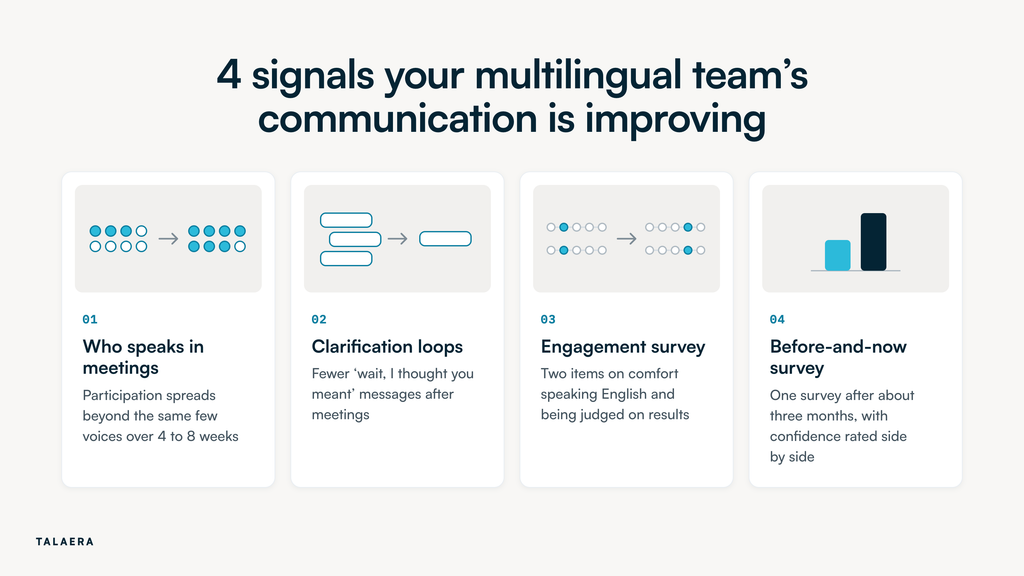
Four signals show whether the changes are working, and none of them needs a new tool. The first is who speaks in meetings. Noting each contributor’s name over four to eight weeks shows whether participation is spreading beyond the same few voices. The second is clarification loops, because fewer “wait, I thought you meant” messages after a meeting mean written decisions are landing.
A third signal comes from your engagement survey. Two items give a direct read on psychological safety and fluency bias. One asks whether people feel comfortable contributing in English in team meetings. Another asks whether they believe their work is judged on results rather than on how they sound.
A single before-and-now survey after about three months is the fourth. Asking people to rate their confidence “before” and “now” side by side gives cleaner data than separate pre- and post-surveys, because people often answer only one of them. Talaera moved its own impact measurement to this format for that reason.
Managing multilingual teams starts with design
The language mix on your team is something to design around, in the same way you plan for time zones and reporting lines. A charter settles which language goes where. Meeting habits give every English level a fair turn, and fair reviews keep fluency from standing in for competence. Every team’s mix is different, so the right charter and meeting rhythm will look different too.
Picking one change for your next team meeting is a good place to start. If you want structured support for the team, you can book a Talaera demo to see how Talaera supports multilingual teams. Talaera’s guide to language barriers at work covers the wider fixes beyond your own team.
AI tools helped us draft this guide. Every Talaera figure was checked against Talaera’s coaching and survey data, and every outside claim against the source it links to.
Frequently asked questions
How do you manage a multilingual team?
Managing a team that speaks different languages works best when language is treated as part of team design. A short team language charter sets which language goes where, with English for cross-team decisions and local languages for informal or sensitive conversations. Round-robin turns give every English level a fair turn in meetings, while reviews judge results separately from fluency.
Should you allow other languages at work?
Yes, in the right places. Banning every language but English pushes informal knowledge-sharing out of sight and isolates people who think faster in their first language. A clear charter keeps English for written decisions and customer work while welcoming other languages in peer chat and sensitive conversations.
How do you run meetings with non-native speakers?
Sharing the agenda and key questions 24 hours ahead lets everyone prepare. During the meeting, round-robin turns with 10 to 15 seconds of think time draw out more voices than open-floor questions. The chat gives people a second way to contribute. Written decisions and named owners, posted within the hour, mean alignment doesn’t depend on real-time listening alone.
How do you support non-native English speakers on your team?
Live practice with a consistent coach works better than self-paced courses alone, especially when short AI practice fills the time between sessions. Among professionals starting 1:1 coaching with Talaera, 30% say they often or always speak up in English meetings, compared with 56% of a separate group of learners finishing training. Manager support matters too, because Talaera sees the strongest outcomes when managers actively support their learners.